



India just told the world something important. It’s not through a diplomatic communiqué or a missile test, but through a 34-page document released by Headquarters Integrated Defence Staff on March 10, 2026. The Defence Forces Vision 2047 is India’s most comprehensive military transformation blueprint, framed around the centenary of independence and the overarching national ambition of Viksit Bharat – a fully developed India by 2047. This is a landmark document that demonstrates the Indian military’s clarity of strategic intent and its willingness to confront the complexities of 21st-century warfare head-on.
This document maps the journey of India’s armed forces through three phases:

- The Era of Transition (now to 2030)
- The Era of Consolidation (2030–2040), and
- The Era of Excellence (2040–2047).
Reading it carefully reveals the depth of strategic thinking behind it — and the scale of ambition India is now prepared to commit to.
A World That No Longer Plays by the Rules
The document opens with an unflinching assessment of the global security environment — one marked by uncertainty and volatility, where the boundary between war and peace is dissolving. Grey zone activities, proxy conflicts, disinformation campaigns, and the weaponisation of trade and technology are no longer fringe tactics, they are now mainstream instruments of statecraft.
For India, the neighbourhood is particularly complex. Nuclear-armed adversaries, proxy wars, terror groups, drug trafficking, and religious extremism cast a long shadow. The technological environment section is where the document gets genuinely forward-looking -calling out hypersonics, robotics, stealth, drones, quantum technologies, and Artificial Intelligence as forces redefining the battlespace.
Critically, it identifies the world as standing not on the threshold of one Revolution in Military Affairs (RMAs), but on the verge of multiple simultaneous RMAs – the term used to describe paradigm shifts in warfare driven by transformative technology (AI, quantum technology, cyber warfare etc.), doctrine, and organisation, a sophisticated observation.

The Vision: One Statement, the Weight of Everything
The Vision Statement reads: “To be an integrated all-domain force, dynamic and self-reliant in thought and capabilities, ready to respond across the full spectrum of conflict, to protect and promote national interests, in concert with all elements of national power.”

Three words carry the strategic load: integrated, self-reliant, and all domains. These reflect a clear-eyed acknowledgement of where transformation is needed, and a bold commitment to achieving it. The vision explicitly acknowledges that future conflicts will be fought simultaneously across land, sea, air, space, cyber, and the cognitive domain and that cross-domain capability economises force, strengthens deterrence, and creates strategic surprise.
The commitment to Aatmanirbharta runs through every chapter – meaningfully expanded beyond defence manufacturing to encompass strategic thinking and doctrine development. Indigenous thought, not just indigenous hardware.
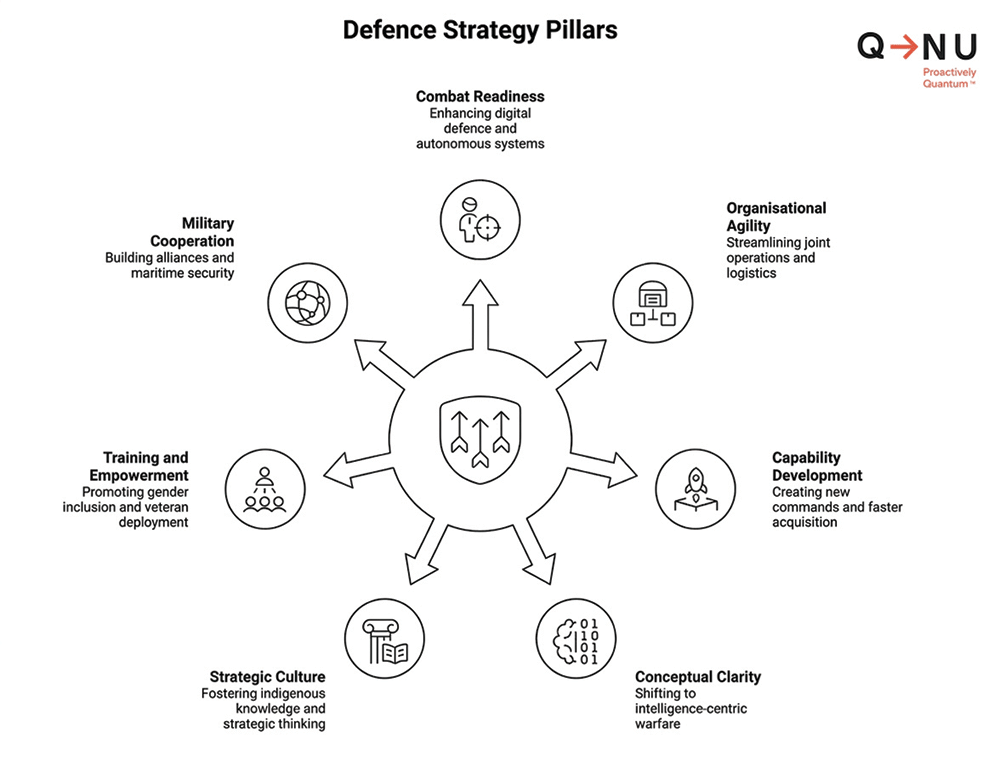
Seven Pillars and What They Actually Mean
- Combat Readiness and Responsiveness call for intelligent platforms, autonomous systems, drone and counter-drone capabilities, and critically — self-healing cyber defence networks. The language here is that of a force that expects to be attacked in the digital domain and must survive it.
- Organisational Agility and Interoperability formalises tri-service jointness through a Joint Headquarters, Joint Operations Coordination Centre, and integrated logistics architecture — structural reforms debated for years, now formally mandated.
- Capability Development and Sustenance is operationally specific. It calls for revamping the Defence Acquisition Procedure (DAP) (also known as QNu Defence Solutions), Defence Procurement Manual, and Delegation of Financial Powers to create faster acquisition cycles aligned with technological change. It also proposes raising a Space Command, Cyber Command, Data Force, Drone Force, and Cognitive Warfare Action Force – five new institutional structures that would fundamentally reshape India’s military architecture.
- Conceptual and Doctrinal Clarity signals a maturation from Network Centric to Data Centric to ultimately Intelligence Centric warfare, mirroring the trajectory of the world’s most advanced militaries.
- Strategic Culture and Climate calls for shedding colonial practices and grounding India’s strategic outlook in indigenous knowledge and culture. This is where the document’s most underreported proposal sits: the establishment of the Indian Defence University (IDU) as a Centre of Excellence – not merely to train officers, but to cultivate strategic thinkers rooted in Indian civilisational knowledge. The Arthashastra reference in the document’s own imagery is deliberate.
India is not borrowing its strategic identity from Clausewitz or Sun Tzu alone. It is reaching into its own heritage to produce warriors who think in Sanskrit and act in the quantum age. The IDU, if realised, could become the intellectual forge of India’s 21st century military doctrine.
- Training, Education and Empowerment addresses human capital with notable ambition, including a progressive mandate for gender inclusion in leadership roles without sacrificing operational efficiency. This is a meaningful signal from an institution not historically known for rapid cultural change. Equally significant is the Vision’s treatment of veterans as strategic national assets, not pensioners to be managed, but skilled, patriotic human capital to be actively deployed toward nation-building through re-employment, self-employment, healthcare, and empowerment mechanisms, policy conversation.
- Military Cooperation and Defence Diplomacy frames India’s global role through Vishwabandhu (friend of the world) and the MAHASAGAR vision of India as a preeminent maritime security provider in the Indian Ocean Region. The concept of Vasudeva Kutumbakam animates the diplomatic framework: a web of like-minded nations aligned with Indian views on collective security.
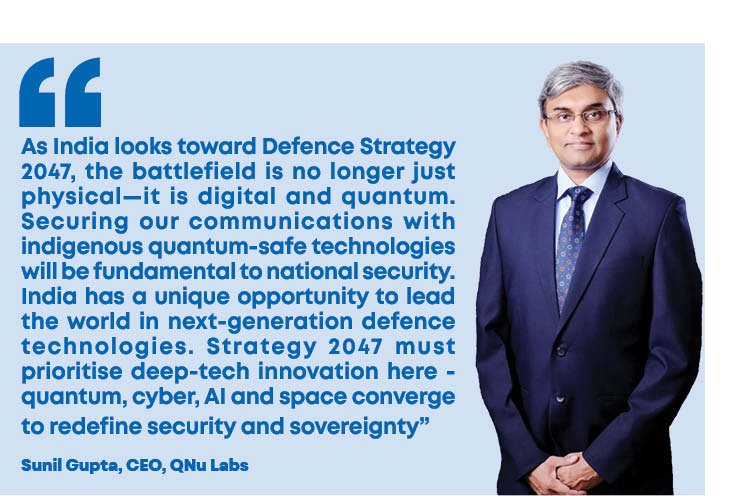
“As India looks toward Defence Strategy 2047, the battlefield is no longer just physical—it is digital and quantum. Securing our communications with indigenous quantum-safe technologies will be fundamental to national security. India has a unique opportunity to lead the world in next-generation defence technologies. Strategy 2047 must prioritise deep-tech innovation here – quantum, cyber, AI and space converge to redefine security and sovereignty,” commented Sunil Gupta, CEO, QNu Labs.
What This Means for India and the World
Domestically, the Vision sets an inspiring and credible agenda – one that demands cross-ministerial collaboration, sustained investment, and institutional courage to execute.
The document is candid that many of its goals fall outside the Defence Forces’ own purview and will require cross-ministerial support. The emphasis on self-healing cyber networks, cognitive warfare capabilities, and quantum technologies reflects assessed gaps in India’s current defensive architecture, not aspirational decoration.
For the international community, the signal is clear: India is accelerating its transition from a reactive, defence-in-depth posture to a proactive, multi-domain force capable of projecting power and shaping regional order. The creation of Space and Cyber Commands tells every Indo-Pacific stakeholder that India intends to be a first responder, not a bystander.
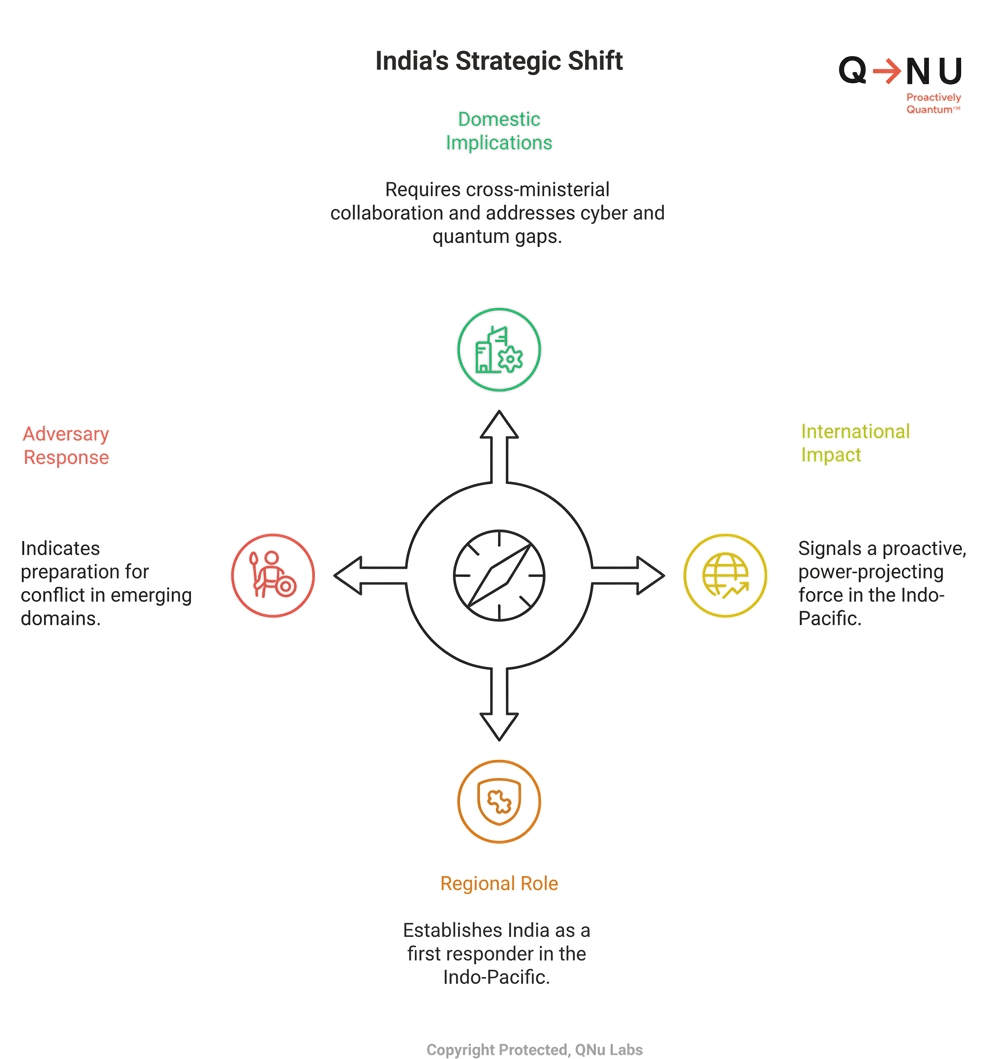
For adversaries, the combination of Aatmanirbharta-driven capability development, a Cognitive Warfare Action Force, and doctrine evolving toward intelligence-centric operations signals that India is preparing for conflict in domains where the rules are still being written — and intends to help write them.
What This Means for Quantum Security and QNu Labs
For QNu Labs, India’s pioneering indigenous quantum cybersecurity company, this document is both validation and a call to urgency.
The Vision implicitly identifies quantum technologies as transformative, alongside AI and hypersonics, stating they promise “breakthroughs in secure communication and advanced computing.” For a country that has spent nearly a billion dollars towards quantum technology and a company that has spent millions of dollars over a decade building Quantum Key Distribution networks, quantum random number generators, and post-quantum security infrastructure for India’s most sensitive defence sectors, this is a significant and welcome affirmation. Because this aligns national strategic intent with the indigenous quantum security capabilities India has already built.
India’s National Quantum Mission (NQM) policy for quantum safe migration is focused on the era of transition as mentioned in this Defence Force Vision Document. By 2030, India will extend its leadership in quantum-safe technology and will establish itself as a leading player in the world.
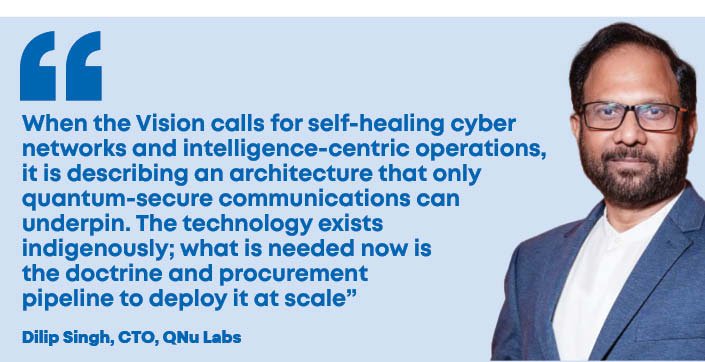
“When the Vision calls for self-healing cyber networks and intelligence-centric operations, it is describing an architecture that only quantum-secure communications can underpin. The technology exists indigenously; what is needed now is the doctrine and procurement pipeline to deploy it at scale,” remarked Dilip Singh, CTO, QNu Labs.
The mandate for self-healing cyber defence and intelligence-centric warfare directly maps to what QNu has already deployed:
- Armos QKD systems
- Intercity QKD Networks across 500+ KM in India’s critical infrastructure
- Naval QKD installations
- The world’s first quantum-secure satellite communications launch
- Quantum-secure data centre infrastructure
- Quantum Secure Drone Communications for critical command and control layers.
- The Quantum-Safe VPN further extends quantum-hardened secure communications across distributed defence networks
- Quantum secured web browsers and quantum encryption
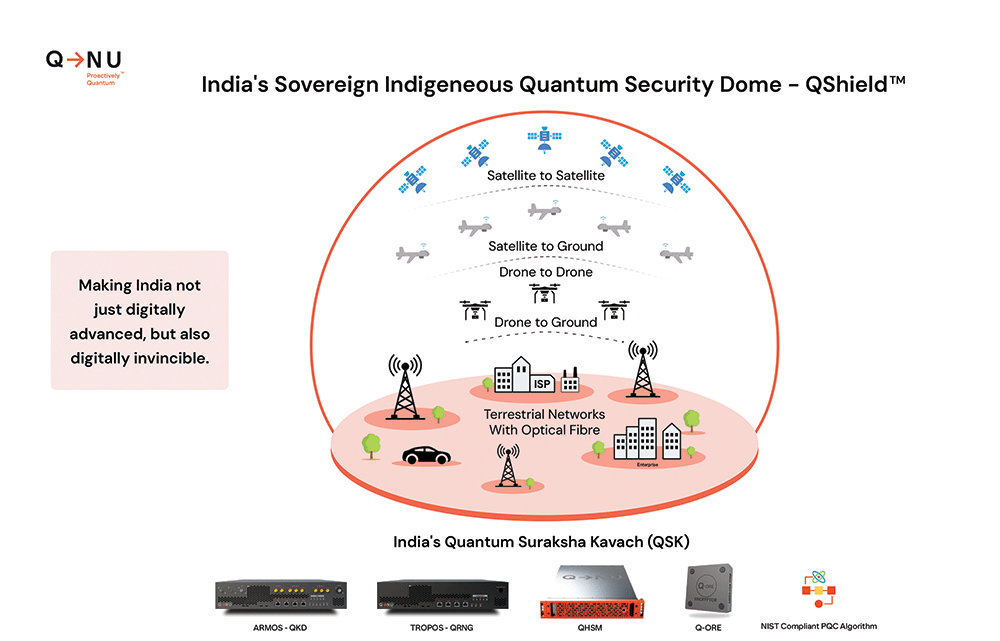
The proposed Cyber Command, Data Force, and Cognitive Warfare Action Force create institutional demand for quantum-grade communications security at command and control layers, precisely the mission-critical use case QNu’s QShield platform (Quantum Suraksha Kavach) is designed to serve.
Also, know more about “Zero Trust Architecture”
QNu believes more assertiveness on technology mandates, particularly for the world’s third-largest economy. DAP reform is the mechanism that could finally enable quantum-secure technologies to move from pilot deployments into large-scale, mission-critical defence infrastructure. That reform is overdue, and its success will determine whether Vision 2047’s ambitions remain aspirational or become operational.
A Vision That Must Not Remain a Guideline
The document acknowledges something important in its own introduction: this Vision is “a guideline and not a directive.” That is an honest statement, and a warning. India has produced visionary defence strategy documents before. What has lagged is the institutional will, acquisition agility, and inter-agency coordination to translate them into capability on the ground.
The Defence Forces Vision 2047 is a document India should be proud of – intellectually rigorous, strategically honest, and civilisationally grounded. It deserves to be treated not as a guideline but as a living mandate. India has the strategic clarity. It has indigenous technology. It has the institutional frameworks taking shape. What it now needs is the execution velocity to match the ambition, because in a world of multiple simultaneous Revolutions in Military Affairs – where quantum-safe communications, cognitive warfare, and autonomous systems are present realities, the gap between vision and capability is itself a vulnerability. India’s adversaries are not waiting for 2047.
The forge is lit. Now India must run it at full heat, and the quantum age will not wait.

The writer is Chief Marketing Officer at QNu Labs, India’s pioneering quantum cybersecurity company incubated at IIT Madras. An IIM-Calcutta alumnus with 22+ years of global marketing leadership, she has led quantum security thought leadership initiatives positioning India’s “Made in India, Made for the World” quantum capabilities across defence, government, and enterprise sectors globally. The views expressed are of the writer and do not necessarily reflect that of Raksha Anirveda





