


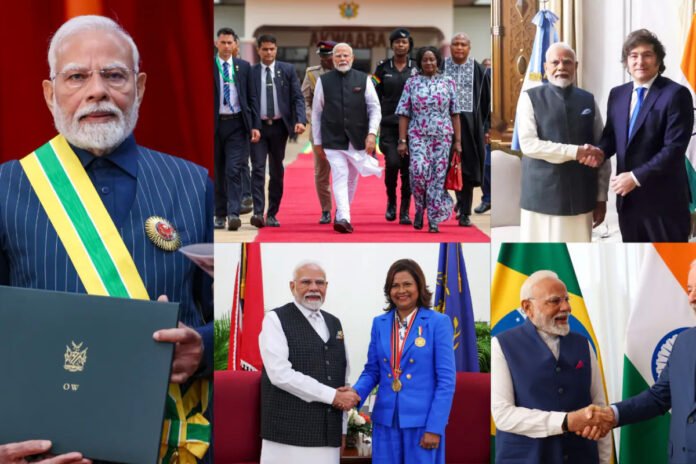
Prime Minister Narendra Modi’s five-nation tour spanning the United Arab Emirates (UAE), the Netherlands, Sweden, Norway, and Italy mark a definitive paradigm shift in New Delhi’s global statecraft. Conducted against the backdrop of systemic volatility – fuelled by chronic conflicts in West Asia and Eastern Europe – the strategic execution of this itinerary highlight that India is no longer merely looking to purchase weapon systems.
Instead, India is systematically embedding its defence manufacturing, supply chain vulnerabilities, and energy corridors into a multi-layered coalition of highly specialised global partners. By intertwining the security architectures of the Persian Gulf, the North Sea, the Arctic Circle, and the Mediterranean, India is mapping out an aggressive strategy for tactical resilience and localised defence co-development.

The Geopolitical Context: Navigating a Fragmented World Order
The strategic layout of this tour maps a deliberate geographical and thematic continuum designed to protect India’s key security vectors. The itinerary begins along critical Middle East maritime choke points and energy lifelines in the United Arab Emirates before moving toward the North Sea and Nordic clusters.
In this second phase, the Netherlands provides entry points into vital semiconductor ecosystems, Sweden offers advanced aerospace and underwater warfare capabilities, and Norway anchors Arctic geopolitics alongside deep-sea domain awareness. The tour concludes in Italy, serving as a critical Mediterranean hub to consolidate the India-Middle East-Europe Economic Corridor (IMEC) architecture and drive naval industrial integration.
This post-globalisation era has forced middle and rising powers to seek functional, interest-driven minilateral configurations rather than rigid block alliances. This five-nation sweep occurs at a flashpoint where major military powers are locked in zero-sum competitions, throwing critical technology access, semiconductor pipelines, and global transit routes into deep disarray.
For India, defensive isolationism is an impossible luxury. Its domestic security mandates demand sustained semiconductor access for high-precision military guidance systems, uncompromised maritime domain awareness over crucial Indian Ocean choke points, and the radical expansion of the Aatmanirbhar Bharat initiative to co-produce weapon platforms locally.

Phase 1: The UAE – Securing the Maritime and Kinetic Underbelly
The tour’s primary point of contact in Abu Dhabi addresses the immediate realities of India’s western maritime frontier. The persistent destabilisation of the Red Sea shipping lanes by non-state actors highlights the vulnerabilities of Indian commercial and defence cargo. By reinforcing ties with UAE President Sheikh Mohammed bin Zayed Al Nahyan, New Delhi is actively working to shield its vital energy and maritime trade corridors from regional turbulence.
From a defence perspective, the relationship with the UAE has rapidly evolved past its legacy framework of simple energy buyer and seller. In terms of joint defence production, active bilateral ventures are focusing on small arms manufacturing, tactical ammunition, and armoured vehicles.

The strategic layout of this tour maps a deliberate geographical and thematic continuum designed to protect India’s key security vectors. The itinerary begins along critical Middle East maritime choke points and energy lifelines in the United Arab Emirates before moving toward the North Sea and Nordic clusters
This is backed by robust logistical anchoring, where bilateral agreements provide the Indian Navy with operational docking rights and logistical access in the Persian Gulf, which is crucial for maintaining prolonged counter-piracy patrols and showing naval strength. Furthermore, both countries are tightening their counter-terrorism frameworks through deepened digital and real-time intelligence feeds that monitor transnational financial networks funding asymmetric warfare targeting South Asia.
Phase 2: The Netherlands – The Frontline of Kinetic Electronics
As the Prime Minister transitioned into Europe, the elevation of ties with the Netherlands to a formal Strategic Partnership brought a vital variable into focus: advanced semiconductor lithography and defence-tech pipelines. Modern electronic warfare, stealth components, and satellite-guided defence arrays rely heavily on advanced microchip architectures.
The Dutch technological footprint – anchored by globally critical semiconductor equipment manufacturers like ASML – is indispensable to India’s long-term military self-reliance. In terms of semiconductor dominance, direct access to these critical supply chains helps secure advanced microchip pipelines for high-precision guided missile systems, which was highlighted by the landmark lithography tools deal between ASML and Tata Electronics for the Dholera fabrication facility.
Simultaneously, the partnership enhances maritime security infrastructure through the joint development of naval drones and secure, autonomous mine-sweeping vessels. Through these initiatives, New Delhi is actively working to insulate its high-tech defence industries from potential blockades or supply chain blackouts in East Asia.
From a defence perspective, the relationship with the UAE has rapidly evolved past its legacy framework of simple energy buyer and seller. In terms of joint defence production, active bilateral ventures are focusing on small arms manufacturing, tactical ammunition, and armoured vehicles
Securing explicit commitments for technological joint ventures with Dutch firms ensures that India’s military-grade fabrication facilities retain unhindered access to European micro-component innovations.
Phase 3: Sweden and Norway – Leveraging the Nordic Defence Powerhouse
The interactions in Gothenburg and the subsequent India-Nordic Summit in Oslo shifted the geopolitical focus directly toward underwater warfare, advanced aerospace designs, and high-altitude defence systems.
The elevation of ties with Sweden to a Strategic Partnership addresses a direct, structural gap within India’s current defence apparatus. In the realm of aerospace technology transfer, Sweden’s expertise in building single-engine fighters serves as an invaluable reference point as India pushes forward with its indigenous Tejas Mk2 and Advanced Medium Combat Aircraft (AMCA) projects.
This is complemented by critical subsurface capabilities, where Saab’s specialised Air-Independent Propulsion (AIP) technology offers an essential resource for the Indian Navy’s conventional submarine fleet, providing enhanced stealth and endurance to counter expanding hostile deployments in the Indian Ocean Region.
In Oslo, conversations with Norwegian counterparts focused heavily on deep-sea engineering and Arctic research. Norway’s mastery of underwater drone technologies and sensor networks provides India with actionable blueprints to enhance its Subsea Maritime Domain Awareness (SMDA).
Italy’s formidable naval defence production ecosystem provides immediate answers to India’s domestic manufacturing bottlenecks, with joint initiatives designed to integrate Italian precision engineering into Indian shipyards, significantly accelerating the rollout of capital warships and advanced electronic fleet defences
As the polar ice caps recede, the opening of new northern trade routes directly threatens to reshape global maritime strategy. Securing an early operational foothold via deep scientific and strategic research in the Arctic allows New Delhi to anticipate shifts that will affect its domestic maritime security commitments.
Phase 4: Italy – The Mediterranean Strategic Hub
The final leg in Rome, centred on bilateral engagements under the Joint Strategic Action Plan 2025-2029, represents India’s ambition to establish a reliable balance of power along European maritime trade routes. The strong personal and ideological alignment between Prime Minister Modi and Italian Prime Minister Giorgia Meloni has transformed a historically transactional relationship into a foundational pillar of Indo-Mediterranean security architecture.
The operational core of the India-Italy joint action strategy relies on three distinct pillars. First, the rapid execution of the IMEC corridor focuses on building alternative, secure trans-continental supply routes that completely bypass contested waters. Second, industrial defence fusion accelerates the domestic co-production of naval electronics, electronic warfare platforms, and advanced naval gun mounts.
Finally, a shared Indo-Pacific alignment reinforces joint patrolling, tracking, and safeguarding of Indian Ocean trade routes against predatory naval build-ups. Through the Ministry of External Affairs, India has continuously focused on moving away from vendor-buyer dependencies toward integrated industrial manufacturing.
The strategy projects a balanced continental power dynamic, where securing deep maritime and technological partnerships across the Atlantic, the North Sea, and the Mediterranean places India as an irreplaceable balancing force. This tour underscores that India’s modern defence doctrine has broken free of its traditional, inward-looking regional box, stepping up as a key architect of international security using targeted technological partnerships and robust maritime diplomacy
Italy’s formidable naval defence production ecosystem provides immediate answers to India’s domestic manufacturing bottlenecks, with joint initiatives designed to integrate Italian precision engineering into Indian shipyards, significantly accelerating the rollout of capital warships and advanced electronic fleet defences.
The Synthesis: A Multipolar Defence Doctrine
When analysed as a single, coordinated diplomatic push, the five-nation tour reveals a highly calculating, defensive strategy aimed at building comprehensive national power.
First, India achieves strategic autonomy via technological multi-sourcing; by actively engaging with multiple advanced European powers simultaneously, the nation systematically dilutes its historical, over-reliant weapon dependencies on any single country.
Second, this diplomacy facilitates defensive supply chain hardening by linking energy commitments from the Gulf with semiconductor equipment components from Western Europe, creating a highly resilient strategic network designed to keep domestic assembly lines running smoothly during unexpected global embargoes or sudden geopolitical breakdowns.
Finally, the strategy projects a balanced continental power dynamic, where securing deep maritime and technological partnerships across the Atlantic, the North Sea, and the Mediterranean places India as an irreplaceable balancing force. This tour underscores that India’s modern defence doctrine has broken free of its traditional, inward-looking regional box, stepping up as a key architect of international security using targeted technological partnerships and robust maritime diplomacy.

–The writer is Assistant Professor, ICFAI School of Liberal Arts, ICFAI University, Jaipur. The views expressed are of the writer and do not necessarily reflect the views of Raksha Anirveda





