


İzmir: Turkey is moving to buy 100 expendable unmanned surface vessels for its navy; it is learned during the SAHA Expo 2026 defence exhibition this month. The decision to procure the systems was made during the February meeting of the Defence Industry Executive Committee, the highest decision-making body in Turkey’s defence procurement and industrial policy.
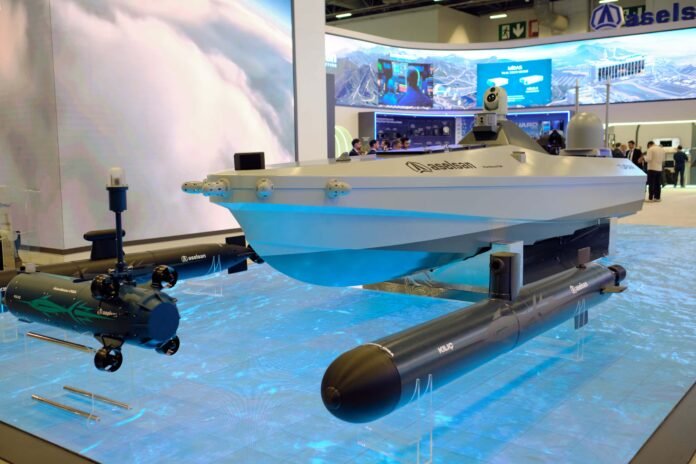
The Secretariat of Defence Industries (SSB) is overseeing the procurement project. The 100 expendable unmanned surface systems will be produced by three different companies. One of the three providers is Aselsan, which has teamed up with Ares Shipyard. They unveiled their joint product, Tufan, during SAHA Expo 2026 in Istanbul.

The second provider is STM, which is cooperating with Yonca Shipyard. Their expendable USV, Yaktu, was also unveiled during the trade show. The third producer is Havelsan, which is working with Sefine Shipyard.
The 100 units are divided as 40 for Aselsan, 32 for STM, and 32 for Havelsan, meaning the overall authorised amount will need to be adjusted slightly to accommodate an operational doctrine that envisions four-drone swarms.
Aselsan’s Tufan unmanned surface vehicle is designed to conduct strike missions against maritime and coastal targets. The vessel is 8 metres long and 1.8 metres wide and carries a high-explosive payload equivalent to one Mk 82 bomb.
STM’s Yaktu USV was developed to meet asymmetric maritime operational requirements, ranging from port protection to open-sea strike missions. It has an overall length of 5.8 metres and a displacement of 1.7 tons.

Both Tufan and Yaktu are configured as expendable, precision-strike unmanned surface platforms designed for engagements against surface targets. They feature compact, low-profile hulls to reduce radar and visual detectability. Both systems support line-of-sight (LOS) and satellite communications, enabling integration into network-centric operations. Their swarm architecture allows multiple units to operate cooperatively, share data in real time, and autonomously allocate tasks during missions.






