


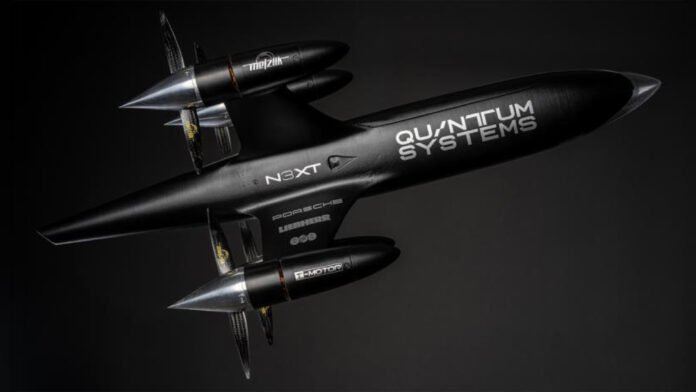
MUNICH. In a dramatic development rewriting the rules of aerial warfare, Munich-based unmanned aerial vehicle (UAV) developer Quantum Systems Group has unveiled a groundbreaking battery-electric drone that achieved an astonishing top speed of 699 km/h (434 mph).
Developed under the company’s advanced N3XT department, the fixed-wing “Apex Recordhunter” aircraft shattered the previous official world record of 409 mph during straight and level internal flight testing.

This ultra-high-speed platform is not meant for consumer hobbyists or standard commercial use; rather, it is designed to pioneer the next generation of low-cost, anti-aircraft interceptor drones capable of downing hostile airborne threats.
The introduction of the Apex Recordhunter comes at a time when modern conflicts are heavily defined by specialised drone warfare. Armed forces are grappling with a massive influx of swift, one-way attack drones deployed across eastern European battlefields.
Many of these newer threats, such as jet-powered kamikaze systems, can cruise at speeds exceeding 310 mph, rendering conventional, slower first-person view (FPV) interceptors entirely obsolete. By packing immense electric propulsion into a highly optimised, tapered aerodynamic chassis, Quantum Systems is demonstrating that battery-powered aircraft can fly fast enough to catch and destroy high-speed military targets.
To achieve this extreme velocity without relying on traditional combustion or jet fuel, the N3XT engineering team integrated cutting-edge hardware. The record-setting drone utilises specialised V4Smart battery cells supplied by a subsidiary of the luxury automotive company Porsche.

This high-discharge battery architecture feeds an electric motor configuration that features a signature four-finned rotor setup and an elongated tail fin assembly. The result is a highly agile, streamlined aircraft capable of sustaining extreme level-flight speeds that push the absolute limits of electric aviation physics.
While the 434-mph run remains unofficial until formal validation is completed by independent observers from Guinness World Records and the Fédération Aéronautique Internationale (FAI), the underlying technology has already proven its disruptive potential.

Crucially, the development of the Apex Recordhunter is a deeply collaborative international effort. Ukrainian engineers operating under the auspices of WIY Drones – a localised division of the Quantum Systems Group – have played a central role in shaping the platform based on immediate tactical feedback.
Given the high costs of firing multi-million-dollar traditional surface-to-air defence missiles to intercept inexpensive enemy drones, these electric interceptors offer a remarkably cost-effective alternative. A standard jet-powered attack drone can cost upwards of $100,000 to manufacture, whereas a localised electric interceptor can be produced for a small fraction of that price, fundamentally shifting the economic calculus of modern air defence.
Building on the engineering momentum of the Apex project, WIY Drones in Ukraine is already moving forward with operational test variants aimed at claiming subsequent national speed milestones.
The division is preparing to launch two highly specialised combat platforms: the “STRILA Interceptor,” designed to chase down targets while carrying a 0.5-kilogramme payload, and the “SPYS system,” a dedicated anti-aircraft class FPV drone built for pure interception speed.
These secondary projects aim to transition the innovations of the Recordhunter demonstrator into deployment-ready defensive assets capable of protecting vital infrastructure from manoeuverable aerial strikes.
With a formal, certified two-way speed run scheduled for the coming weeks to officially cement its place in the record books, Quantum Systems has effectively proven that the future of short-range air defence relies heavily on autonomous, lightning-fast electric aviation.






