


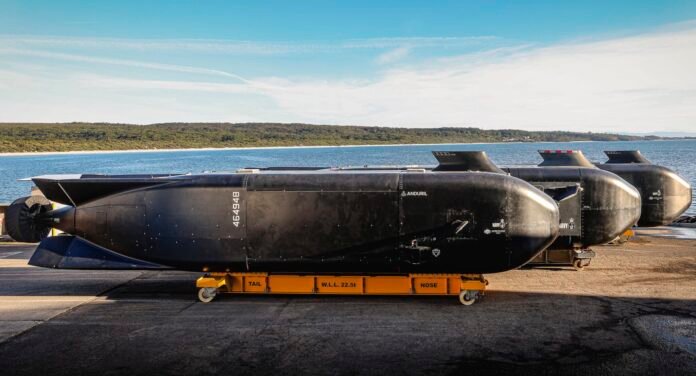
the Royal Australian Navy’s Ghost Shark is an extra-large autonomous underwater vehicle designed to conduct missions without a crew aboard. Australia’s government has contracted Anduril Australia to deliver, maintain and continue developing the system over five years. Officials say the initial fleet will number “dozens”, but have not disclosed a precise quantity.
The programme grew out of a 2022 partnership between Anduril, the navy and the Defence Science and Technology Group. The government says the three contracted prototypes were delivered ahead of schedule and within budget, enabling the project to move into production. A$1.7 billion is allocated to the new contract; that follows roughly A$140 million in earlier government investment in development, payloads and production facilities.

The vehicle’s exact dimensions, range, depth rating and payload configuration have not been officially detailed publicly. Australian authorities and Anduril have kept key technical details confidential. Independent analysis has described the Ghost Shark as an all-electric platform, while Anduril says its electric powertrain is intended to support long-range, longduration operations without surfacing.
That endurance could make the vehicle useful for intelligence, surveillance and reconnaissance missions, as well as strike operations. The Australian government has identified those mission categories but has not publicly specified weapons or operational tactics. Analysts have suggested possible roles such as monitoring maritime activity and laying mines, but those remain assessments rather than a public inventory of confirmed capabilities.
The programme is intended to add capacity alongside crewed submarines and surface vessels, not replace them. Uncrewed craft could undertake some persistent or hazardous tasks without putting a submarine crew at risk, while potentially allowing crewed vessels to focus on other missions. Their practical contribution will depend on factors including reliable autonomy, communications, sensor performance and the ability to maintain and deploy the vehicles over long distances.
The navy’s chief has said Ghost Sharks can be launched from shore or from a warship. The system has also been transported by a C-17 aircraft, suggesting it can be moved between operating areas by air. Such options may help Australia deploy the vehicles across its extensive maritime approaches, though specific operating procedures and deployment locations have not been made public.

The production decision also carries an industrial component. More than 40 Australian companies are part of the supply chain, and the government expects the contract to support existing jobs and create additional skilled roles. Anduril is establishing local manufacturing capacity, aligning the project with Canberra’s stated goal of building sovereign defence technology in Australia.
Ghost Shark arrives as Australia expands its undersea capabilities through several parallel programmes, including the AUKUS plan for nuclear-powered submarines. The two efforts differ sharply in scale and purpose: Ghost Shark is an uncrewed system designed for autonomous missions, while AUKUS is intended to provide crewed, long-range submarine capability. Australian officials have framed the drone fleet as complementary to both future submarines and the surface fleet.

The next test will be whether production vehicles can deliver the promised persistence and mission flexibility in operational conditions. With sensitive specifications still undisclosed, the fleet’s true reach and effectiveness will become clearer as it enters service and the navy integrates it into its broader maritime force.






