


There exist only two kinds of Nations in the World, the first are those who design & produce their own Weapons and the second are those who purchase Weapons. Only nations which can make their own weapons can have a Military Doctrine, all other Nations at best can have a Military Strategy. The Former (Weapon Producers) shall always be the Leaders and the Latter (Weapon Purchasers) will always the followers in the World of Geopolitics.
– Extract from ‘Rise of the Ancient: Phoenix Resurrection’ by Grp Capt Arun Kashyap

The recent protracted conflicts, whether Russo-Ukraine or Iran-USA have established the need of indigenous weapon industry for a Nation to survive. Both Ukrainian and Iranian battlefields have established that weapons employed by the warring nations have to align with the Nation’s war doctrine, terrain and prevailing weather conditions.
Ukraine, despite all the aid from NATO and USA, imbedded foreign troops and advisors was unable to hold the Russian assault because it was compelled to make its Military Strategy as per the weapons supplied to it by its benefactors (NATO and USA), while Iran having designed its weapons as per its Military Doctrine, topography – besides existing weather – has been able to hold off and beat US-Israel combine.
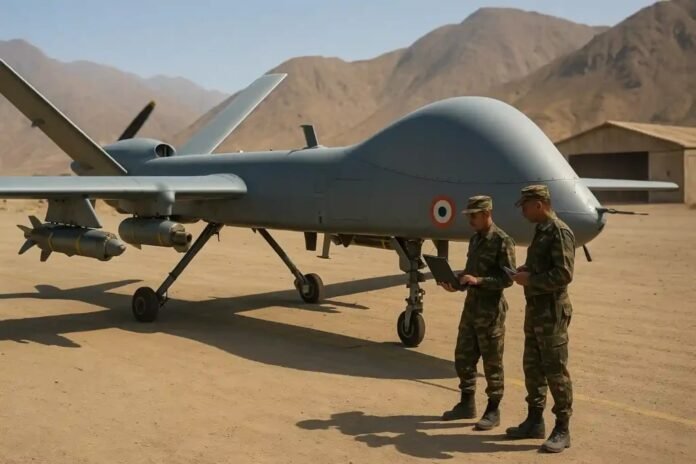
Bhartiya (Indian) RFP for 87 MALE drones suffers from the Ukrainian complex of adopting weapon systems already in use in other world theatres and not based on its topography and prevailing weather phenomenon. This shall prove disastrous for both its forces and its arms industry especially when you take into consideration that the intended area of usage of these Platforms is J&K and Ladakh besides the Tibetan Plateau.
Bharat with its Air Force as the lead agency has raised an RFP for procurement of 87 MALE drones for ISR, MST (Data transfer and targeting), communication and UCAV role. This innocuous decision is perhaps the most crucial military acquisition by Bharat affecting its fighting efficacy in the next conflict or conflict like situation Low Intensity Conflict Operations (LICO), which would likely intensify as Pakistan’s internal troubles mount. Acquisition of MALE instead of HALE drones may end up being a disastrous mistake.

The recent protracted conflicts, whether Russo-Ukraine or Iran-USA have established the need of indigenous weapon industry for a Nation to survive. Both Ukrainian and Iranian battlefields have established that weapons employed by the warring nations have to align with the Nation’s war doctrine, terrain and prevailing weather conditions
Why MALE Suits Israel and Europe But Not Bharat?
The lowest layer of atmosphere which contains almost 80% of atmosphere’s mass, is water-vapour (hence all the weather phenomenon) and it varies in height from equator to poles due to the centrifugal force caused by earth’s rotation.
At the Equator, the troposphere extends to 18 kms or 60,000 feet and at Poles it is restricted to about 10 kms or 33,000 feet. The height of the Troposphere is often affected by earth’s terrain, like high mountains (Himalayas and Tibet Plateau).

The high density of air in the troposphere makes the operation of both turbo-props and turbojets easier than in the Stratosphere (the layer above Troposphere which is devoid of any weather phenomenon and winds).
The tropopause or the top of the troposphere is at about 35,000 feet over Israel, Europe and USA. Thus, most of the Israeli, European and American drones designed are MALE-Medium Altitude Long Endurance – implying they can operate up to 30-40,000 feet with duration of 24 hrs or more.
Americans have ventured into the HALE regime, implying altitudes of 50,000 feet and above with endurance exceeding 24 hrs. Thus, it is apparent that MALE is conducive only for higher latitudes where tropopause is at or below 35,000 feet, which permits them to operate in the Stratosphere to escape the vagaries of nature.
Bharat’s Drone Dilemma: MALE vs HALE
Bharat’s conflict zones-Jammu & Kashmir, Ladakh, and Arunachal Pradesh-involve the Tibetan Plateau, Himalayas, and Karakoram ranges at 15,000-20,000 feet elevation. This terrain fundamentally undermines MALE drone effectiveness.
MALE drones (max ceiling ~40,000 feet) would operate only 5,000-20,000 feet above ground – making them vulnerable even to basic MANPADs. More critically, the Sub-Tropical Jet Stream (STJ) flows at 26,000-40,000 feet with core velocities of 140-210 knots during the primary conflict season (September–March). Since most MALE drones cruise at just 150-200 knots, they effectively cannot penetrate Pakistani or Tibetan airspace against these headwinds. DRDO’s own TAPAS BH-101 failed to even meet the 30,000-feet and 24-hour endurance threshold.
Bhartiya (Indian) RFP for 87 MALE drones suffers from the Ukrainian complex of adopting weapon systems already in use in other world theatres and not based on its topography and prevailing weather phenomenon. This shall prove disastrous for both its forces and its arms industry especially when you take into consideration that the intended area of usage of these Platforms is J&K and Ladakh besides the Tibetan Plateau
Meanwhile, adversaries operate well above these constraints. Pakistan’s Bayraktar AKINCI flies at 50,000 feet at 240 knots-and with STJ as tailwind, it can strike into Bharat at near-Mach speeds carrying stand-off missiles with 150-240 km range. China fields HALE drones like the WZ-7 (ceiling 59,000 feet, 450 knots) and CH-7 (45,000 feet, 500+ knots), comfortably above STJ and the high terrain.
Procuring 87 MALE drones tailored to DRDO/HAL limitations – rather than operational realities-would be a costly strategic blunder. Bharat urgently needs HALE drones capable of overflying the STJ band, operating effectively over high-altitude terrain, and exploiting tailwinds on return. The asymmetry with adversaries demands nothing less.
The 87-Drone Bid: The Contenders and Their Limitations
Bharat’s procurement race for 87 MALE drones has attracted ten bidders, but a closer look at the contenders reveals a troubling pattern – most are offering platforms already proven inadequate for Bharat’s operational theatre.
HAL is partnering with Israel for the Heron-II, capable of just 150 knots maximum and a 35,000-feet ceiling. Adani Defence’s Drishti, based on the Hermes-900, fares worse – 30,000-feet ceiling and a meagre 60-knot loiter speed. L&T has tied up with US-based General Atomics, whose MQ-9B SkyGuardian/SeaGuardian – already supplied in small numbers to Bharat – offers the best specs among MALE contenders: 40,000-feet ceiling and 210 knots. However, America’s history of unpredictable technology transfer policies remains a serious concern. Bharat Forge has partnered with France’s Turgis Gaillard for the AAROK, broadly comparable to the MQ-9B. Rounding out the field are TASL, Solar Defence, Raphe-mPhibr, and idea-Forge, all planning indigenous MALE designs.
The 87-drone acquisition falls under the IDDM (Indigenously Designed, Developed and Manufactured) framework, mandating 60% indigenisation and domestic final assembly. In principle, this is commendable. In practice, it risks becoming superficial unless critical technologies – powerplants and advanced avionics – are genuinely indigenised
Regardless of the partner or pedigree, every one of these platforms remains fatally constrained by the Sub-Tropical Jet Stream and high-altitude terrain discussed earlier.
A Game-Changing Threat: The SA-67 Loitering Missile
Beyond terrain and weather, a new and asymmetric threat has emerged that fundamentally alters the calculus for MALE drones – Iran’s SA-67, also known as Missile 358 or Saqr-1.
The concept is deceptively simple: a loitering surface-to-air missile that cruises at mid-altitude, hunting enemy UAVs. Built from reverse-engineered Russian R-27 missile bodies powered by off-the-shelf Dutch AMT turbojet engines – the kind used in hobby aircraft – the SA-67 costs under $50,000 per unit. Its passive infrared seeker silently scans the skies; upon detecting a heat signature, it accelerates to 1,000 km/h and destroys the target with a proximity fragmentation warhead. During cruise, the engine produces minimal heat, making it virtually undetectable to its prey.
The results have been devastating. The SA-67 has downed over 50 Hermes-900 and MQ-9 Reaper drones – each costing at least 60 times more than the missile itself. It is also credited with bringing down an F-35 over Iran. Crucially, the SA-67 has a ceiling of 35,000 feet – exactly the operational altitude Bharat’s RFP specifies. Houthis already deploy it extensively, and given Pakistan’s deep links with the 313 Brigade terrorist network, its proliferation into the next India-Pakistan conflict is a realistic threat. HALE drones, operating above 40,000 feet, would simply fly beyond the SA-67’s reach.
Procuring 87 MALE drones – platforms that cannot effectively penetrate enemy airspace, are vulnerable to a $50,000 missile, and struggle in the very terrain and weather conditions of Bharat’s conflict zones – would be a strategic miscalculation with potentially irreversible consequences
The Indigenisation Illusion
The 87-drone acquisition falls under the IDDM (Indigenously Designed, Developed and Manufactured) framework, mandating 60% indigenisation and domestic final assembly. In principle, this is commendable. In practice, it risks becoming superficial unless critical technologies – powerplants and advanced avionics – are genuinely indigenised.
The irony runs deep. TAPAS, Bharat’s own MALE drone, runs on a Russian engine. The Tejas LCA depends on an American GE F404 – whose constrained supply has already bottlenecked production. The ALH helicopter is powered by a French engine. Not a single major Indian aerial platform carries a home-grown powerplant. If indigenisation means assembling foreign-sourced critical components in Indian sheds, it offers little strategic resilience in wartime.
The Inescapable Conclusion
Procuring 87 MALE drones – platforms that cannot effectively penetrate enemy airspace, are vulnerable to a $50,000 missile, and struggle in the very terrain and weather conditions of Bharat’s conflict zones – would be a strategic miscalculation with potentially irreversible consequences.
The RFP needs one fundamental change: Buy HALE. Bye MALE.

The writer is an Indian Air Force veteran and published author who has been a Navigation and Missile Instructor alongside being a weapon system evaluator. At present, he is a performance instructor for the Boeing 737. The views expressed are personal and do not necessarily carry the views of Raksha Anirveda





