


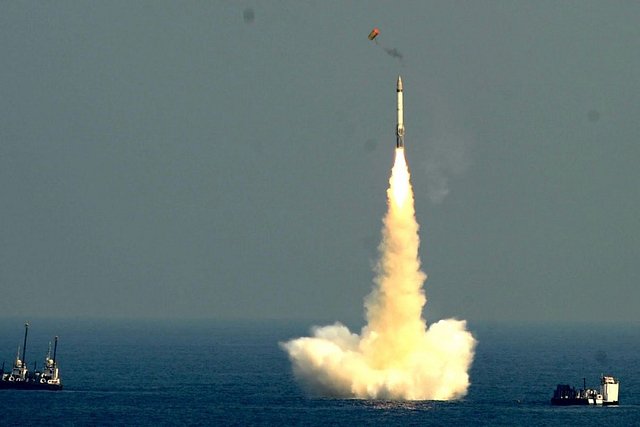
New Delhi: India’s Defence Research and Development Organisation (DRDO) has successfully completed the development of the K-5 submarine-launched ballistic missile (SLBM), marking a significant advancement in the country’s nuclear deterrence capabilities.
The missile’s completion was revealed during the foundation stone laying ceremony of the Kerala Spacepark (KSPACE) in Thiruvananthapuram on June 25, 2025, where a former BrahMos Aerospace scientist confirmed that the K-5 has an operational range of 5,000 to 6,000 kilometres.

The K-5 represents the pinnacle of India’s secretive “K” series of submarine-launched ballistic missiles, named in honour of former President A.P.J. Abdul Kalam. This development builds upon the successes of its predecessors, including the K-15 (750 km range) and K-4 (3,500 km range), which have already been successfully tested and inducted into service.
The K-5 missile is a sophisticated three-stage, solid-fuelled system that demonstrates India’s advanced missile technology. With a total weight of approximately 20 tonnes, the missile can deliver a nuclear payload of up to 2 tonnes over its maximum range. The system measures approximately 12 metres in length with a diameter of 2.45 metres, sharing design similarities with the Russian R-39 SLBM.
DRDO has demonstrated several key components of the K-5 missile system, including its canister, nose cap, torrential air bottle, and TOR gas generator casing. The missile employs cold-launch technology, using gas pressure to eject the missile from its canister before its rocket motors ignite. This innovative approach significantly reduces acoustic and thermal signatures, enhancing the stealth characteristics crucial for underwater operations.
The K-5 is reportedly equipped with countermeasures to avoid radar detection and incorporates Multiple Independently Targetable Reentry Vehicles (MIRVs), allowing it to engage multiple targets simultaneously or penetrate hardened defence systems. This capability makes it particularly effective against adversaries with advanced missile defence systems.

The K-5 missile is designed for integration with India’s advanced submarine platforms, particularly the larger S4 and S4* variants of the Arihant-class nuclear-powered ballistic missile submarines (SSBNs). These submarines feature increased displacement of 7,000 tonnes and extended hull sections to accommodate eight missile launch tubes, compared to the four tubes on the original Arihant-class submarines.
India’s current submarine fleet includes INS Arihant (commissioned in 2016) and INS Arighaat (commissioned in August 2024), both operational and conducting deep-sea patrols. The third submarine, INS Aridhaman (S4), is expected to be commissioned in 2025, followed by the fourth submarine, S4*, which was quietly launched in October 2024.

The submarine S4* represents a significant advancement, featuring approximately 75% indigenous content and carrying only K-4 ballistic missiles with a range of 3,500 kilometres. Future submarines in the series are expected to accommodate the longer-range K-5 missiles, significantly extending India’s strategic reach.
The K-5 development is part of India’s comprehensive K-series missile program, which includes missiles with varying ranges to provide flexible deterrence options.






