


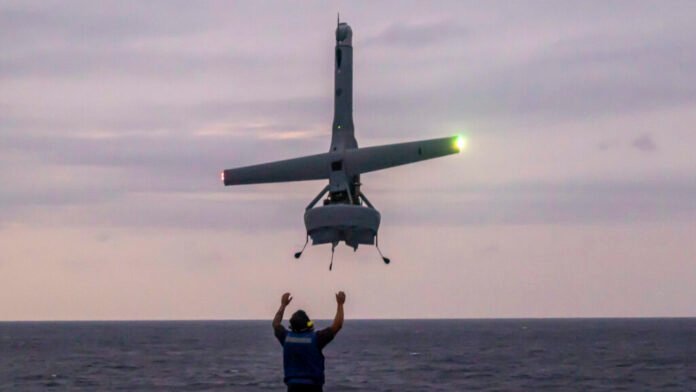
Washington: The Defence Innovation Unit (DIU) is seeking firms that can supply a drone capable of carrying fighter-sized munitions to strike targets hundreds of miles away, a new notice says, citing a growing threat of anti-ship weapons and constraints on long-range strike capabilities for maritime forces.
Adding some complexity to the solicitation dubbed Runway Independent Maritime & Expeditionary Strike: Those drones also need to operate with minimal launch and recovery infrastructure, meaning they could take off from ships like an Arleigh Burke-class destroyer that lack a large flight deck typically needed for deploying aircraft.

“Long-range, anti-ship weapons present a growing threat to US Navy ships and degrade their ability to accomplish a mission,” the notice says. “While access to long-range strike methods can mitigate this threat, naval surface combatants are constrained in their ability to support long-range strikes over extended combat operations due to reliance on single-use missile systems, with limited magazine depth and limited at-sea munition replenishment capability.
“To address this problem, the Department of the Navy desires an Unmanned Aerial System (UAS) capable of supporting naval surface combatants through executing long range strikes with standard munition payloads while providing tactical flexibility by operating from expeditionary locations with minimal infrastructure, or from ships without large flight decks,” it continues.
The “primary attributes” sought by DIU for the new drone include a one-way range of 1400 nautical miles when carrying payloads, or a radius of 600 nautical miles, as well as the ability to deliver 1000-pound-class munitions used by existing aircraft. Those traits likely require a drone of considerable size: For comparison, an F/A-18 Super Hornet has a range of nearly 1,300 nautical miles in a “clean” configuration carrying two AIM-9X Sidewinder interceptors, according to Naval Air Systems Command, while a GBU-32 Joint Direct Attack Munition weighs 1,000 pounds.
Among other key attributes like mission autonomy, an open systems architecture and the ability to operate in contested environments, DIU is asking for drone solutions that are “cost effective.” Eligible solutions are additionally expected to be ready for “significant physical prototyping” within a year of a contract award. US and foreign-owned businesses are permitted to compete.

While minimal launch and recovery infrastructure is listed as a primary attribute, operating without a large flight deck is treated as “secondary” in the notice. Other secondary attributes include the ability to withstand the maritime environment — often defined by rough seas, high winds and corrosive blasts of saltwater — low latency, and a cruise speed “comparable to existing long-range strike methods.”






