


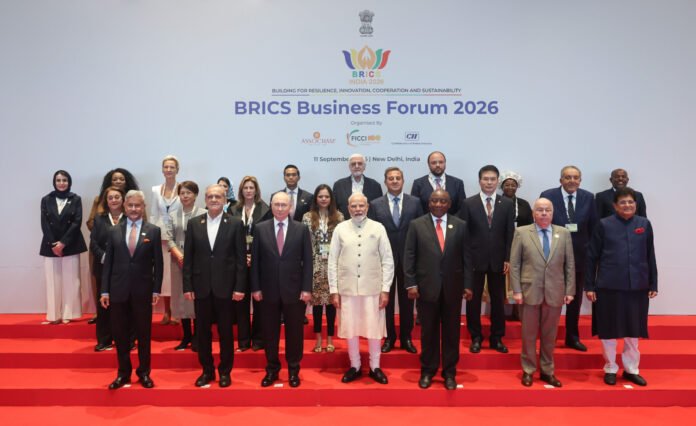
The single fact that matters from this weekend is that eleven states – two of them actively at war with each other – endorsed the same document. On Saturday, September 12, the 18th BRICS Summit unanimously adopted the New Delhi Declaration: forty-five pages, a hundred and forty paragraphs, built around India’s Chairship theme of resilience, innovation, cooperation and sustainability.
Only four months earlier, in May, the foreign ministers hadn’t even managed a joint statement. By September their leaders had agreed on common language covering Pahalgam, Palestine, tariffs and carbon border taxes.

BRICS is not a coherent bloc and not an alliance – India would leave if it tried to become one. But it is the only large table where states holding half of humanity can argue and occasionally agree, without a Western chair at the head and without needing to be anti-Western to sit there.
Managing three hostile or semi-hostile relationships in one city over three days, without anything detonating, and getting everyone to sign at the end, is itself a first-order act of defence diplomacy.
Those who have spent careers planning the movement of men and materiel recognise the choreography of a summit at once – it is, in effect, a logistics operation wearing a silk tie. And the Indian practitioner of that particular craft has quietly become one of the more interesting exponents of it anywhere in the world today.
The Numbers Behind the Argument
By India’s count, BRICS has eleven full members – the original five plus Egypt, Ethiopia, Iran, Saudi Arabia and the UAE (2024), and Indonesia (2025) – with a wider “partner country” tier around them.

The Indian government’s figures: roughly 40% of global GDP at purchasing-power parity, about 49.5% of world population, a quarter of global merchandise trade, and a collective economy near $28.5 trillion.
Prime Minister Modi put it more sharply at the Business Forum: BRICS output has grown four-and-a-half times in two decades against two-and-a-half times for the world as a whole.

The New Delhi Declaration succeeded where May’s foreign ministers meeting failed – proof that consensus can survive live hostilities if the drafting is careful enough
India’s own numbers have shifted too – 7.8% real GDP growth in the first quarter of FY2026-27, record exports of $824.9 billion in 2024-25, a move past Japan into the world’s fourth-largest economy, and defence exports around $2.76 billion.
None of this makes India a superpower, and claims to that effect deserve scepticism. But when its Prime Minister chairs a session on global governance, the numbers now argue for him in a way they didn’t in 2012.
The bloc as a whole holds the world’s second- and fifth-largest economies, several of its largest hydrocarbon exporters, two of its biggest food and fertiliser producers, and the two most populous nations on earth – a combination that guarantees the room’s attention even before anyone speaks.
Not NATO – and the Distinction Matters
BRICS began as a label coined by a Goldman Sachs economist in 2001; the states began meeting in 2006, and formalised their partnership in 2009. What followed was slow institution-building – the New Development Bank, the Contingent Reserve Arrangement, the long-gestating BRICS Pay – none of it displacing existing structures, all of it creating optionality. Kazan in 2024 roughly doubled the grouping’s membership, which complicated coordination without doubling capability.
The comparison to NATO is tempting and wrong. NATO has a mutual-defence clause, an integrated command, standardisation down to ammunition calibre, and thirty-two states bound by treaty obligation.
BRICS has none of it – no defence pact, no headquarters, no secretariat, no binding obligation on anyone. It works entirely by consensus, meaning every member holds a veto. NATO organises security; BRICS organises development.
Reading BRICS as a nascent eastern military bloc distorts policy discussions in Washington and Brussels alike, flatters those inside the grouping who would like it to become exactly that, and makes India’s own position harder to explain than it needs to be.
Iran and the UAE settled their sharpest dispute not through text, but through a Pezeshkian-Al Nahyan sideline meeting – the highest-level contact between the two since their war began
It also inverts the logic of security itself: diversified supply chains, local-currency settlement and energy cooperation don’t deter an armoured thrust, but they do reduce the odds that an economic shock turns into a political crisis, and a political crisis into a war.
That is contribution to security through the developmental route rather than the military one – a different instrument entirely, and one India is notably well placed to wield, given that its most valuable asset in the room is precisely the absence of a security bloc to defend.
The Compromise on Iran and the UAE
The real obstacle to the Declaration wasn’t the West – it was two members sitting at the same table while shooting at each other’s interests. Since American and Israeli strikes on Iran began on February 28, Tehran has targeted US bases in the Gulf, including in the UAE. In May that split the foreign ministers over language on Gaza, and the meeting closed without a statement.
This time the Sherpas negotiated through the night, closing at four in the morning. India’s approach was to shift the argument off named countries and onto general principles of unprovoked aggression and the UN Charter – territory no single veto could dominate.
What actually unlocked the deadlock, though, was a meeting on the margins: Pezeshkian sitting down with Abu Dhabi’s Crown Prince Sheikh Khaled bin Mohamed bin Zayed Al Nahyan – the highest-level Iran-UAE contact since the war began.
The resulting text expressed concern over attacks on civilian infrastructure and peaceful, IAEA-safeguarded nuclear facilities, worded so Iran could read a rebuke of the strikes against it while the UAE could read a text naming no one.
Both sides signed. It echoes what India managed at the 2023 G20, when a divided room found language on Ukraine that named no aggressor. Twice now, India has chaired a fractured table to consensus by finding the principle everyone could endorse and nobody could be indicted by.
What the Fine Print Actually Says – and Skips
The Declaration condemns terrorism “regardless of motivation, whenever, wherever and by whomsoever committed,” names the April 22, Pahalgam attack in Jammu & Kashmir directly, and again presses for a Comprehensive Convention on International Terrorism that has sat blocked since 1996.
No treaty, no command, no obligations – just a consensus platform that manages development risk instead of collective defence
Getting that language past eleven capitals – one of which has spent two decades slow-walking terror listings at the UN – took the year-long groundwork of the Counter-Terrorism Working Group’s plenary sessions.
On Security Council reform, China and Russia “reiterate their support” for India’s and Brazil’s aspirations – not a seat, but a sentence Beijing didn’t have to sign. Unilateral tariffs and carbon border adjustment mechanisms are criticised as discriminatory toward developing economies; energy security is framed as central to national security; local-currency settlement is acknowledged without a one-size-fits-all mandate.
What’s absent instructs as much as what’s present. The West Asia paragraph names neither the United States nor Israel and doesn’t condemn the strikes on Iran – a fortnight earlier, at Bishkek, India had signed an SCO text that did.
Ukraine goes unmentioned beyond a generic call for dialogue. Palestine, by contrast, gets firmer language: concern over continued violence in Gaza despite the October 2025 ceasefire, and a call to halt forced displacement.
India blocked an Alipay linkage on security grounds while quietly building bilateral local-currency settlement – treating clearing systems like national borders
As former diplomat Nirupama Menon Rao put it, consensus was held through carefully generalised language – BRICS can keep hard conversations alive even while struggling to assign responsibility or organise collective action. The paragraphs likely to matter in five years are the duller ones: energy infrastructure, critical minerals, MSME finance, counter-terrorism sub-groups – the ones that create working-level obligations rather than headlines.
Three Bilaterals that Outweighed the Text
The Declaration will be remembered less than three private conversations. Modi and Putin met Friday to discuss trade, defence, energy and civil nuclear cooperation, working toward a $100 billion trade target by 2030 – against a backdrop in which bilateral trade already hit a record $70 billion in 2024, roughly 96% of it now settled in rouble and rupees.
That settlement architecture, built under sanctions pressure, is precisely what has drawn US tariffs of up to 50% on Indian goods, later eased to 18% under a February 2026 understanding tied to a wind-down of Russian crude purchases – a deal that hasn’t fully held.
PM Modi’s meeting with Pezeshkian focused on Chabahar port and the International North-South Transport Corridor, India’s only routes to Central Asia bypassing Pakistan, both hostage for years to sanctions and now to war.
And Xi’s visit – his first in seven years – produced talk of normalisation along the Line of Actual Control, building on the 2024 disengagement agreement, eased Chinese export restrictions on rare earths, and restored flights and border trade points.
It remains, deliberately, managed competition rather than friendship: another patrol-related confrontation occurred as recently as August 2026, and India has held firm – consistently since 2020 – that border stability is the precondition for everything else.
For military planners the calculus doesn’t shift on the strength of a summit handshake; capability, not intention, remains the basis of any serious appreciation, and capability takes a decade to build or dismantle where intention can be revised in a fortnight.
A quarter of the world’s seaborne crude nearly stalled this year, turning economic chokepoints into a genuine national-security concern for India
Even so, whatever the Declaration fails to resolve on paper, BRICS put principals from opposing wars in the same physical room – call it, in military terms, a liaison mechanism, and not a trivial one. The 2024 Modi-Xi meeting at Kazan set the current border reset in motion; the Pezeshkian-Al Nahyan conversation in Delhi may yet do something comparable for the Gulf.
Economic Security as National Security – and the Honest Limits
India spent its Chairship year pushing incremental, deliberately modest steps: a logistics and customs cooperation framework, a standards-harmonisation memorandum, and above all the Strategy for BRICS Economic Partnership 2030, finalised in Jaipur in August.
PM Modi proposed measurable targets at the Business Forum – removing the top ten intra-BRICS trade barriers, backing a hundred start-ups a year to scale across member markets, a thousand new business partnerships – a harder-edged register than two decades of communiqués.
On payments, India deliberately declined to back a unified bloc-wide settlement system that might read as anti-dollar, pursuing instead narrower bilateral local-currency links – while, in early September, blocking a proposed Alipay linkage with India’s own instant-payments system on national security grounds.
That instinct, treating payment rails as strategic infrastructure, is likely to become a template. The Strait of Hormuz crisis this year, which briefly cut a quarter of the world’s seaborne crude and a fifth of its LNG, and drove Brent above $92 a barrel, made the underlying case starkly: economic chokepoints are now as consequential to Indian security as any land border.
No country named on West Asia, no mention of Ukraine – but eleven capitals in dispute with each other still left New Delhi having signed the same page
None of this should be oversold. Analysts including Chatham House’s assessment note the founders still don’t agree on what BRICS is for – India and Brazil want a development platform, Russia and China want a geopolitical counterweight, and expansion since Kazan has widened rather than narrowed that gap.
India signed a text at Bishkek condemning strikes on Iran and, a fortnight later, chaired one in Delhi that didn’t. Both were arguably right for the room in front of them; neither adds up to a fixed position.
Tighter mini-lateral groupings, like the emerging Pakistan-Turkey-Saudi defence arrangement, are a reminder that small groups can act while large ones mostly deliberate.
What the Declaration did not settle is what the four-a.m. finish, and the Pezeshkian-Al Nahyan meeting it produced, arguably did: eleven states, some at open war or under sanction or in unresolved territorial dispute with the host, arrived in one city, argued through the night, and signed anyway.
Whether BRICS becomes the fountainhead of a new order or one tributary among several, the more durable shift is procedural India increasingly treats defence and economic diplomacy as instruments of first resort, deployed before a crisis, rather than courtesies extended after the real business is done elsewhere.

Lt Gen S K Gadeock is a distinguished military leader, global strategist, and scholar who served as the Commandant of the Defence Services Staff College. A decorated veteran and former Logistics Advisor to the Botswana Defence Force, he has held numerous high-ranking appointments including Director General of the Amity Institute of Defence & Strategic Studies. Serving on the Advisory Board of Raksha Anirveda, he is a prolific writer and motivational speaker.





