


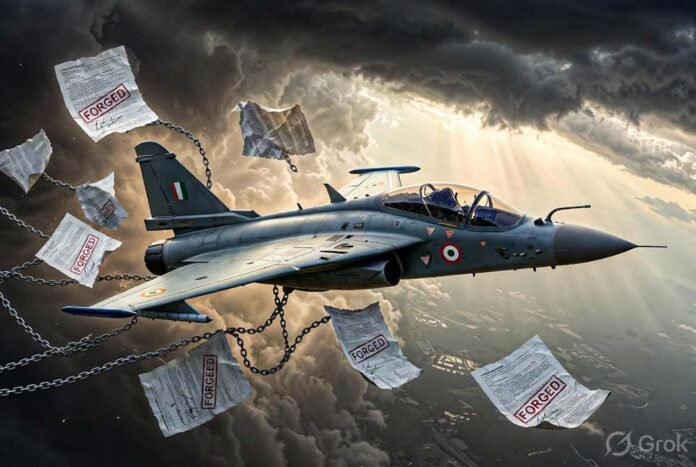
In India’s defence factories, every small part of a fighter jet matters. One weak nut or bolt can put a pilot’s life in danger. So when news came out about fake test reports for our pride, the Tejas Mk-1A fighter aircraft, many of us in the industry felt angry and worried at the same time.
Here is what happened in simple words. A Hyderabad-based company called Tec Aero Devices, along with its CEO M Sivarama Prasad, is now facing police action. The Karnataka Police have registered a case because the company allegedly gave HAL 199 forged test reports for parts meant for the Tejas jet. A test report is a certificate that proves a part has been checked properly and is safe to use. These reports were fake — they carried false signatures from another firm, Axis Inspection Solutions, to make them look genuine. The good news is that HAL’s own internal audit caught the cheating in time. The company has been blacklisted, its payments stopped, and most importantly, no faulty part actually reached any aircraft. This shows HAL is alert and doing its duty. But it also raises an uncomfortable question — how did such cheating happen at all in a programme as important as Tejas?

Most government contracts are given on the L1 system, meaning the lowest bidder wins. Add reverse auctions to this, where vendors keep cutting their price to win the order, and the profit margin becomes razor-thin. Honest vendors who run proper labs, employ skilled workers and do real testing find it very hard to survive at such low prices. In this gap, some fly-by-night operators jump in, especially for smaller mechanical parts, and they survive only by cutting corners
Having spent over 25 years in precision engineering and having worked closely with HAL on aerospace projects, I do not see this as just one bad company. I see it as a sign of deeper problems in our defence supply chain. Let me explain the root cause. Most government contracts are given on the L1 system, meaning the lowest bidder wins. Add reverse auctions to this, where vendors keep cutting their price to win the order, and the profit margin becomes razor-thin. Honest vendors who run proper labs, employ skilled workers and do real testing find it very hard to survive at such low prices. In this gap, some fly-by-night operators jump in, especially for smaller mechanical parts, and they survive only by cutting corners. Mix in possible favouritism in purchase departments or weak quality checks, and you get exactly what we saw — forged papers slipping past the first round of approvals. This hurts genuine small and medium businesses like ours that invest in quality, certifications and long-term trust. Worse, it risks slowing down India’s dream of Aatmanirbhar Bharat, our goal of becoming self-reliant in defence.
But let us be fair and not blame the whole system. HAL behaved responsibly — it conducted the audit, issued show-cause notices and brought in the police quickly. The fact that the fraud was caught before any part went into an aircraft proves that our vigilance is improving, even as Tejas production is speeding up. India has truly come a long way, building its own fighters, helicopters and missiles. Record orders, growing private sector participation and policies like Make in India are showing results. Yet these success stories should not make us blind to the cracks. Even rare corruption or carelessness in quality departments can damage public trust and slow down our self-reliance journey at the very moment we need speed and reliability the most.
The answer lies in balanced reforms that reward ability, not just the cheapest price. While evaluating tenders, much more weight — perhaps 60 to 70 percent — should be given to technical capability, past track record, financial strength and proven testing facilities, instead of going purely by who quotes lowest. We need digital tracking of test reports so that fake ones can be spotted instantly. Surprise audits, compulsory third-party verification and a strong blacklisting system that applies across all defence public sector units would all help greatly
So what is the way forward? The answer lies in balanced reforms that reward ability, not just the cheapest price. While evaluating tenders, much more weight — perhaps 60 to 70 percent — should be given to technical capability, past track record, financial strength and proven testing facilities, instead of going purely by who quotes lowest. We need digital tracking of test reports so that fake ones can be spotted instantly. Surprise audits, compulsory third-party verification and a strong blacklisting system that applies across all defence public sector units would all help greatly. At the same time, honest small businesses must be supported through faster payments, technology tie-ups and industrial clusters in hubs like Karnataka. And we need stronger internal accountability, so that any favouritism or corruption inside purchase and quality teams faces quick punishment.
At the end of the day, Tejas is not merely a fighter jet. It is a symbol of Indian skill, courage and determination. Incidents like this test our resolve, but they must not break it. By learning from this scandal, tightening our processes without killing speed, and backing genuine players who deliver real quality, we can build a supply chain worthy of our brave pilots and our national dream.

The ball is now in the court of policymakers, HAL leadership and industry bodies. Let us act before another shadow falls on our proud defence journey.

-The writer is an award-winning science communicator and a Defence, Aerospace & Geopolitical Analyst. He is the Managing Director of ADD Engineering Components India Pvt. Ltd., a subsidiary of ADD Engineering GmbH, Germany. You can reach him at: girishlinganna@gmail.com. The views expressed are personal and do not necessarily carry the views of Raksha Anirveda






