



On this auspicious Independence Day 2026, as the Indian tricolour flies high, India looks back on a year of unprecedented strategic self-reliance and forward to a future sculpted by technological defiance. The global order is witnessing a structural realignment, marked by India’s rapid transition over the past decade from a balancing emerging power to a decisive global heavyweight. This transformation is anchored in a triad of core pillars: explosive economic growth that has repositioned New Delhi as a vital engine of the global economy; an aggressive leap in technological sovereignty across AI, deep-tech and manufacturing; and a sophisticated, multi-aligned diplomacy that leverages high-trust partnerships to secure strategic autonomy.
A defining manifestation of this new era is India’s evolving defence paradigm. No longer content with merely importing military hardware, India is deploying its economic scale and technological prowess to co-author the future of global security – a shift perfectly embodied by the deepening, high-trust strategic ecosystem between New Delhi and Tel Aviv. However, as the geopolitical landscape undergoes a structural realignment, both nations also recognise that long-term security cannot be bought off the shelf. It must be co-authored.

The Evolution of a Strategic Architecture
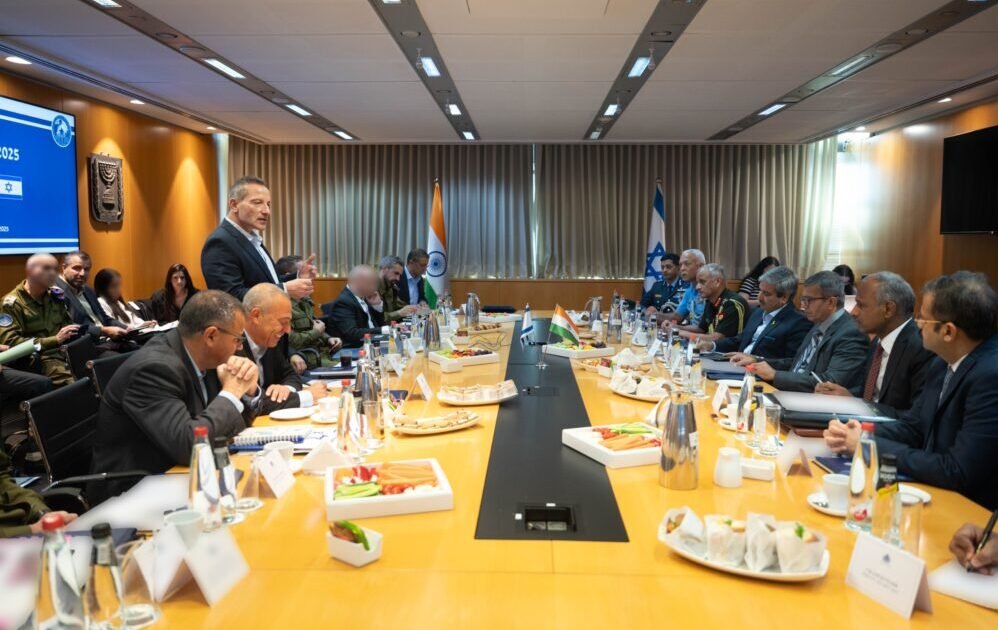
As Major General (Res.) Amir Baram, Director General of the Israel Ministry of Defence (IMOD), notes, “What Israel and India have built together goes beyond a series of transactions; it is a relationship rooted in trust, sustained through regular dialogue at the highest levels. Our two Ministries meet regularly through Joint Working Group sessions and high-level visits between Tel Aviv and New Delhi to keep pace with a partnership that continues to deepen.”
The Israel-India relationship has evolved from a basic transactional arrangement into a deep, structural alliance centered around joint technology creation, high-level strategic alignment and regular high-level ministerial reviews
This institutionalised proximity has allowed the two nations to transition away from intermittent defence contracts toward a continuous, integrated defence architecture. The framework is no longer merely about balancing trade deficits or securing supply lines. Instead, it focuses on fusing Israel’s unparalleled iterative engineering culture with India’s immense manufacturing scale, software prowess and diverse operational testing environments.
DRISHTI 2.0: Institutionalising the Innovation Bridge
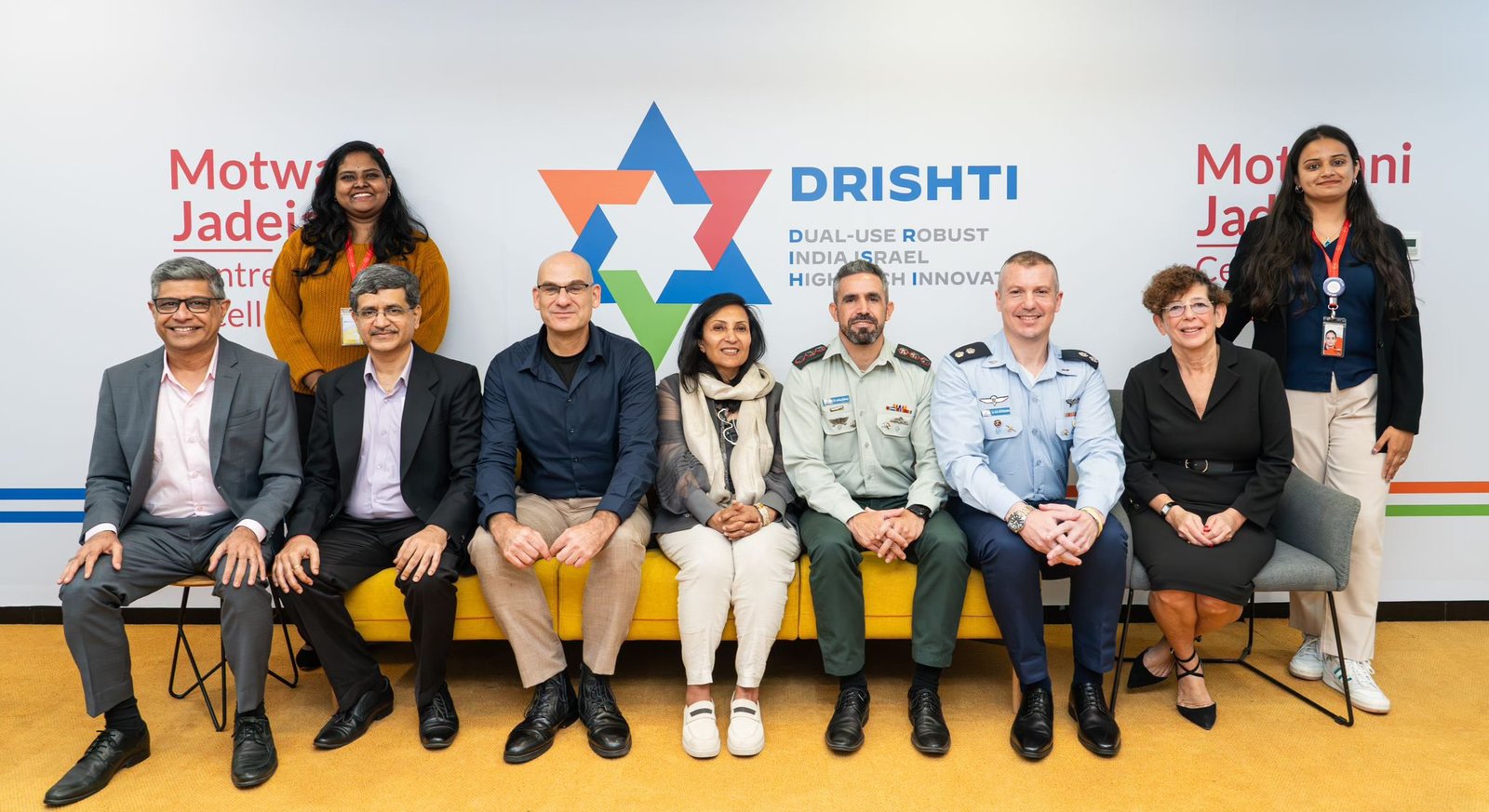
The launch of DRISHTI 2.0 – executed by the IMOD’s Directorate of Defence Research & Development (DDR&D) in partnership with T-Hub in Hyderabad – is the operational manifestation of this structural evolution. The original DRISHTI framework, an acronym for Dual-use Robust India-Israel High-Tech Innovation, focused on lowering the barriers of entry for early-stage startups working on technologies applicable to both commercial and defence sectors.
DRISHTI 2.0 dramatically scales this ambition. By introducing specialised frameworks like DRISHTI VIP, the programme targets mature, mid-tier Israeli defence-tech and deep-tech enterprises that possess market-ready solutions.

Through curated Indian roadshows, targeted business-to-business matchmaking, and structural regulatory navigation, DRISHTI 2.0 creates an express highway for integrating advanced foreign technology directly into the Indian industrial fabric.
Crucially, this architecture leverages T-Hub’s status as the world’s largest innovation accelerator. By utilising a civilian innovation engine to anchor a bilateral defence-tech pipeline, both governments are acknowledging a fundamental reality of modern conflict: the breakthroughs reshaping the battlefield are increasingly originating in the civilian deep-tech ecosystem.

Managed by the Israel Ministry of Defence’s DDR&D and T-Hub, this new phase introduces the DRISHTI VIP track to rapidly bring mature, combat-ready Israeli deep-tech solutions into the Indian industrial sector
From the Tactical to the Frontier: Reshaping Modern Warfare
The technological scope of this partnership reflects the shifting character of global conflict. The historical bedrock of the collaboration remains highly visible: air and missile defence systems, such as the long-range surface-to-air missile co-developed by India’s DRDO and Israel Aerospace Industries, alongside widely deployed unmanned aerial vehicles. Yet, the current frontier is defined by software-defined warfare, electronic spectrum dominance and autonomous systems.
Recent bilateral engagements clearly highlight this strategic shift, particularly across three key pillars. First, within the Counter-Drone Architecture, joint seminars and workshops have focused intensely on resolving the asymmetric threats posed by low-cost loitering munitions and small unmanned aerial systems (sUAS). The core objective here is to pair Israeli combat-proven kinetic and electronic interception mechanisms directly with Indian artificial intelligence layer protocols.
Second, the domain of Quantum and Autonomy has taken centre stage. At high-profile forums like the Bengaluru Tech Summit, the Israel Ministry of Defence’s Directorate of Defence Research & Development (IMOD DDR&D) has systematically showcased active breakthroughs in quantum computing, edge-computing AI, and swarm autonomy. Rather than abstract future concepts, these are highly practical, emerging frameworks engineered to be integrated directly into legacy military hardware.
While historical cooperation focused heavily on heavy missile defence and standard aviation platforms, the current focus centers on critical domains like counter-drone networks, quantum computing and autonomous swarm systems
Third, the creation of The Critical and Emerging Tech Track establishes dedicated bureaucratic structures specifically designed to handle technologies that fall outside standard defence procurement rules. This specialised pathway ensures that rapid developments in biotechnology, secure communications and advanced materials do not get bottlenecked by traditional, slow-moving defence acquisition cycles.
By focusing on these fields, the alliance ensures that India’s homeland security, border protection and active defence capabilities are augmented by tech that has been relentlessly refined against complex, real-world counter-terrorism and asymmetric challenges.
The Dual Engines of Defence Diplomacy
For Israel, the optimisation of this partnership aligns with a clear domestic and foreign policy calculus. Expanding defence exports acts as an essential engine for the Israel Defence Forces’ (IDF) internal force build-up. The revenue, data and industrial scale generated by deep international partnerships directly subsidise the domestic research and development cycles required to keep the IDF at the absolute cutting edge.
Concurrently, it serves as a potent diplomatic vector. In an era where middle powers are seeking strategic autonomy, Israel’s willingness to share core intellectual property and engage in true technological co-development makes it an invaluable partner for emerging global heavyweights. As Major General Baram states, “Growing Israel’s defence exports is a cornerstone of the Ministry’s strategy, both as an engine of the IDF’s force build-up and of Israeli industry, and as a tool that strengthens our standing on the world stage. India, with its scale and diverse operational needs, is central to our eastward expansion.”
For Israel, the alliance supports its critical eastward expansion and helps fund the IDF’s force build-up. For India, it provides a direct path toward self-reliance by shifting the focus from importing systems to creating joint intellectual property
For India, the collaboration is a powerful accelerant for its Aatmanirbhar Bharat initiative. Rather than fostering an environment of perpetual technological dependency, the industry-to-industry ties cultivated by the DRISHTI programmes ensure that Indian engineers, manufacturers, and software developers are working side-by-side with their Israeli counterparts. This deep operational integration transfers institutional knowledge and engineering methodologies down to the people actually building the technologies.
Ultimately, these tracks converge into a powerful B2B Ecosystem and Co-Development Paradigm. This framework acts as a direct bridge, seamlessly blending the Israeli Deep-Tech Ecosystem – defined by its combat-proven technologies and rapid, iterative engineering culture – with the Indian Industrial Ecosystem, which contributes world-class software competence, massive manufacturing scale and diverse operational testing environments. By funneling these parallel strengths into the DRISHTI 2.0 / T-Hub accelerator node, the partnership effectively translates raw innovation into rapid commercialisation and shared, joint intellectual property creation.
An Anchor for Regional Stability
The true measure of the contemporary India-Israel alignment lies in its long-term, structural resilience. By embedding the bilateral architecture within private industries, academic research labs and technology accelerators, both nations have insulated their strategic relationship from shifting political currents.
Ultimately, the transformation of the India-Israel defence dynamic from a buyer-seller relationship to a co-development powerhouse reflects the broader narrative of India’s milestone decade. Initiatives like DRISHTI 2.0 prove that India is no longer merely participating in the global tech and security ecosystems – it is actively shaping them
India’s ascent to a recognised global power is structurally supported by a network of deep, high-trust security partnerships. In this network, Israel occupies a unique position. It offers not just hardware, but a shared philosophy of survival, innovation and strategic self-reliance. As the boundaries between technology and national sovereignty continue to blur, the bridge built between Tel Aviv and New Delhi stands out as a highly sophisticated model for international defence collaboration in the twenty-first century.
Ultimately, the transformation of the India-Israel defence dynamic from a buyer-seller relationship to a co-development powerhouse reflects the broader narrative of India’s milestone decade. Initiatives like DRISHTI 2.0 prove that India is no longer merely participating in the global tech and security ecosystems – it is actively shaping them. As the decade of transition solidifies into an era of permanent global influence, this high-tech bilateral blueprint stands as definitive proof that India has arrived as a true, self-reliant global power. On this historic day, we celebrate the unbreakable bond between our two ancient civilisations, marching forward into a future of shared prosperity and mutual strength – Chaverut Emet v’Shutafut Eitanah (True Friendship and an Enduring Partnership).






