


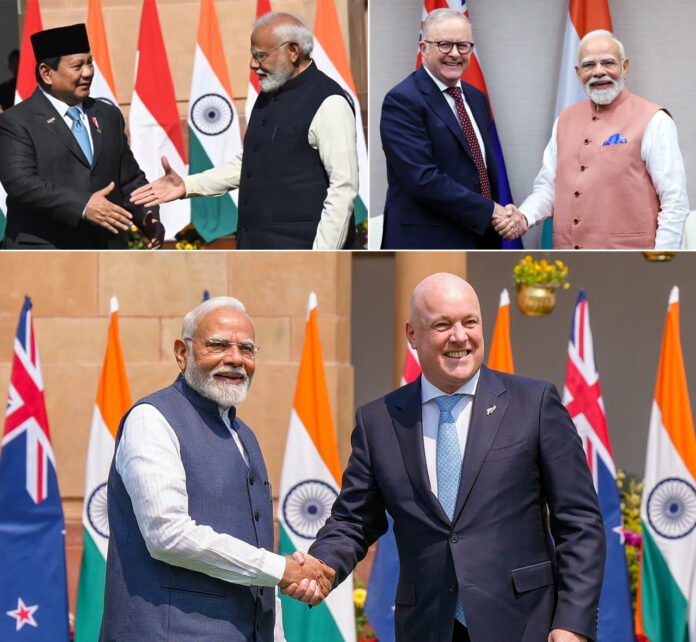
Prime Minister Narendra Modi’s visits to Indonesia, Australia and New Zealand are best understood not as three separate bilateral engagements but as a carefully sequenced strategic mission across the Indo-Pacific. Coming immediately after the visits to Mauritius and Seychelles, the tour reflects a larger maritime design, stretching from the western Indian Ocean to the Pacific. Taken together, these visits signal that India increasingly views the Indo-Pacific as a single integrated strategic theatre where maritime security, resilient supply chains, critical minerals and trusted partnerships will shape the balance of power in the decades ahead.
The strategic significance of the tour lies in its geography. India’s recent engagements with Mauritius and Seychelles strengthened its presence in the western Indian Ocean. The present tour shifts the focus to the eastern maritime zones of the Indian Ocean and beyond, reinforcing the Act East Policy and operationalising the MAHASAGAR (Mutual and Holistic Advancement for Security and Growth Across Regions) vision. Rather than responding to any single geopolitical development, India is steadily constructing a network of partnerships that advances security, economic resilience and strategic autonomy across the Indo-Pacific.

Australia constitutes the second pillar of India’s Indo-Pacific strategy. Regular summit-level dialogue and expanding defence cooperation have transformed Australia into one of India’s closest strategic partners. Both countries also work closely through the Quad, although the relationship today is increasingly driven by its own bilateral momentum
Indonesia naturally forms the first pillar of this strategy. Its location astride the Strait of Malacca makes it indispensable to India’s maritime interests. The Strait remains one of the world’s busiest sea lanes of communication, carrying a substantial share of global trade and energy flows between the Indian and Pacific Oceans. For India, whose economic growth depends heavily upon secure maritime commerce, cooperation with Indonesia is, therefore, a strategic necessity rather than merely a diplomatic choice.
The Comprehensive Strategic Partnership established during Prime Minister Modi’s 2018 visit has emerged as an important pillar of India’s Act East Policy. Maritime cooperation, defence collaboration, trade, connectivity and people-to-people exchanges have steadily expanded. India’s engagement around Sabang, located near the entrance to the Malacca Strait, has further strengthened maritime domain awareness and cooperation against piracy and other non-traditional security threats. Indonesia’s role within ASEAN also makes it an important partner in supporting a stable and rules-based regional order.
Economic considerations are equally compelling. Indonesia is India’s largest trading partner within ASEAN and one of the world’s leading producers of nickel, a mineral critical for electric vehicle batteries and clean energy technologies. As countries diversify supply chains and reduce excessive dependence on single sources, cooperation in critical minerals has acquired strategic importance. Joint initiatives in downstream processing, value addition and resilient supply chains can contribute significantly to India’s long-term industrial and energy security.
Indonesia anchors India’s engagement with ASEAN and the Strait of Malacca. Australia strengthens cooperation in critical minerals, technology, maritime security and resilient supply chains. New Zealand extends India’s diplomatic and economic engagement into the Pacific. Together, they represent pillars of India’s Indo-Pacific architecture
Defence cooperation is also expected to receive considerable attention. Discussions relating to the proposed export of the BrahMos supersonic cruise missile represent more than a commercial transaction. If concluded, the agreement would mark another milestone in India’s emergence as a credible defence exporter while strengthening maritime deterrence and strategic trust with one of Southeast Asia’s most important maritime powers.

Australia constitutes the second pillar of this Indo-Pacific strategy. Since the elevation of bilateral ties to a Comprehensive Strategic Partnership in 2020, cooperation has expanded well beyond traditional diplomacy. Critical minerals, cybersecurity, emerging technologies, resilient supply chains, education and maritime security now define the relationship. Regular summit-level dialogue and expanding defence cooperation have transformed Australia into one of India’s closest strategic partners. Both countries also work closely through the Quad, although the relationship today is increasingly driven by its own bilateral momentum.
New Zealand completes India’s outreach into the wider Pacific. The visit is historically significant as the first by an Indian Prime Minister in four decades. More importantly, it reflects the rapid expansion of bilateral ties following Prime Minister Christopher Luxon’s visit to India and the growing importance both countries attach to the Pacific region. Cooperation in trade, education, technology, agriculture, maritime governance and people-to-people exchanges provides a broader foundation for a partnership that is steadily acquiring greater strategic relevance.

The challenge now lies in implementing the strategy. High-level visits generate political momentum, but their success depends on the execution of agreements, stronger trade and investment, deeper maritime cooperation, greater collaboration in critical minerals and emerging technologies, and sustained institutional dialogue. Strategic convergence must increasingly translate into measurable outcomes
Viewed collectively, these three relationships demonstrate that India’s Indo-Pacific policy is based neither on alliance politics nor on containment. Instead, New Delhi is pursuing a network of issue-based partnerships in which each country contributes distinct strategic strengths. Indonesia anchors India’s engagement with ASEAN and the Strait of Malacca. Australia strengthens cooperation in critical minerals, technology, maritime security and resilient supply chains. New Zealand extends India’s diplomatic and economic engagement into the Pacific. Together, they represent complementary pillars of India’s Indo-Pacific architecture.
The challenge now lies in implementation. High-level visits generate political momentum, but their success ultimately depends on timely execution of agreements, stronger trade and investment, deeper maritime cooperation, greater collaboration in critical minerals and emerging technologies, and sustained institutional dialogue. Strategic convergence must increasingly translate into measurable outcomes.
For India, the larger message is clear. The Indo-Pacific is no longer simply a geographical construct; it is the principal arena where economic security, maritime stability and strategic influence converge. By linking the western Indian Ocean with Southeast Asia, Australia and the Pacific through sustained diplomatic engagement, India is gradually constructing a coherent maritime strategy rooted in partnerships rather than blocs. If pursued with consistency, this approach will strengthen India’s strategic autonomy while reinforcing its position as a leading Indo-Pacific power committed to a free, open, inclusive and rules-based regional order.

The writer commanded 15 Punjab in Lebanon under United Nations Flag, commanded 27 Sector as DIG in Churachandpur and was Brigadier Operational Logistics in HQ Western Command. He is currently an analyst on geopolitics, international and defence affairs. The views expressed are personal and do not necessarily carry the views of Raksha Anirveda





