


International relations have been instrumental in great power rivalries. Throughout history, several contests among a multitude of formidable state actors have generated consequential outcomes for the world order. In the third decade of the 21st century, this canvas of great powers has widened, particularly in Asia.
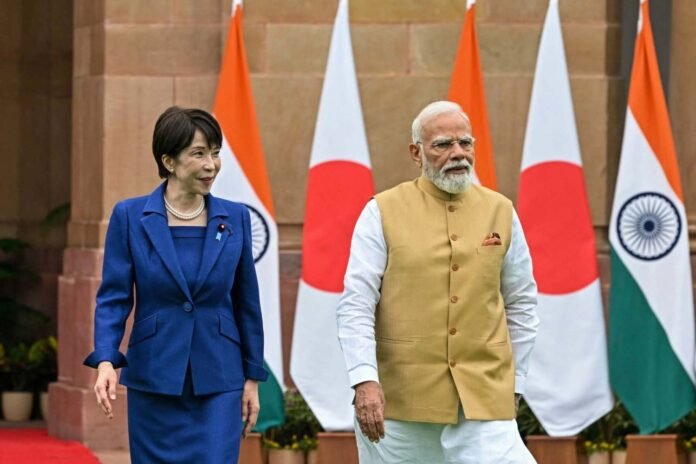
The recently concluded visit of the Japanese premier Sanae Takaichi must be viewed through that lens. Determined to deepen Indo-Japanese cooperation, the visit came at a critical time in Asian geopolitics: the increasing discord between the United States and its Asian allies on one hand and the growing friction with China on the other. The visit’s agenda was not only to solidify cooperation between both countries in the economic realm but also to strengthen the strategic nature of the partnership across several domains that have assumed salience in recent years — defence, infrastructure, tourism, among others.

The visit, therefore, underscores the need for a deeper analysis from the perspective of what it means for the stakeholders involved.
A key issue is Washington’s ambivalent attitude in the Indo-Pacific region. The renaming of the American Indo-Pacific naval command to Asia-Pacific Command is symptomatic of its growing neglect of the Indo-Pacific consensus
De-Risking the Partnership from American Policy Blunders
Under the Trump administration, America’s approach towards its allies, particularly those in Asia, has been marked by a combination of threats, blusters, and pure transactional politics. This combination, manifesting itself in economically coercive measures like the imposition of punitive tariffs, refusal to guarantee the safety of allies, and unnecessary meddling in matters that essentially are the internal issues of countries like the persistent attempts to argue that it ‘successfully mediated’ between India and Pakistan during Operation Sindoor that stopped hostilities has become the cause for a lot of discomfiture for the Asian allies of the United States.
A key issue is the increasingly ambivalent attitude of the United States in the Indo-Pacific region. The renaming of the American Indo-Pacific naval command to Asia-Pacific Command is increasingly symptomatic of Washington’s growing neglect of the Indo-Pacific consensus. In order to reduce their dependence on America’s mercurial leadership, India and Japan have reaffirmed their commitment to keeping the strategic Indo-Pacific region ‘free and open’. This signals the strategic alignment of India’s new MAHASAGAR vision and Japan’s Free and Open Indo-Pacific (FOIP) Initiative. The aim is clear — to de-risk the Asian naval architecture of the like-minded states in the Quad and its extended sphere from Washington’s foreign policy flip-flops.
Reconfiguring Geopolitical Calculations in Asia
If hydrocarbon energy sources like oil were the epitome of power in the 19th and 20th centuries, critical minerals are the new currency of power in the 21st century. Not only is it necessary for the sustenance of key sectors of an economy, but the possession of large reserves of such minerals, coupled with the ability to refine and process them into durable finished products, is also the new marker of national power. In this context, China has a formidable presence. Beijing has huge reserves of critical minerals such as gallium and graphite, and it controls 40% to 90% of the refining and processing capacities of lithium, cobalt, and nickel.

China has huge reserves of critical minerals. Knowing China’s ability to strategically weaponise such resources to arm-twist other states into kowtowing before it, both countries have deepened their cooperation in this area
Knowing China’s ability to strategically weaponise such resources to arm-twist other states into kowtowing before it, both countries have deepened their cooperation in this area. This finds its outcome through the signing of a joint declaration by both countries to develop a sustainable roadmap to ensure the uninterrupted supply of raw materials and minerals that are vital for the maintenance of industrial production.
In addition, both have been actively trying to explore the maritime domain to strengthen their supply chains; this is evident from India’s Ministry of Mines and Japan’s Ministry of Economy, Technology, and Industry forging an agreement that is aimed at promoting joint exploration, deep-sea mining, and stockpiling such findings. This underscores that maritime zones such as the Indian Ocean Region (IOR) and the Sea of Japan are acquiring increasing salience in the strategic matrix of both countries. An important lesson from this is that emphasis on keeping the Indo-Pacific region open is directed towards China, which has come to adopt a strategically assertive posture in the region.

Further, this visit signals that both countries may forge a joint front in another key area of the maritime region, the South China Sea. The maritime body can be said to lie at the heart of the Indo-Pacific region, through which $3 trillion of annual trade passes. In addition, the water body has humungous untapped reserves of oil and natural gas and hosts one of the world’s most lucrative fishing grounds. To make matters all the more serious, more than 30% of global oil and natural gas passes through this strategic waterway. Hence, a strong maritime consensus on promoting a ‘free and inclusive Indo-Pacific’ agenda, which champions the ‘freedom of navigation’ narrative by India and Japan in collaboration with other allies in East and South-East Asia, is essential given that Beijing claims sovereignty over 90% of the strategic maritime region based on its questionable ‘nine-dash line’ claims.
The Japanese Prime Minister’s visit serves as a strategic signal that both countries are working to reorient the architecture of great power politics in Asia towards a more certain, predictable, and stable order
The Salience of Oil Still Remains
The Iran-US-Israel war in the Middle East exposed how, despite renewable energy becoming the focus of global energy architecture, hydrocarbon sources continue to occupy a consequential place in the global energy matrix. In order to reduce the likelihood of future energy disruptions upending their economies, India and Japan signed pacts on strategic stockpiles and reserve mechanisms. The Clean Ammonia Project in the Indian state of Odisha being built with Japanese investment, and the Cooperative Bio Gas initiative signed by both highlights the fact that both are determined to not only shield their respective populations from such energy uncertainties but also double down on green energy projects to accelerate the transition to a cleaner and more sustainable tomorrow and strategically wean their dependence off fossil fuels.
The Japanese Prime Minister’s visit to India, therefore, serves as a strategic signal that both countries are working to reorient the architecture of great power politics in Asia towards a more certain, predictable, and stable order. In this situation, multipolarity and the development of institutional bulwarks against intensifying Chinese assertiveness and American uncertainties are assuming significance, thereby highlighting how earnest attempts are underway to stabilise the geopolitical order in Asia.

The writer is a doctoral candidate in Political Science at Mahatma Gandhi Central University. The views expressed are personal and do not necessarily reflect the views of Raksha Anirveda





