


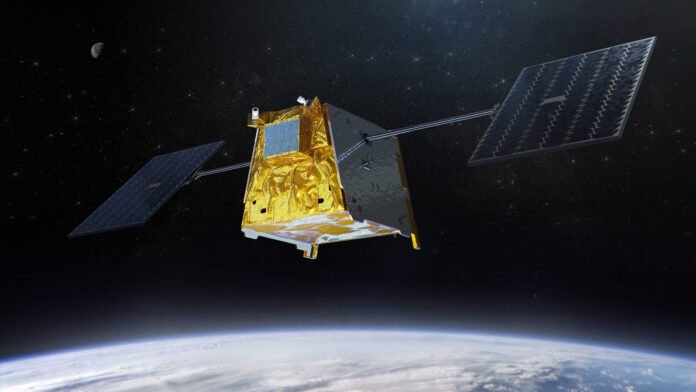
Toulouse, France. Airbus UpNext, a wholly-owned subsidiary of Airbus, has launched a new demonstrator called Airbus UpNext SpaceRAN (Space Radio Access Network). Its mission is to enable standardised global connectivity by exploring advanced 5G Non-Terrestrial Network (NTN) capabilities.
Airbus is committed to providing customers with a secure and cost-effective way to stay connected in an increasingly digitised world. This demonstrator aims to explore the 5G NTN, a versatile connectivity technology compatible with all types of business applications. Whether for commercial, defence or governmental use, it will confirm the feasibility of providing universal connectivity that is standardised, interoperable, and globally available.

Airbus UpNext SpaceRAN will leverage Airbus’ software-defined satellite1 capabilities to manage and optimise 5G signals in orbit. By processing data directly in space rather than simply relaying it, the demonstrator2 will prove that we can reduce latency, maximise data throughput, and enable more efficient network management and routing, opening the door to user to user direct connectivity.
“The successful exploration of this technology will unlock advantages across various sectors. For commercial aviation, it holds the potential to boost operational efficiency and simplify interoperability, all while enabling enhanced passenger experiences,” says Michael Augello, CEO of Airbus UpNext. “Similarly, for the military and government sectors, it aims to provide more resilient and secure communications, supporting improved situational awareness and accelerating real-time decision-making.”
To bring this initiative to life, Airbus has assembled a consortium of partners, including Aalyria, AccelerComm, CesiumAstro, Deutsche Telekom, Eutelsat, the Industrial Technology Research Institute (ITRI), Keysight Technologies, Onati, Radisys, Sener and ST Engineering iDirect.
Developed as part of Air!5G, a project supported by the French government through the France 2030 investment plan under the Future Networks strategy, this demonstrator is expected to show its first results by 2028. It will be key to preparing the next generation of wireless technology (6G) and eventually driving down the cost of orbital data transmission.







