


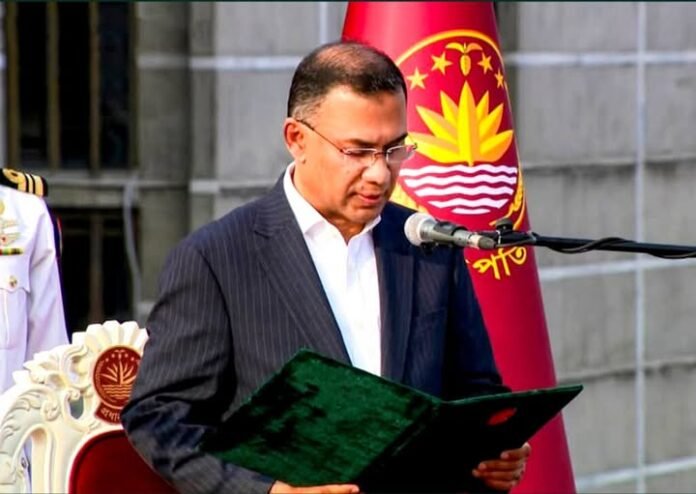
His comeback was rapturous, resulting in the Bangladesh National Party (BNP) winning two-thirds of the seats in the Jatiya Sansad (National Parliament) in the national election of the country.
The victory of the BNP has set off geopolitical calculations among the major actors of the South Asian region, particularly heavyweights like India and Pakistan. In this context, it becomes essential for New Delhi to keep in mind various factors while dealing with this new regime.

Keeping in mind the BNP’s past track record, it becomes essential for India to view the new regime with a pinch of salt, notwithstanding the ‘Bangladesh first’ foreign policy of Tarique Rahman’s government; the possibility of Bangladesh once again descending into an anti-India front cannot be underestimated
Past Track Record
Stability in Bangladesh, with which India shares a gargantuan 4,096 km long border, has always been a matter of considerable concern for India. This concern played a role in ensuring that regimes in Bangladesh remain friendly to India, particularly in dealing with radical anti-India elements. This concern for stability experienced considerable stress under Khaleda Zia’s government of 2001-2006, when the Jamaat-e-Islami was an alliance partner.
At that time, Bangladesh not only became a hotbed of anti-India activities but also became a breeding ground for Islamic extremism, sponsored by the deep state of Pakistan. To make matters worse, conflicts over water sharing and immigration, particularly in the sensitive border districts of West Bengal, assumed centrality.
Hence, keeping in mind the past track record of BNP, it becomes essential for New Delhi to view the new regime with a pinch of salt, notwithstanding the ‘Bangladesh first’ foreign policy of Tarique Rahman’s government; the possibility of Bangladesh once again descending into an anti-India front cannot be underestimated.
Safety of Minorities
The security concerns of India assume importance in the context of the security and development of the minority communities in Bangladesh, whose civilisational roots lie in India. During the time of the interim government of Mohammed Yunus, minority communities, particularly the Hindu community, suffered considerably. Lynchings, pillage, murder, bodily violations of women became a more or less daily spectacle.

India’s security concerns assume importance in the context of the security of the minority communities in Bangladesh, whose civilisational roots lie in India. During the time of the interim government of Mohammed Yunus, minority communities, particularly the Hindu community, suffered considerably
Despite New Delhi repeatedly expressing concerns over these issues, Bangladesh either turned a deaf ear or rejected such ‘appeals’. In that vein, despite the new government of Tarique Rahman assuming power, the safety and security of the already hapless minorities continue to linger.
Collusion with Pakistan
This brings us directly to the third and the most important concern — Dhaka’s growing closeness with its erstwhile ruler and tormentor, Pakistan. Over the past year, Dhaka has been intensifying engagement with Islamabad across multiple domains, from security to trade, from water to immigration. While on the surface, such engagement appears benign and routine, on a deeper analysis, it is anything but that.

This growing camaraderie with Pakistan is manifesting directly in the meteoric rise of the Jamaat-e-Islami. A radical Islamist organisation, the group historically was not only opposed to the Bangladesh independence movement waged by the liberation fighters led by Bangabandhu Sheikh Mujibur Rahman, but has also stood for renewing close ties with Islamabad.
The Jamaat has been pro-Pakistan and is also a part of a broader Pakistani strategic ploy to destabilise India, keeping the eastern sector of India’s security matrix on the perpetual boil. India must see it as a part of the plan of the Pakistani deep state, which it seeks to carry out via its acolyte, the Jamaat-e-Islami
The capture of more than sixty seats in the Bangladeshi election not only positions the organisation as the main opposition party, but makes it a potent force as far as the optics of street power politics in Bangladesh is concerned. Hence, Delhi must bear in mind the fact that the Jamaat has not only been historically pro-Pakistan but is also a part of a broader Pakistani strategic ploy to destabilise India’s stability, hence, keeping the eastern sector of India’s security matrix on the perpetual boil. India must see it as a part of the plan of the Pakistani deep state, which it seeks to carry out via its acolyte, the Jamaat-e-Islami.
Therefore, the mandarins of India’s foreign and security policy must develop a realist and pragmatic orientation when it comes to the new regime of Bangladesh and exercise cautious optimism.

The writer is a doctoral candidate in Political Science at Mahatma Gandhi Central University. The views expressed are personal and do not necessarily reflect the views of Raksha Anirveda





