


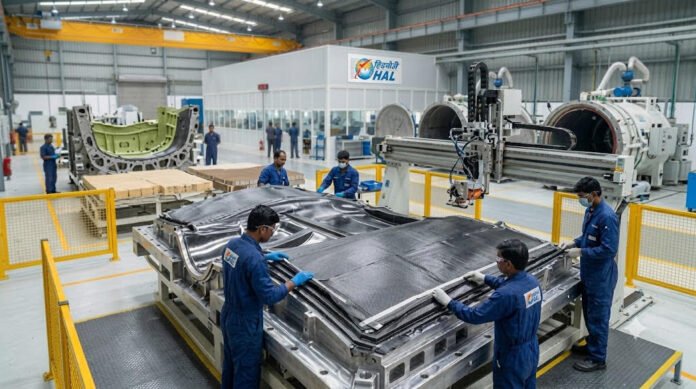
For decades, the Aerospace Composites Division (ACD) at Hindustan Aeronautics Limited’s (HAL) Bangalore Complex has been quietly fabricating the carbon-fibre skins, honeycomb panels and structural assemblies that go into nearly every Indian aircraft — the Tejas, the HTT-40, the Dhruv, the Dornier, the LCH and more. It is skilled work, done by skilled people. And precisely because of that, it is time to ask an uncomfortable question: does India still need HAL to do this work in-house at all?
The argument that ACD has become more burden than asset is no longer fringe. It follows directly from the path HAL’s own leadership has chosen.

HAL is Already Voting with its Feet
The clearest signal comes from the top. HAL’s former Chairman had openly described the outsourcing of complete Tejas Mk1A airframe and aerostructure manufacturing to private firms as an “invisible fourth production line” — a way to lift output toward 24–30 jets a year while HAL concentrates on final integration and systems assembly. For the Tejas Mk2, the composite-intensive windscreen and canopy are being handed to private companies with proven aerospace-composites experience. For later programmes, private firms are slated to deliver entire pre-equipped modules.
The entire rationale for the private-sector push is that outside firms can build airframe sections faster than HAL’s own lines. If private composites manufacturers are genuinely quicker and can scale, then every aerostructure ACD insists on building in-house is an aircraft delivered later to the Indian Air Force
Read that sequence honestly. HAL’s strategy is to push 70–80% of manufacturing out to private industry and reposition itself as a systems integrator that owns design, quality and delivery. If that is the destination, then a large, fixed-cost, in-house composites manufacturing division is not the future — it is the legacy being phased out one tender at a time. Keeping ACD at full scale while simultaneously paying private vendors to do the same work is the textbook definition of a redundant cost centre.
The Bottleneck Problem
The case for change is sharpened by HAL’s reputation for slow delivery. The company has faced sustained criticism — including from within the armed forces — that its traditional in-house production moves at a “snail’s pace.” The entire rationale for the private-sector push is that outside firms can build airframe sections faster than HAL’s own lines. If private composites manufacturers are genuinely quicker and can scale, then every aerostructure ACD insists on building in-house is an aircraft delivered later to the Indian Air Force. In a security environment where delivery timelines matter, a captive division that slows the queue is not a strategic asset. It is a liability wearing a strategic costume.
India absolutely needs sovereign composites capability. It does not follow that the capability must live inside HAL. A vibrant ecosystem of Indian private composites manufacturers — exactly what the Tejas outsourcing programme is building — delivers the same sovereignty with more capacity, more competition and lower cost
The Economics No Longer Favour Doing it Yourself
There is also a hard financial logic. HAL’s margin on the Tejas Mk1A was reportedly negotiated down from roughly 12% to 6%. With margins that thin, carrying the overhead of a full composites manufacturing division — plant, tooling, qualification infrastructure, and a large skilled workforce — is expensive. A private vendor can amortise that same capability across multiple customers, including civil aerospace and exports, in a way a captive government division never will. ACD builds only for HAL’s order book; a private composites specialist can chase Boeing, Airbus and Tier-1 supply chains. The unit economics will almost always favour the firm with the broader market.

“Strategic” is Not the Same as “In-house”
The strongest defence of ACD is that composites are too critical to outsource. But this conflates two different things. India absolutely needs sovereign composites capability. It does not follow that the capability must live inside HAL. A vibrant ecosystem of Indian private composites manufacturers — exactly what the Tejas outsourcing programme is building — delivers the same sovereignty with more capacity, more competition and lower cost. HAL can retain design authority, qualification standards and the most exotic, low-volume structures while letting the market handle the rest. That is what mature aerospace nations in the West already do: the integrator integrates, and a competitive supply base manufactures.
India’s private aerospace-composites base is still young and largely unproven at the volumes and quality levels combat aircraft demand; leaning on it too early risks the very delays critics blame HAL for. A captive division also guarantees surge capacity and security of supply that a commercial vendor — answerable to other customers — may not
What “Winding Down” Should Actually Mean
Pulling down ACD does not mean throwing away its people or its know-how — that would be its own kind of waste. It means a deliberate transition: shrink the manufacturing footprint as private vendors qualify, rather than running parallel capacity indefinitely; redeploy ACD’s expertise into design, R&D, materials qualification and oversight — the high-value functions a systems integrator must keep; and spin out or partner the production assets with private players rather than letting them sit underused. Done well, this turns a fixed cost into a national capability multiplier.

The Honest Counterpoint
In fairness, the opposite case is real and should not be dismissed. India’s private aerospace-composites base is still young and largely unproven at the volumes and quality levels combat aircraft demand; leaning on it too early risks the very delays critics blame HAL for. A captive division also guarantees surge capacity and security of supply that a commercial vendor — answerable to other customers — may not. And HAL does not publish division-level profit figures, so the claim that ACD is specifically loss-making is an inference, not a documented fact. Dismantle the in-house capability too fast and India could find itself dependent on a handful of private firms with their own bottlenecks.
The responsible version of this argument, then, is not “shut ACD tomorrow.” It is “stop pretending a full in-house composites division is HAL’s future, and manage its wind-down as deliberately as HAL is managing its outsourcing.” On current trajectory, that conversation is overdue.

-The writer is an award-winning science communicator and a Defence, Aerospace & Geopolitical Analyst. He is the Managing Director of ADD Engineering Components India Pvt. Ltd., a subsidiary of ADD Engineering GmbH, Germany. You can reach him at: girishlinganna@gmail.com. The views expressed are personal and do not necessarily carry the views of Raksha Anirveda





