


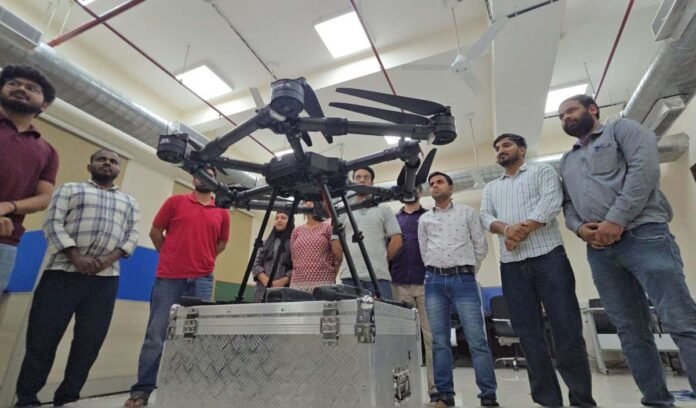
Jammu: High above rugged terrain, beyond the reach of the naked eye and most conventional sensors, a silent machine glides through the sky. It leaves no radio trace, emits barely a whisper, and follows its path with uncanny precision. This is not science fiction—it is the new stealth drone developed by Indian Institute of Technology Jammu, now poised to redefine how the Indian Army sees and fights on the modern battlefield.
The drone, is designed with a clear mission: to operate where others fail—deep inside contested zones, under hostile surveillance, and in environments where electronic warfare dominates.

How Does the Drone Stay Invisible to Radar?
The secret to its invisibility lies not in a single breakthrough, but in a combination of clever engineering choices. Traditional drones rely heavily on radio frequency (RF) communication, which makes them easy targets for detection and jamming. This drone takes a radically different approach—it abandons conventional radio signals altogether.
Instead, it uses optical fibre-based communication, which does not emit detectable radio waves. Without an RF signature, enemy radar systems struggle to even “see” the drone.
Its physical design reinforces this stealth. The drone is built using carbon composites and plastic materials, which significantly reduce its radar cross-section. In simple terms, radar waves hitting the drone are not reflected back strongly enough to reveal its presence.
Even its sound profile has been minimised. Low-noise propellers ensure that it remains acoustically stealthy, making detection difficult not just electronically, but also physically.

The result is a drone that operates like a ghost—present, active, but nearly impossible to detect.
Can This Drone Fly Without Using a GPS Signal?
Yes, and this is one of its most critical advantages.

Modern drones are heavily dependent on GPS for navigation, making them vulnerable to GPS jamming or spoofing, common tactics in electronic warfare. But this drone has been designed to function even in GPS-denied environments.
It uses vision-based artificial intelligence and pre-programmed navigation systems to guide its flight.
In practical terms, this means the drone can “see” its surroundings, interpret terrain, and follow a predetermined path without relying on satellite signals. Even if an adversary disrupts GPS signals, the drone continues its mission unaffected.
This capability is especially valuable in conflict zones where GPS interference is routine. It ensures that the drone remains reliable when it is needed most—behind enemy lines or in high-risk areas.
More Than Surveillance: A Combat Multiplier
The drone is not just a passive observer. It has been designed as a multi-role platform capable of carrying an additional interceptor drone.
This means it can detect, track, and even neutralise enemy drones’ mid-air. In an era where drone warfare is rapidly expanding, this feature transforms it from a surveillance tool into an active combat asset.
Operating at high altitudes, often beyond visual range, it becomes a strategic eye in the sky—feeding real-time intelligence while remaining undetected.
When Will the Indian Army Start Using These Drones?
While an exact deployment date has not been officially announced, developments suggest that induction may not be far off.
According to reports, demand within the Indian Army has surged, and both procurement processes and operator training are being fast-tracked.
Given the urgency driven by recent conflicts and evolving threats, initial deployments could begin soon after final testing and validation phases are completed. The Army’s growing reliance on unmanned systems indicates that such indigenous platforms will likely be integrated in the near term rather than years down the line.
Why This Drone Matters
The emergence of this drone reflects a larger shift in military strategy. Warfare is no longer defined solely by tanks and fighter jets—it is increasingly shaped by information dominance, stealth, and autonomy.
A drone that cannot be jammed or detected offers a decisive edge. It allows forces to gather intelligence, monitor enemy movements, and conduct operations without exposing personnel to risk.
It also signals a broader move toward self-reliance in defence technology. By developing such systems domestically, India reduces dependence on foreign suppliers while tailoring solutions to its unique operational challenges.
The Future of Invisible Warfare
As this drone prepares for eventual deployment, it represents more than a technological innovation—it embodies a new philosophy of warfare. One where invisibility is power, silence is strength, and autonomy is survival.
Somewhere in the near future, when these drones take to the skies in operational roles, they may not be seen or heard. But their impact will be unmistakable.
Because in modern warfare, the most dangerous weapon is often the one you never knew was there.






