


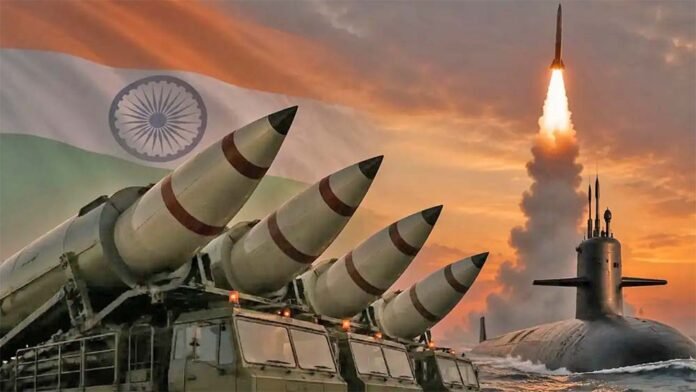
For the first time ever, India has kept some of its nuclear weapons in a “deployed” condition. This important news comes from SIPRI, a well-known research institute based in Sweden that keeps a close watch on weapons, wars, and arms control across the world. In its latest Yearbook released on Monday, June 08, SIPRI revealed that India deployed 12 nuclear warheads in 2025, while China increased its deployed warheads from 24 to 34.
Now, what does “deployed” actually mean? Let us understand this in a simple way. Think of a nuclear warhead as the explosive part of a nuclear weapon. Countries keep these warheads in two ways. First, in storage — like keeping a sword inside a locked cupboard. The weapon is safe, but it will take time to take it out and prepare it. Second, deployed — like keeping the sword close at hand, ready when needed. Deployed warheads are already fitted on missiles, aircraft, or submarines, and can be used immediately or almost immediately when ordered.

One thing must be made clear here. “Deployed” does not mean India’s weapons are on hair-trigger alert like those of Russia and America, where missiles can be fired within minutes of an order. India’s shift is a modest one — most likely a small number of warheads kept ready on systems such as its nuclear submarines. The vast majority of India’s warheads still remain safely in storage, just as before. So this is a careful step, not a dramatic change in India’s overall approach.
India has what experts call a “nuclear triad” — the ability to launch nuclear weapons from land, air, and sea. From the sea, India has its Arihant-class nuclear submarines. From the air, fighter jets like the Mirage 2000 and Jaguar can carry these weapons, and possibly the Rafale and Su-30MKI too. On land, India has missile systems like the Agni, Prithvi, Nirbhay, and BRAHMOS series
Till now, India had always kept all its nuclear warheads in storage, separate from missiles and aircraft. That was India’s long-standing practice. SIPRI’s new report marks the first time it has assessed that 12 of India’s warheads are now operationally deployed.
So how can India deliver these weapons if ever needed? India has what experts call a “nuclear triad” — the ability to launch nuclear weapons from land, air, and sea. From the sea, India has its Arihant-class nuclear submarines. From the air, fighter jets like the Mirage 2000 and Jaguar can carry these weapons, and possibly the Rafale and Su-30MKI too. On land, India has missile systems like the Agni, Prithvi, Nirbhay, and BRAHMOS series. This triad gives India multiple options and strengthens its deterrence.
The timing of this change is very important. Remember May 2025? India and Pakistan, both nuclear-armed neighbours, fought a short but tense four-day conflict. During those days, Pakistan tried to use its nuclear capability as a warning signal. But India did not back down and stood firm, showing confidence in its strategic strength. SIPRI also noted that India struck some Pakistani air and missile bases during the conflict, some of which may have had links to nuclear operations. Thankfully, both countries acted with care and did not let the situation grow into a bigger war. Since SIPRI’s 2026 Yearbook is based on data from 2025 — the same year as this conflict — these findings carry extra weight.

Now let us look at the bigger global picture. According to SIPRI, nine countries possess nuclear weapons — the United States, Russia, the United Kingdom, France, China, India, Pakistan, North Korea, and Israel. As of January 2026, the world had around 12,187 nuclear warheads in total. About 9,745 of these were in military stockpiles, and around 4,012 were actually deployed on missiles and aircraft.
More countries are now depending on nuclear weapons to show their power and influence. SIPRI warned that recent events, especially the India-Pakistan conflict, have raised fresh questions about whether nuclear deterrence truly prevents wars, and cautioned that nuclear risks are rising worldwide
More worryingly, around 2,100 to 2,200 warheads are kept in a “high state of readiness” on ballistic missiles — these can be launched within minutes. Almost all of these belong to Russia and the United States. Russia has 1,796 deployed warheads and America has 1,770. France comes third with 280, followed by the United Kingdom with 120. SIPRI added that China and India may occasionally keep a small number of warheads mounted on missiles even during peacetime.

What about India’s total arsenal? SIPRI estimates India’s stockpile has grown to around 190 warheads, up from about 180 a year before. India is also focusing on long-range weapons that can reach targets across China, while Pakistan remains a key factor in India’s military planning. Pakistan itself has nearly 170 warheads and has not deployed any of them. However, SIPRI says Pakistan continued collecting fissile material — the special material needed to make nuclear bombs — in 2025, suggesting it may expand its arsenal over the coming decade. Israel is believed to have around 90 warheads, and North Korea roughly 50.
SIPRI’s overall message is a serious one. More countries are now depending on nuclear weapons to show their power and influence. The institute warned that recent events, especially the India-Pakistan conflict, have raised fresh questions about whether nuclear deterrence truly prevents wars, and cautioned that nuclear risks are rising worldwide.
In simple words, the world’s most dangerous weapons are inching closer to readiness, and India has taken its first careful step in that direction. It is a development that deserves everyone’s attention.

-The writer is an award-winning science communicator and a Defence, Aerospace & Geopolitical Analyst. He is the Managing Director of ADD Engineering Components India Pvt. Ltd., a subsidiary of ADD Engineering GmbH, Germany. You can reach him at: girishlinganna@gmail.com. The views expressed are personal and do not necessarily carry the views of Raksha Anirveda





