


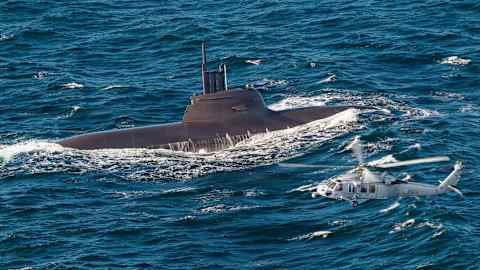
Victoria (British Columbia): A German shipbuilder has won the competition for the largest defence procurement in Canadian history, beating out a South Korean firm on the project to build 12 new submarines.
Canadian Prime Minister Mark Carney announced July 6 that TKMS has been selected as the winning bidder in the country’s project to acquire the new boats. The company offered Canada its Type 212CD submarine which is being built for both Germany and Norway.

Carney did not provide a dollar figure on the submarine project but noted the deal is expected to be the largest defence procurement in the country’s history. It is estimated that the entire project could cost as much as $70 billion ($100 billion Canadian) when long-term maintenance, new infrastructure, weapons and other factors are considered over the life of the boats.
Negotiations with TKMS will begin shortly with a contract expected to be in place by the end of the year. TKMS beat out a bid from Hanwha Ocean, which was offering its KSS-III submarine.
“This was a difficult, close decision between two highly qualified suppliers,” Carney said in making the announcement in Halifax, Nova Scotia. “Both the TKMS and the Hanwha platforms met the very high capabilities of the Royal Canadian Navy, and both of them put forward strong proposals to maximise benefits for Canadian workers and businesses.”
“These subs will strengthen our defence industrial base, they will deepen our partnerships with trusted allies, and they will open new opportunities for Canadian businesses in European supply chains,” he added.

The new submarines will replace the Royal Canadian Navy’s aging Victoria-class submarines. Government officials said the first submarine is expected in 2033 with three more hopefully being delivered in 2034.
“In the end, this decision was about choosing the absolute best platform and partnership to meet Canada’s combined strategic, security and economic interests,” Carney said.

Carney made the announcement the day before the NATO Summit is set to begin in Turkey. “These subs will strengthen our defence industrial base, they will deepen our partnerships with trusted allies, and they will open new opportunities for Canadian businesses in European supply chains,” Carney said.
Oliver Burkhard, CEO of TKMS, said in a statement that the company is ready to provide Canada with significant economic benefits. “We stand ready to work alongside the government of Canada, Canadian industry and our partners in Germany and Norway to deliver a world-class submarine capability that will strengthen security, create economic opportunity and generate lasting benefits for future generations,” Burkhard said.
Glenn Copeland, CEO of Hanwha Canada, said the company was disappointed with its loss but he noted that the competition showed Canada what South Korea can offer. “The team at Hanwha have demonstrated to the Canadian public and government that there is unlimited potential to unlock within the South Korean defence industrial base and that Hanwha and its business divisions will continue to grow aside from today’s decision,” Copeland said in a statement. “We look forward to continuing to demonstrate why Hanwha is the backbone of the world’s fourth-largest defence export nation.”
Hanwha mounted a significant economic and public relations push to convince Canada about the value of its boats. That included the Republic of Korea Navy sending one of its KSS-III submarines to Victoria, British Columbia, in May to show the long-range capabilities of the boat as well as to conduct joint operations with the Royal Canadian Navy.
The South Koreans were also promoting the procurement as a way for Canada to expand its relations in the Asia-Pacific region. Carney said that the loss for Hanwha does not signal a change in Canada’s commitment to the area. “We’re very committed to the Indo-Pacific strategy,” he said. “There are a series of other initiatives Canada and Korea are pursuing that build our economic resilience and security footprint.”
Stephen Fuhr, secretary of state for defence procurement, said at a news conference in Victoria on July 6 that the submarine competition was completed in record time. The whole process took less than a year. Fuhr said one of the main criticisms of Canada’s defence procurement process is that it is too lengthy. But he noted he intends to change that and speed up other future defence procurements.
The current fleet of Victoria-class submarines operated by the Royal Canadian Navy will be decommissioned in the mid-2030s, the Canadian government has noted.






