


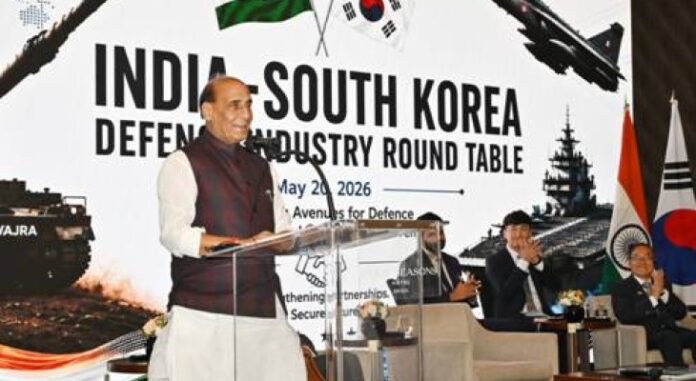
NEW DELHI. South Korea has formally announced plans to launch a “second wave” of strategic investments in India, pivoting heavily toward shipbuilding, defence manufacturing, and advanced industrial collaboration. The diplomatic and economic shift signals a strategic departure from Seoul’s historic investments in the subcontinent, moving beyond the automotive and consumer electronics focus that characterised its initial entry into the Indian market three decades ago.
Speaking on the development, South Korean Ambassador to India Lee Seong-ho detailed how changing geopolitical dynamics and volatile global supply chains are driving Seoul to anchor its long-term economic diversification strategies in New Delhi. By injecting capital and technical know-how into heavy industries, South Korea intends to expand cross-border trade exponentially while establishing a resilient manufacturing corridor in Asia.

Shifting Focus to Heavy Industry and Maritime Security
The initial era of South Korean investment in the 1990s established household brands like Hyundai, Samsung, and LG across India. However, the emerging investment paradigm looks fundamentally different. Driven by the “Make in India” vision, Seoul is leveraging its global leadership in shipbuilding and complex manufacturing to build co-production facilities on Indian soil.
This maritime push aligns with escalating concerns over international trade routes. Pointing to recent systemic disruptions in West Asia, Ambassador Lee highlighted how deeply interconnected the vulnerabilities of both nations are regarding energy security and maritime stability. Because both states remain fundamentally reliant on the same West Asian energy corridors, establishing localised, high-tech industrial capacity in India is viewed as a necessary buffer against global supply shocks.
Expanding the Defence Arsenal
Defence manufacturing stands out as a core pillar of this new wave. The bilateral defence partnership has already achieved commercial success through the K9 Vajra Howitzer programme, a localised artillery project tailored for the Indian Army. building on this momentum, negotiators from both capitals are already outlining a third phase of the K9 partnership alongside fresh initiatives.
According to diplomatic briefings, discussions are underway to co-develop and manufacture advanced air defence guns, missile defence units, and complex naval systems. The collaboration allows South Korea to counter its native domestic challenges – namely a rapidly aging workforce and territorial limitations – by utilising India’s massive engineering talent pool and industrial scale.

Driving the Digital Bridge
Beyond heavy machinery and weapons platforms, the capital influx is heavily integrated with the “India-Korea Digital Bridge” – a framework formalised during President Lee Jae-myung’s state visit to India earlier this year. The digital push focuses heavily on:
- Artificial Intelligence (AI): Joint software development, industrial automation, and cognitive defence systems.
- Critical Minerals: Deep-tech geological mapping and AI-driven exploration to secure the semiconductor and secondary battery supply chains.
- Telecommunications: Collaborative engineering on next-generation network hardware to reduce reliance on vulnerable hardware pipelines.
The structural economic push follows closely on the heels of a high-level diplomatic tour by Indian External Affairs Minister S Jaishankar, who met with South Korean Foreign Minister Cho Hyun in Seoul to review progress across trade, clean energy, and joint startups.

By upgrading their ties from traditional trading partners to structural economic dependencies, both democracies seek to stabilise a fragile international rules-based order. For South Korea, India represents an indispensable market and an ideological ally capable of representing the Global South; for India, the partnership guarantees an injection of specialised manufacturing expertise critical to achieving true industrial self-reliance.






