


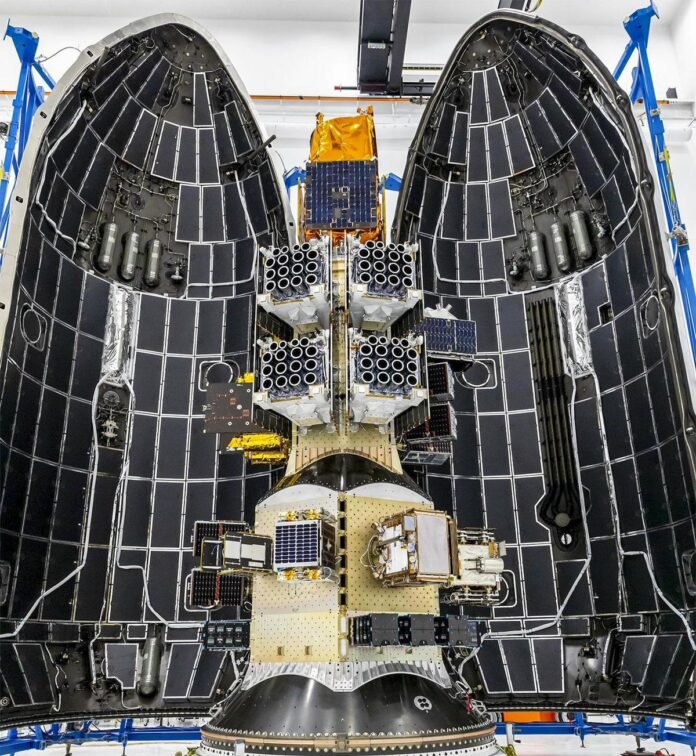
Bengaluru. In a major setback for India’s burgeoning private space sector, Bengaluru-based space-tech startup GalaxEye Space announced on Tuesday, July 7 that contact with its maiden satellite, Mission Drishti, has been severed. The 190 kg spacecraft encountered a critical system anomaly during the final stage of its Launch and Early Orbit Phase (LEOP), triggered by a severe space weather event.
Initial root-cause analysis by the company indicates that extreme radiation associated with a geomagnetic solar storm compromised an essential onboard system. Following the event, telemetry with the spacecraft became increasingly intermittent before breaking down completely. Although engineers are working to restore a connection, GalaxEye officially acknowledged that the likelihood of recovering the spacecraft is currently minimal.

A Pioneering Capability Grounded
Launched on May 3, 2026, aboard a SpaceX Falcon 9 rocket from the Vandenberg Space Force Base in California, Mission Drishti was heralded as a technological breakthrough. It was built as the world’s first “OptoSAR” satellite – a proprietary platform integrating both high-resolution multi-spectral optical cameras and all-weather Synthetic Aperture Radar (SAR) sensors into a single 2-in-1 system.
Conventional remote sensing satellites are frequently limited by lighting conditions and weather anomalies. By combining radar and optical technologies, Mission Drishti was designed to seamlessly peer through thick cloud cover, adverse weather, and total darkness. This hybrid intelligence was intended to provide uninterrupted, day-and-night imagery crucial for strategic surveillance, disaster management, infrastructure planning, and defence applications. The loss removes a vital emerging asset from India’s specialised Earth observation fleet.
Mission Accomplishments Despite the Anomaly
Despite the premature termination of its operational lifecycle, GalaxEye emphasised that the mission was far from a total failure. During its active multi-week operating phase post-launch, the spacecraft successfully completed the vast majority of its planned LEOP protocols.
The startup’s Mission Control Centre in Bengaluru validated critical in-house technologies. Mission Drishti effectively executed its structural deployments, precision attitude-control manoeuvres, and onboard computing tasks while maintaining a stable communication link prior to the solar storm. According to the company, these operational milestones successfully validated the end-to-end framework required to design, manufacture and command advanced Earth observation hardware.

Looking Ahead: Strategic Resilience
Founded in 2021 by a team of five Indian Institute of Technology Madras (IIT Madras) alumni, GalaxEye has raised approximately $20 million from prominent backers, including Infosys, Speciale Invest, and Zerodha’s Rainmatter. The company remains highly optimistic about its long-term constellation roadmap, despite the abrupt space weather disruption.
“While the satellite experienced an anomaly following an extreme space weather event, the mission has provided invaluable engineering insights that will directly strengthen our future missions,” stated Suyash Singh, Co-founder and CEO of GalaxEye Space.

Singh further explained that the setback has served as a catalyst to reshape the company’s manufacturing strategy. To protect future payloads against harsh space environments, GalaxEye is accelerating plans to migrate a significant portion of its supply chain, component manufacturing and structural development entirely in-house. This shift aims to grant the company total visibility and stringent quality control over its entire technological value chain.
Refusing to let the setback stall their momentum, GalaxEye announced that the engineering data harvested from Mission Drishti will be integrated directly into its next-generation spacecraft architecture.






