


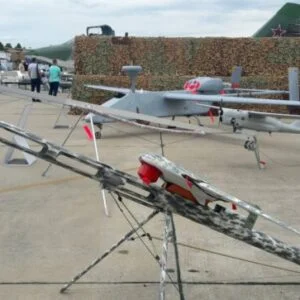
Tel Aviv: The Russians in Syria use a new type of UAV to monitor the movements of the Free Syrian Army and the Turkish Army in northern Syria. The Free Syrian Army fights against the Syrian regime and according to sources the number of its fighters has decreased dramatically. Free Syrian Army (FSA) was the fighting force of the opposition during Syrian civil war. This fighting group lost power mainly because the intervention of Russia that has helped the Syrian regime. Now under a new name the Syrian National Army (SNA), it has gained some combat capabilities.

According to the Syrian sources, the Russians are operating the latest UAV made from their ZALA 421-16E5G UAV. The new unique unmanned aerial system ZALA 421-16E5G is airdrome-free, equipped with a serial hybrid power plant that provides a guaranteed flight time of more than 12 hours. The unmanned system is designed for long-distance flights and is capable of providing aviation monitoring at a distance of more than 100 kilometres. The Russian side uses UAVs for reconnaissance and intelligence purposes to track the movements of the Syrian rebel factions and the Turkish army in Idlib province, in north-western Syria, and these send coordinates of targets located to Russian fighter jets working against them if necessary.
The ZALA 421-16E5G is equipped with a combined payload with an HD thermal imager and a 60x Full HD video camera. The video stream is broadcast in HD format, which allows the operator of the ground station to see the streaming image in the smallest detail. Optionally, the UAV can be equipped with a laser scanning module, a set of cameras for aerial photography, or other equipment that requires power on board. The computing power of the ZX1 on-board computer based on artificial intelligence makes it possible to process data in Full HD and transmit HD video and photos via encrypted communication channels to the ground control station, ensuring the effectiveness of monitoring even before the aircraft lands. The power plant is equipped with a buffer storage battery, which ensures the operation of the UAV in “electric” mode for an hour. A full recharge of the buffer battery in the air will take 2 hours.

-The writer is an Israel-based freelance journalist. The views expressed are of the writer and do not necessarily reflect the views of Raksha Anirveda





