


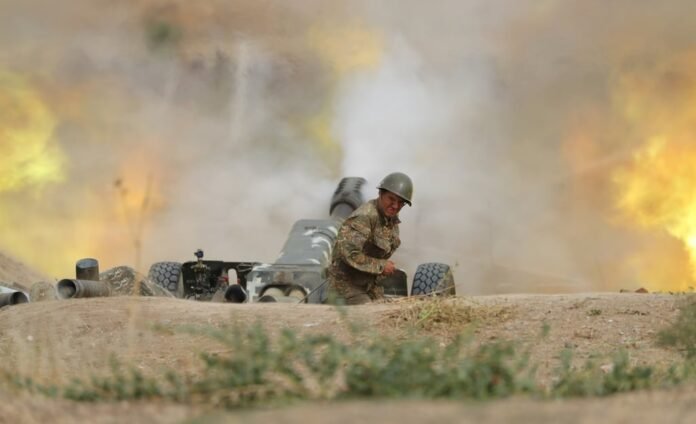
The Armenia-Azerbaijan conflict was the first to give the world an inkling of how future wars would emerge. Technology, including the effective use of rockets, drones and missiles, was witnessed for the first time. Armenia employed Russian missiles, rockets and EW systems, while Azerbaijan fired Israeli and Turkish weapon systems, including drones and loitering munitions. Since then, Armenia has procured Indian manufactured Pinaka missiles and Akash air defence systems.
The Ukraine conflict enhanced the role of technology on the battlefield. Drones accounted for 80% of strikes on both sides. Russia initially employed Iran’s Shahed drones, subsequently modified into its own version, Geran, while in Ukraine, drone manufacturing became a cottage industry, with dual-use parts being imported from across the world and drones assembled. Today, it is a battle of drones and missiles while ground operations have stalled.

The battlefield became transparent with proliferation of drones, AI-based analysis, and the availability of commercial satellite imagery. Surprise became difficult. Armoured and artillery weapon systems were targeted by drones embedded with AI, which hunted them and were subsequently modified for anti-jamming. Even foot soldiers found it difficult to avoid detection by drones. Once detected, escape was unlikely. Offensive operations and surprise elements will be difficult to achieve in any future conflict. Finding countermeasures to drones is the need of the hour.
The battlefield has become transparent with the proliferation of drones, AI-based analysis, and the availability of commercial satellite imagery. Launching offensive operations and achieving surprise elements have become difficult in a conflict. Finding countermeasures to drones is the need of the hour
Any defence system would be overwhelmed when drones and missiles are launched simultaneously, and Ukraine initially faced the brunt. It soon became clear that expending costly missiles against cheap drones was not the solution. It was compelled to develop its own countermeasures as war progressed and produced a multi-layered anti-drone weapon incorporating acoustic drone detection, which was fairly successful against Russian strikes. These have now been deployed with nations in the Middle East.
Until recently, robots were considered suitable only for resupply missions, casualty evacuation, surveillance, and mining and demining operations. Their roles are now increasing. In April this year, Ukraine employed for the first timet time unmanned ground vehicles and drones to enforce the surrender of a few Russian soldiers. The controller of these systems was safe at a distance, while the robots were armed with effective small arms. This was announced by the Ukrainian President Zelenskyy. The claim has not been verified, but it is a turning point in how conflicts could evolve. This may be a one-off incident, but as technology develops, robots could well begin replacing soldiers on the battlefield, at least in certain tasks.
Iran was able to breach Israel’s famed Iron Dome systems due to the use of cluster ammunition in missiles, despite Israel having prior warning. Most of the damage in Israel was caused by cluster ammunition. Incidentally, neither Israel nor Iran is a signatory to the UN Convention on cluster munitions
Ukraine also had to innovate to manage another critical shortage, which was a lack of manpower. Thus, the shift to robots. It is reported to possess a large robotic arsenal, which they claim to have utilised in thousands of missions in the first few months of this year. Ukrainian military mentions that there has been a shift from aerial weapons like drones to robots, basically because the skies have become saturated with drones. As war progresses, capabilities and ranges of drones continue to increase, while robots will dominate ground operations.

While Ukraine is a conflict between two neighbouring countries, the Iran war involves adversaries located at a distance, the US-Israel combine and Iran. It also has unequal adversaries, the US possessing overwhelming military power as well as the latest technology, while Iran fights an asymmetrical war for survival. It was evident that operations would be dominated by air and space power, while the possibility of deploying troops on the ground remains non-existent. Thus, the nature of technology employed in such a war will be different.
The conflict largely involved air power versus long-range vectors, with high accuracy, as well as the use of AI in other fields. Iran spread its missile and drone arsenal across the country in underground shelters to prevent destruction. Simultaneously, these had to move rapidly, deploy and fire before they were detected. It banked on Chinese satellites and other systems for information on US bases and their aerial assets. Iran’s missiles and drones were quite accurate, and the damage to US bases has been immense.

AI is utilised in the information warfare domain by rival sides. The US narrative appears to pale in front of Iran’s. The conflict displayed a new mix of AI, satire and narrative warfare in a major conflict. Recent conflicts also displayed innovative methods of employing smart technology, such as pager blasts
The use of cluster ammunition in its missiles enabled Iran to breach Israel’s famed Iron Dome systems, despite Israel having prior warning due to the distance involved. Most of the damage in Israel was caused by cluster ammunition. Incidentally, neither Israel nor Iran is a signatory to the UN Convention on cluster munitions.
While Israel faced missiles, nations in the Middle East targeted by Iran were largely hit by drones accompanied by slower and older missiles. The US and its Middle Eastern allies were compelled to employ Patriot systems worth millions of dollars to counter drones, which cost a fraction of that amount.
AI is also utilised in the information warfare domain by both sides. Iran no longer projects itself as a religious-ideological state. It combines its state media resources, covert (largely Chinese-controlled) social media influencers and AI tools to target audiences in the West, specifically the US. The US, on the other hand, is focusing on justifying the necessity of the war to its domestic audiences and allies, employing AI-based narratives. The US narrative appears to pale in front of Iran’s. The conflict displayed new levels of merger of AI, satire and narrative warfare in a major conflict.
A spider web-type operation is a major concern for India in future conflicts, as Pakistani sleeper cells exist in various parts of the country. India’s defence industry has made breakthroughs in drone, counter-drone, and EW, among other domains. This was visible at the recent North Tech Symposium in Prayagraj
Recent conflicts also displayed innovative methods of employing smart technology. These included Israel’s use of pager blasts against Hezbollah and Ukraine’s Operation Spider Web, which involved drones launched from deep within Russia. A spider web-type operation is a major concern for India in future conflicts, as Pakistani sleeper cells exist in different parts of the country. Israel also exploited its technology to determine the time and place of the meeting of Iran’s top leadership, all of whom were killed in a single joint US-Israel strike.
India has been assessing both these conflicts alongside the lessons which emerged from Operation Sindoor. It has enhanced the employment of drones for surveillance and also equipped its troops with drones based on their operational tasks. Along northern borders, employment of drones enables real-time information on adversarial movements, especially near critical passes. While troops could visit these passes once a day, drones can now monitor 24/7. The Indian defence industry, with local technology, has achieved breakthroughs in drone, counter-drone, and EW, among other domains. This was visible at the recently concluded North Tech Symposium in Prayagraj.
As technology develops, the nature of warfare will change. Enhancements in the capabilities of drones and missiles would require enhancements in counter systems. Growth in technology by one nation becomes a concern for others, as they must continuously develop countermeasures.
The role of traditional forces in future wars also needs to be assessed. Will robots be deployed alongside troops in forward areas, and what tasks could be assigned to them or will air power need to give space to missiles and drones? The ultimate question is whether warfare will move to the realm of sci-fi or remain a mix of traditional and sci-fi.

The writer is a strategic analyst and a motivator. He can be reached at @kakar_harsha. The views expressed are of the writer and do not necessarily reflect the views of Raksha Anirveda





