


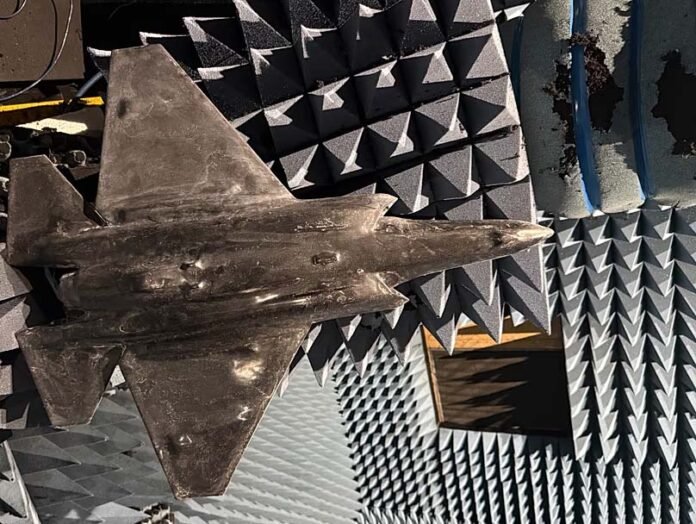
LISBON. In a quiet laboratory at the edge of the Atlantic, a radical technological leap is unfolding that could break the global monopoly on military stealth. Scientists in Portugal have successfully engineered a custom, plasma-produced graphene coating that effectively absorbs electromagnetic radiation. The pioneering material holds the potential to render standard warplanes and unmanned aerial vehicles (UAVs) almost entirely invisible to conventional radar systems, positioning Europe as an independent powerhouse in next-generation defence manufacturing.
The innovative technology is the brainchild of GTechPlasma, a highly specialised spin-off company born out of the Institute for Plasmas and Nuclear Fusion at the prestigious Instituto Superior Técnico in Lisbon. Leveraging a proprietary, heavily patented plasma-based production system, the research team has discovered a method to manipulate carbon-based precursors – such as methane and ethyl alcohol – at a precise atomic scale. This granular control allows them to synthesise high-quality graphene sheets just one atom thick, meticulously tailored to trap and dissipate incoming radar waves rather than reflecting them back to detection systems.

“Our system allows us to control the entire process at the atomic level,” explained Bruno Soares Gonçalves, co-founder of GTechPlasma. According to Gonçalves, the strategic implications for modern warfare are immense. Early laboratory estimates indicate that when the graphene-based material is applied to a standard, non-stealth fighter jet like the American-made F-16, its radar cross-section drops exponentially. Under radar surveillance, a multi-ton supersonic fighter jet coated in this material would register as nothing more than a passing bird.
In tactical terms, this does not mean absolute magic-trick invisibility, but rather a profound delay in enemy response times. “The aircraft is either not detected, or detected too late, and that is a decisive military advantage,” Gonçalves noted.
Currently, the world’s most advanced stealth aircraft, such as the US-manufactured F-35 Lightning II or the B-2 Spirit bomber, rely on complex, heavy composite coatings and highly specific angular geometries to evade radar. These systems are notoriously expensive to maintain, easily damaged by atmospheric wear, and heavily guarded. The United States maintains ironclad export restrictions on its stealth coatings, prohibiting the transfer of the chemical formulas even to close international allies.
Portugal’s “Made in Europe” alternative entirely rewrites this calculus. Because the graphene coating can theoretically be transformed into specialised paints or lightweight external layers, it could be applied broadly across legacy fleets and suitcase-sized reconnaissance drones alike without altering their structural aerodynamics. Beyond pure stealth, the GTechPlasma team points out that the material’s unparalleled capacity for electromagnetic shielding offers vital protection against electronic warfare, radar-jamming, and high-energy radiation.

The venture is rapidly transitioning from a localised laboratory triumph to a full-scale industrial reality. GTechPlasma’s current laboratory apparatus yields roughly 40 milligrams of high-quality graphene per minute. To bridge the gap toward military-grade commercialisation, the company has partnered with Plasmaphene, an industrial manufacturer based in Vila Viçosa. Backed by the European Union’s Compete 2030 funding programme, Plasmaphene is constructing automated facilities featuring modular production units to scale- up output significantly.
Demonstrating immediate defence application, GTechPlasma has already delivered an initial batch of 260 grams of the radar-absorbing black powder to a domestic Portuguese drone manufacturer. As European defence ministries urgently seek sovereign technologies to fortify regional security, this thin layer of carbon may soon rewrite the rules of the skies.







