

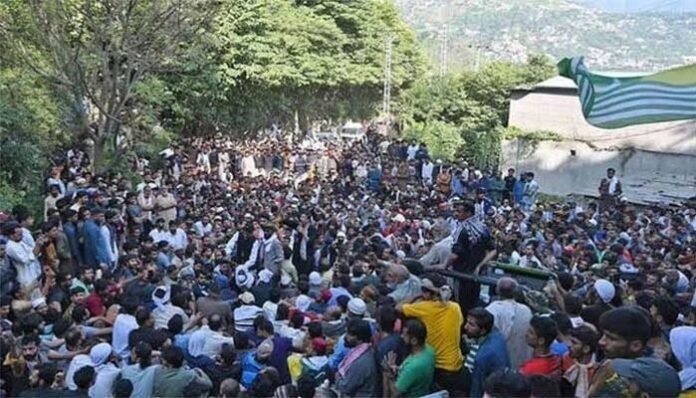
For years, unrest in Pakistan-occupied Jammu and Kashmir was treated as something temporary and manageable. There would be anger over prices, protests over shortages, negotiations, announcements, and then a gradual return to normalcy. Islamabad appeared confident that a familiar cycle of accommodation and pressure would restore calm. What is unfolding now feels different. The protests spreading across the region no longer look like a passing reaction to economic hardship. They reflect something more serious: a growing loss of faith that the existing political arrangement can deliver either accountability or meaningful local agency.
The present unrest did not begin with ideology or geopolitics. It began with everyday frustrations that accumulated over time and eventually found organised expression. Rising electricity tariffs, inflation, unemployment, wheat prices, and frustration over public services created fertile ground for mobilisation. The Joint Awami Action Committee succeeded because it connected issues people lived with every day to a larger argument that many already felt but had not articulated clearly. The question was no longer why life was becoming harder. It became why a region rich in natural resources continued to struggle while decisions appeared to be made elsewhere, and benefits seemed to travel elsewhere.

Hydropower became the most visible symbol of this anger. Residents are increasingly asking a question that governments find difficult to answer once it gains public traction: if rivers flow through our land and power is generated here, why do local communities continue to face shortages, rising bills, and little visible improvement in daily life? Whether entirely accurate in economic terms became less important than what the question represented politically. The grievance was no longer about electricity alone. It became a question of ownership, fairness, and whether local people existed merely as spectators to decisions affecting their own future.
The Joint Awami Action Committee succeeded because it linked everyday issues to a larger argument that many already felt but had not articulated clearly. The question was no longer why life was becoming harder. It became why a region rich in natural resources continued to struggle while decisions appeared to be made elsewhere, and benefits seemed to go elsewhere
What transformed frustration into unrest was not one failed agreement but repeated disappointment. Concessions were announced, implementation remained uneven, and trust gradually weakened. People tend to tolerate hardship longer than observers expect when they believe conditions will improve. What becomes difficult to accept is the feeling that every promise arrives incomplete and every compromise only postpones the same argument.
That explains why the present agitation has acquired a sharper political edge than earlier protest cycles. Demonstrations that began around economic demands increasingly raised broader questions about representation, administrative control, and the limits of local institutions. Pakistan-occupied Kashmir has its own political offices, legislative structures, and constitutional framework. On paper, the arrangement suggests local self-administration. Yet many critics inside the region have long argued that decisive authority remains concentrated beyond those institutions and that elected bodies often operate within narrow boundaries rather than exercising genuine political discretion.
Reports of the crackdown have intensified sentiments. Allegations of excessive force have deepened the perception among sections of the population that disagreement is increasingly treated as a security problem rather than a political signal. States can suppress demonstrations. They find it much harder to suppress the memory created by forceful responses
The contradiction is uncomfortable because Pakistan has invested heavily in projecting the territory as evidence of political inclusion and local autonomy. Internationally, Islamabad repeatedly invokes democratic aspirations, representation, and political rights in relation to Jammu and Kashmir. Yet when demands for accountability, governance, and local decision-making emerge within territories under its own administration, the response has too often appeared securitised rather than political.

That perception has been reinforced by recurring allegations raised over time by rights organisations, activists, and international monitoring mechanisms concerning arbitrary detention, enforced disappearances, custodial abuse, and restrictions on dissent across Pakistan and territories under its administration. Individual cases differ, and allegations require scrutiny, but the larger problem lies elsewhere. These concerns have persisted for too long and surfaced too often to be dismissed simply as hostile narratives. Where allegations of custodial deaths and disappearances enter public consciousness, the political damage extends beyond the individuals involved. People begin to believe that institutions designed to protect them answer upward rather than outward.
Roads and investment do not automatically bring acceptance. People eventually ask who gains, who decides, and whether local concerns matter at all. That becomes harder to ignore when frustration keeps returning. For India, the issue is even sharper since CPEC passes through its claimed territory, turning local unrest into a wider strategic question
Recent reports and local accounts surrounding the crackdown have further intensified this sentiment. Protest leaders facing arrests, sedition accusations, and allegations of excessive force have deepened the perception among sections of the population that disagreement is increasingly treated as a security problem rather than a political signal. States can suppress demonstrations. They find it much harder to suppress the memory created by forceful responses.

There is another reason these events deserve attention. The unrest reflects a generational shift that governments across the world are still learning to understand. Younger populations are more connected, compare outcomes more quickly, and show less patience for symbolic politics. Titles, flags, and formal institutions matter less when daily experience suggests limited influence over decisions. The language of sacrifice and historical grievance also carries less weight when expectations increasingly revolve around services, opportunity, and visible fairness.
The unrest matters beyond Pakistan because this region sits within the larger geography of the China-Pakistan Economic Corridor. It sits along territory linked to the corridor, a project Pakistan has long showcased as a symbol of growth and strategic success. But roads and investment do not automatically bring acceptance. People eventually ask who gains, who decides, and whether local concerns matter at all. That becomes harder to ignore when frustration keeps returning. For India, the issue is even sharper since CPEC passes through its claimed territory, turning local unrest into a wider strategic question.
The deeper lesson from PoK extends beyond one region and a single protest movement. Political order rarely weakens because of one event. It weakens when citizens come to believe that institutions hear them but do not answer, that authority exists, but accountability does not, and that promises outlast outcomes
For India, the implications are strategic and should be approached with restraint rather than celebration. Public unrest along the Line of Control should not be romanticised or treated as an automatic geopolitical gain. The people protesting are responding to their own realities and deserve to be understood on those terms. They reinforce a longstanding Indian position that legitimacy cannot rest indefinitely on administrative control or political theatre. More importantly, PoK remains a disputed territory that rightfully belongs to India.
More importantly, they create an opportunity to expose Pakistan’s selective use of human rights language. New Delhi’s strongest argument is not rhetorical escalation. It lies in demonstrating governance outcomes, political participation, economic development, and institutional delivery in Jammu and Kashmir, while continuing to underscore the contradiction between Pakistan’s external messaging and its internal record.
The deeper lesson from Pakistan-occupied Kashmir extends beyond one region and a single protest movement. Political order rarely weakens because of one event. It weakens when citizens come to believe that institutions hear them but do not answer, that authority exists, but accountability does not, and that promises outlast outcomes.
That may be the most difficult question confronting Pakistan today. The protests may eventually fade, agreements may once again be announced, and normal routines may return. But once people begin asking who governs, who benefits, and who decides, those questions rarely disappear with the crowds.
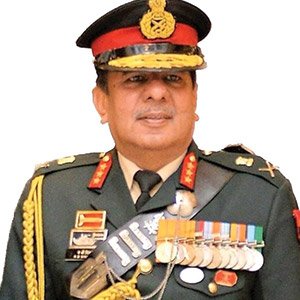
The writer, a PVSM, AVSM, VSM has had an illustrious career spanning nearly four decades. A distinguished Armoured Corps officer, he has served in various prestigious staff and command appointments including Commander Independent Armoured Brigade, ADG PP, GOC Armoured Division and GOC Strike 1. The officer retired as DG Mechanised Forces in December 2017 during which he was the architect to initiate process for reintroduction of Light Tank and Chairman on the study on C5ISR for Indian Army. Subsequently he was Consultant MoD/OFB from 2018 to 2020. He is also a reputed defence analyst, a motivational speaker and prolific writer on matters of military, defence technology and national security. The views expressed are personal and do not necessarily carry the views of Raksha Anirveda





