Washington: In an annual report by the US Secretary of Defence to the US Congress on the military and security developments involving China, it has dealt in detail China’s alleged two-pronged war with Taiwan and India and the possibilities of China expanding its overseas bases into new frontiers.

The report details on how China intends to dig into today’s technological advancements and innovations to better equip its forces. With China’s official defence budget having doubled since 2012 to a whopping $205 billion, it is imperative to keenly look at China’s military strategy.
The report says that the PLA has had multiple skirmishes with the Indian army on the borders and specifically mentions cases of Chinese trespassing into Indian territory and also refers to the building of a tiny village like a colony by China in the upper Subansiri region of Arunachal Pradesh.
The details of this says “sometime in 2020, China built a large 100-home civilian village inside disputed territory between China’s Tibet Autonomous Region and India’s Arunachal Pradesh state in the eastern sector of the LAC. These and other infrastructure development efforts along the India-China border have been a source of consternation in the Indian government and media. In contrast, China has attempted to blame India for provoking the standoff through India’s increased infrastructure development near the LAC. Asserting that its deployments to the LAC were in response to Indian provocation, Beijing has refused to withdraw any forces until India’s forces have withdrawn behind China’s version of the LAC and ceased infrastructure improvements in the area.”
Within China, the Western Theatre Command focuses on Xinjiang and Tibet Autonomous Regions, where the CCP perceives a high threat of separatism and terrorism, particularly among Muslim Uyghur populations in Xinjiang.

The PLARF (People’s Liberation Army Rocket Force) which mans, trains, and equips China’s strategic land-based nuclear and conventional missile forces and associated support forces and missile bases advanced its long-term modernisation plans to enhance its “strategic deterrence” capabilities. In view of this, it has reportedly launched more than 250 ballistic missiles for testing and training. This was more than the rest of the world combined.
China has commenced building three solid-fuelled ICBM silo fields, which will cumulatively contain hundreds of new ICBM silos says China expert Aadil Brar.

“The report adds that China is building a new ICBM that will improve its nuclear-capable missile forces and which will require increased production. We know China is building ICBM silos, but the report adds that China is building a new type of ICBM. According to the report, DF-41s are likely candidate for the deployment in the silos that have been built so far,” he added.
However, Brar says “the most watched and discussed of all the developments was the projection that PLA will have 1000 warheads by 2030. This a projection by the US DOD. China has the capability to reach that target. The report also says China is moving towards a launch-on-warning strategy for its nuclear arsenal. Both these are very significant confirmations of some of the recent trends we have noticed in open-source analysis.”
Although China publicly advocates peaceful unification with Taiwan, it has never renounced the use of military force. The circumstances under which China has historically indicated it would consider using force remain ambiguous and have evolved over time.
China continues to signal its willingness to use military force against Taiwan. The PLA has a range of options to coerce Taipei based on its increasing capabilities in multiple domains. China could pursue a measured approach by signalling its readiness to use force or conduct punitive actions against Taiwan.
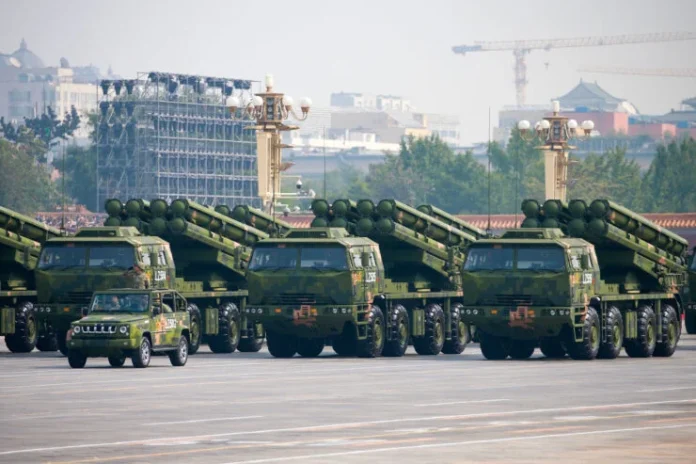
Notably, China would seek to deter potential US intervention in any Taiwan contingency campaign – capabilities relevant to deterring or countering potential US intervention were among those that China highlighted during its October 2019 military parade celebrating its 70th anniversary.
When asked about the possibility of China waging a “two-pronged” war with Taiwan and India, Brar said that it is highly unlikely.
“China believes the growing India-US cooperation can create problems along the LAC in the future, especially during a situation vis-à-vis Taiwan. China also has Tibet in mind where the internal culture and political life isn’t entirely in Beijing’s control. That’s my own opinion on the strategy mentioned in the report,” Aadil said.