


on April 30, 2026, the Pakistan Navy proudly welcomed its first China-built Hangor-class submarine, PNS/M Hangor, during a ceremony in Sanya, China. President Asif Ali Zardari and Navy Chief Admiral Naveed Ashraf attended. Pakistani leaders called this $5 billion project a major achievement for protecting sea trade and balancing power in the Arabian Sea. But the real story is more complex.
This project looks more like a practical fix than a game-changer. Pakistan could not buy nuclear-powered ballistic missile submarines (SSBNs) from friendly nations. So it chose an unusual path: placing nuclear weapons on ordinary diesel-electric submarines fitted with Air-Independent Propulsion (AIP), which lets them stay underwater longer without surfacing.

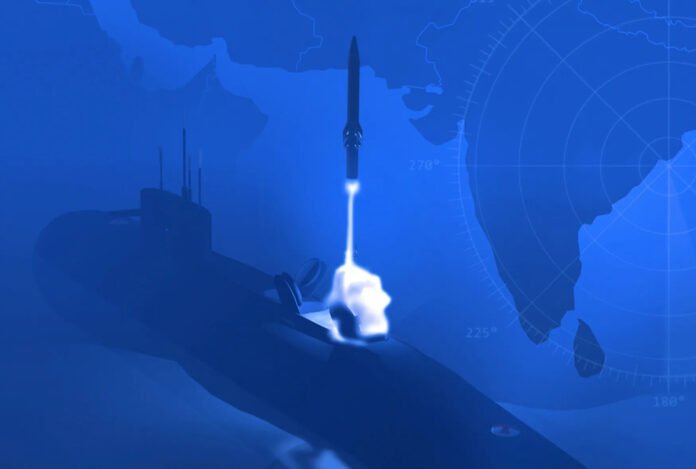
The heart of this threat is the Babur-3 submarine-launched cruise missile. First tested underwater in 2017, it has a claimed range of around 450 kilometres and can carry a nuclear warhead. The idea is simple. By hiding nuclear-armed missiles at sea, Pakistan hopes to strike back even if its land-based weapons are destroyed in a surprise first attack. A quiet submarine is hard to find, which strengthens deterrence. But this plan works only if the submarine avoids being detected and destroyed.
Pakistan could not buy nuclear-powered ballistic missile submarines (SSBNs) from friendly nations. So it chose an unusual path: placing nuclear weapons on ordinary diesel-electric submarines fitted with Air-Independent Propulsion (AIP), which lets them stay underwater longer without surfacing
So how does AIP work? Any engine that burns fuel needs oxygen, like a candle needs air. A normal diesel submarine lacks enough oxygen underwater, so it must surface and raise a snorkel (breathing tube) to recharge batteries — exposing itself to enemy radar. AIP solves this. The submarine carries its own liquid oxygen, like a scuba diver carrying a tank instead of a snorkeler who keeps surfacing. In the Hangor’s Stirling engine, stored oxygen and diesel burn in a sealed chamber, the heat pushes pistons, the pistons spin a generator, and the electricity charges batteries that drive the propeller. Exhaust is quietly dissolved into seawater. So the boat can stay deep for many days, silently.
These submarines, based on China’s Type 039B Yuan-class, are about 76 metres long and weigh 2,800 tonnes. Of eight planned, four are built in China and four at Karachi Shipyard. As Pakistan’s old French Agosta-90B boats near retirement, the Hangor will become its main sea-based nuclear platform.
But there is a big weakness: speed. AIP keeps the boat silent, not fast. To save limited oxygen, these submarines crawl at four to six knots. If found, they cannot race away like a nuclear boat. And to hit major Indian targets, a Hangor must come within 450 kilometres — straight into waters the Indian Navy watches closely.

Over ten years, India has built a strong, multi-layered anti-submarine wall across the Arabian Sea. Its Boeing P-8I Poseidon aircraft and MQ-9B Predator drones hunt threats far from the coast, carrying torpedoes, special radars and sensors that expose quiet submarines
Here India’s preparation matters. Over ten years, India has built a strong, multi-layered anti-submarine wall across the Arabian Sea. Its Boeing P-8I Poseidon aircraft and MQ-9B Predator drones hunt threats far from the coast, carrying torpedoes, special radars and sensors that expose quiet submarines. MH-60R Romeo helicopters lower dipping sonars into the sea and drop lightweight torpedoes, widening the search. India is also adding anti-submarine corvettes and laying underwater sensor networks along key shipping routes. Together, these layers make it dangerous for any slow conventional submarine to creep near the Indian coast. A detected Hangor would have very few escape options. Worse for the crew, the very act of firing a Babur-3 reveals the submarine’s position, and at six knots there is simply no quick way to slip out of the danger zone afterwards.
This is where Pakistan’s plan differs from real nuclear powers. Big nations use dedicated SSBNs — nuclear-powered submarines built only to carry nuclear ballistic missiles. Their reactor makes steam to turn turbines, needing no outside air, so they hide in deep oceans for months, limited only by food and crew endurance. There is also the SSN, a nuclear attack submarine that hunts enemy ships and submarines. Simply put, SSNs fight underwater wars, while SSBNs quietly guarantee revenge and thus help prevent war. Pakistan’s conventional boats cannot offer that same survival assurance.

By loading nuclear missiles onto ordinary attack submarines, Pakistan blurs the line between a normal sea battle and a nuclear crisis. If India sinks a Pakistani submarine during a clash, neither side may know whether it carried ordinary torpedoes or nuclear Babur-3 missiles
Worse, the plan creates dangerous confusion. By loading nuclear missiles onto ordinary attack submarines, Pakistan blurs the line between a normal sea battle and a nuclear crisis. If India sinks a Pakistani submarine during a clash, neither side may know whether it carried ordinary torpedoes or nuclear Babur-3 missiles. Islamabad could wrongly believe its nuclear force was deliberately attacked, triggering fast and reckless escalation. This is exactly why advanced powers keep their warships and nuclear-deterrent submarines separate.
So, is the Hangor a threat to India? The honest answer is: yes and no. It forces India to spend more time, money and attention on submarine hunting, and keeps the navy permanently alert in the Arabian Sea. The presence of nuclear weapons underwater is itself a worry. But this is no unbeatable weapon. A slow, short-range, conventionally powered submarine entering India’s well-watched waters is taking a heavy gamble — and its biggest danger may not be a planned strike, but an accidental nuclear war between two uneasy nuclear neighbours.

-The writer is an award-winning science communicator and a Defence, Aerospace & Geopolitical Analyst. He is the Managing Director of ADD Engineering Components India Pvt. Ltd., a subsidiary of ADD Engineering GmbH, Germany. You can reach him at: girishlinganna@gmail.com. The views expressed are personal and do not necessarily carry the views of Raksha Anirveda





