


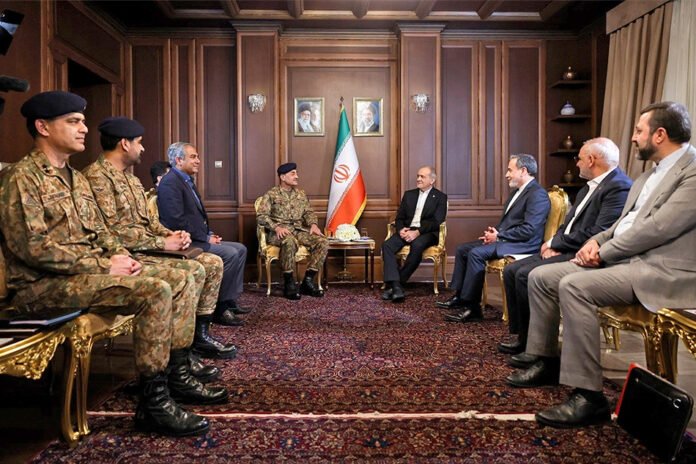
At first glance, Pakistan’s peacemaker moment appears to cut against India’s narrative. It has also triggered debate over what this means for India’s long-standing ambition to be recognised as a leading global power and a consequential diplomatic actor.
For over two decades, India has carefully cultivated an image of itself as a rising power defined by strategic autonomy, economic weight, democratic legitimacy and responsible international behaviour. It has positioned itself as a bridge between North and South, East and West, and as a credible voice in an increasingly fragmented global order.

Yet diplomacy, particularly in moments of crisis, often rewards visibility as much as structural power. Pakistan’s ability to insert itself into a high-stakes geopolitical crisis has, at least temporarily, created a perception of diplomatic initiative that India has not visibly matched.
At first glance, Pakistan’s peacemaker moment appears to cut against India’s narrative. It has also triggered debate over what this means for India’s long-standing ambition to be recognised as a leading global power and a consequential diplomatic actor
This matters because global leadership is not measured only by GDP, military strength or summitry. It is also measured by the capacity to shape outcomes in moments of instability.
In that respect, Pakistan’s role — especially its reported access to both Washington and Tehran, alongside the personal diplomacy surrounding its military leadership — has projected agility. Even if the mediation remains fragile, contested or overstated, the optics alone have strategic consequences.
A Strategic Challenge To India
For India, the challenge is not that Pakistan has displaced it as a global actor. That would overstate the case. India’s economic scale, diplomatic reach, technological base and geopolitical relevance remain of a different order. The challenge is that Pakistan’s move complicates India’s claim to be the region’s primary diplomatic anchor.

It raises uncomfortable questions in some strategic circles: Why was India not more visible in a crisis involving two countries with which it has bilateral relations? Why did New Delhi appear more an observer rather than a shaper? And does Pakistan’s emergence risk strengthening narratives — however exaggerated — that India’s diplomatic ambitions sometimes outpace its crisis diplomacy?
Diplomacy, particularly in moments of crisis, often rewards visibility as much as structural power. Pakistan’s ability to insert itself into a high-stakes geopolitical crisis has, at least temporarily, created a perception of diplomatic initiative that India has not visibly matched
These questions matter, but they should not be overstated.

Pakistan’s mediation, while notable, rests on uncertain foundations. Reports differ on how decisive its role has actually been, with some analyses suggesting Islamabad has functioned more as a conduit than as the principal architect of diplomacy. Iran itself has at times sent mixed signals regarding the depth and format of talks. That ambiguity means India should view this less as a strategic setback than as a diplomatic wake-up call.
Indeed, India can still salvage the situation — and potentially turn it to its advantage.
India’s Strengths
First, India should resist the temptation to react competitively to Pakistan’s diplomatic visibility. Great-power credibility is not built through reactive diplomacy. It is built through sustained strategic positioning. New Delhi’s strength has long been its ability to avoid being drawn into performative geopolitical contests. Preserving that discipline matters.
Second, India can leverage what Pakistan currently lacks: broad-based structural influence.
Unlike Pakistan, India has deep and credible ties across nearly every major actor involved — the United States, Iran, Saudi Arabia, the UAE, Israel and increasingly Europe. Few countries can engage these actors simultaneously with strategic seriousness. That is not a small asset; it is precisely the foundation from which diplomatic leadership can be built.
India should use that advantage to position itself not necessarily as a headline mediator, but as a longer-term architect of regional stabilisation.
India’s interests in energy security, maritime stability and connectivity give it a natural stake in shaping post-crisis arrangements in West Asia. It could revive discussions around regional energy corridors, expand its role in maritime security dialogues, and use various other regional and global platforms to anchor a broader conversation about stability through interdependence
One avenue is economic diplomacy.
India’s interests in energy security, maritime stability and connectivity give it a natural stake in shaping post-crisis arrangements in West Asia. It could revive discussions around regional energy corridors, expand its role in maritime security dialogues, and use platforms linked to the India-Middle East-Europe Economic Corridor to anchor a broader conversation about stability through interdependence.
That would allow India to shift the frame from crisis mediation to strategic statecraft.
Third, India should deepen quiet diplomacy with Iran.
Despite periods of strain, India retains civilisational depth and strategic history with Tehran. Reinvesting in that relationship — particularly through connectivity, trade mechanisms and calibrated political engagement — would not only protect Indian interests but also demonstrate that influence is not measured solely by visible mediation roles.
Fourth, New Delhi should convert multilateral forums into leadership platforms.
India often underutilises the diplomatic possibilities of forums where it already has standing, from the G20 legacy to BRICS and the Shanghai Cooperation Organisation. These are not substitutes for bilateral diplomacy, but they can amplify India’s ability to shape agendas on regional security, maritime norms and conflict prevention.
One recurring gap in Indian foreign policy is that substantive diplomacy is not always matched by narrative projection. In a world where perceptions matter, strategic silence can sometimes be mistaken for strategic absence. India does not need spectacle, but it does need clearer articulation of how it sees regional security and the role it intends to play within it
Fifth, India should sharpen its strategic communication.
One recurring gap in Indian foreign policy is that substantive diplomacy is not always matched by narrative projection. In a world where perceptions matter, strategic silence can sometimes be mistaken for strategic absence. India does not need spectacle, but it does need clearer articulation of how it sees regional security and the role it intends to play within it.
Most importantly, India should recognise that global leadership is rarely linear.
It is built not through winning every diplomatic moment, but through demonstrating resilience, adaptability and long-term relevance. Pakistan may have gained a moment of diplomatic prominence. But moments are not the same as durable geopolitical weight.
In fact, India may be better served by avoiding the burdens of high-risk mediation while positioning itself to shape what comes after.
There is also a deeper opportunity here.
Road Ahead For India
Pakistan’s rise as a temporary diplomatic actor underscores a broader truth: regional diplomacy is becoming more fluid and multipolar. That environment may actually favour India, whose strategic autonomy has long been designed for precisely such a world.
If India responds with insecurity, it risks validating the perception of setback. If it responds with confidence — by deepening regional engagement, leveraging structural strengths, and shaping the post-crisis order — it can not only salvage the situation but emerge stronger
Rather than seeing Pakistan’s role as a zero-sum loss, New Delhi could treat it as a signal to expand its diplomatic ambition beyond traditional templates.
The real test of India’s global leadership was never whether it would be the sole mediator in every crisis.
It is whether it can convert moments of geopolitical surprise into opportunities for strategic repositioning.
That remains entirely possible.
If India responds with insecurity, it risks validating the perception of setback. If it responds with confidence — by deepening regional engagement, leveraging structural strengths, and shaping the post-crisis order — it can not only salvage the situation but emerge stronger.
Global leadership is not diminished because another state has a diplomatic moment.
It is diminished only if one fails to respond strategically.
For India, the opportunity to do so is still very much alive.

-The writer is a New Delhi-based senior commentator on international and strategic affairs, environmental issues, an interfaith practitioner, and a media consultant. The views expressed are personal and do not necessarily carry the views of Raksha Anirveda





