


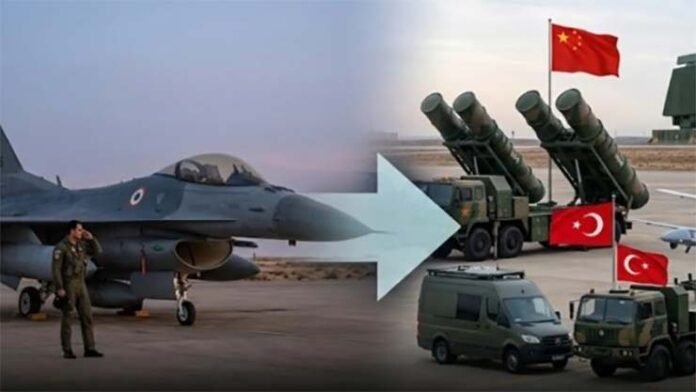
New Delhi: Pakistan is accelerating its procurement of Chinese long‑range and medium‑range missile systems (despite its abject failure to stop Indian missiles destroying key Pak military assets) alongside Turkish drones and loitering munitions, a move driven by vulnerabilities exposed during India’s Operation Sindoor in May 2025, according to media reports.
These acquisitions aim to plug gaps in Pakistan’s air defence network and enhance counter‑drone capabilities along the eastern border and Line of Control.

Pakistan is reported to be acquiring the HQ‑9 long‑range surface‑to‑air missile system from China, a platform often compared to Russia’s S‑400. With an engagement range of up to 250 kilometres, the HQ‑9 is designed to intercept aircraft, cruise missiles, and certain ballistic missile threats, providing Pakistan with a strategic shield against India’s stand‑off weapons.
Alongside this, the Pakistan Air Force is procuring HQ‑16, HQ‑17, and L‑17 medium‑range air defence missiles, which together form a layered network capable of addressing multiple aerial threats at varying altitudes and ranges.
The HQ‑9 system is expected to be deployed along Pakistan’s eastern border, where Indian Air Force operations pose the greatest challenge. The HQ‑16 and HQ‑17, already proven in Chinese service, will complement the HQ‑9 by covering shorter ranges and faster response scenarios.
The L‑17, a relatively newer system, adds redundancy and flexibility to Pakistan’s defensive posture. Collectively, these acquisitions represent a significant expansion of Pakistan’s reliance on Chinese technology, embedding Beijing’s defence architecture deeply into Islamabad’s strategic planning.

On the unmanned front, Pakistan is reportedly purchasing Karayel UAVs from Turkey. Developed by Vestel, the Karayel is a medium‑altitude, long‑endurance drone capable of reconnaissance and precision strikes. It has been combat‑tested in Middle Eastern theatres, where it demonstrated resilience against electronic warfare and effectiveness in precision targeting.
In addition, Turkish loitering munitions are being acquired, weapons that have gained prominence in recent conflicts for their ability to suppress radar sites and air defence systems. These munitions, often described as “suicide drones,” provide Pakistan with a cost‑effective means of neutralising high‑value targets during a conflict.

The acquisitions are directly linked to lessons from Operation Sindoor, where India employed BRAHMOS cruise missiles, Akash surface‑to‑air systems, and other stand‑off weapons to devastating effect.
Pakistan’s existing air defence network was unable to adequately counter these attacks, exposing vulnerabilities in radar coverage and interception capability. The new Chinese and Turkish systems are intended to provide a layered defence against such threats, while also offering offensive options through UAVs and loitering munitions.
India has been closely monitoring these developments. The Indian Air Force and Ministry of Defence are focusing on enhancing electronic warfare capabilities to degrade adversary systems, while expanding deployment of indigenous platforms such as the S‑400 ‘Sudarshan’, Akash, and DRDO‑developed counter‑drone solutions.
The emphasis is on building resilience against both missile and drone threats, ensuring that India maintains its technological edge despite Pakistan’s acquisitions.
Strategically, Pakistan’s procurement underscores its dual reliance on China and Turkey for advanced defence technology. While Chinese systems provide the backbone of its air defence, Turkish drones add flexibility and offensive reach.
This combination reflects Islamabad’s attempt to diversify suppliers while still anchoring its defence modernisation in partnerships with Beijing. For India, the challenge lies in countering a more sophisticated and layered Pakistani defence network, which could complicate future operations along the border.






