


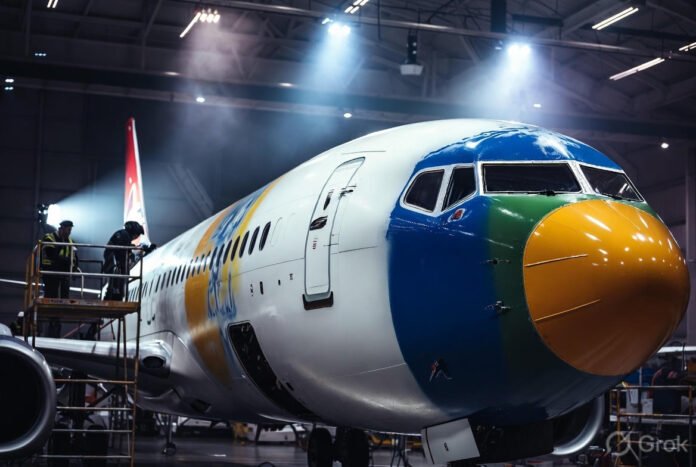
Hard to believe, but giving a fresh coat of paint to just one commercial airplane can cost between ₹1 crore to ₹2 crore ($120,000 to $250,000). Yes, you read that right. Most people look at a shiny new plane and think, “Arre, it’s only some paint and a few brushes.” But the truth is very different. Paint is actually one of the cheapest parts of the whole story. The real money goes into science, safety, precision work, and the heavy loss of income while the plane is grounded.
Let us take a popular example — the Boeing 737, one of the most common commercial aircraft flying across the world, including on busy Indian routes with airlines like IndiGo and Air India. Its outer surface area is nearly 323,000 square feet — as big as several football fields put together. Painting something this huge, with full care and zero mistakes, is no small job.

Before any new colour goes on, the old paint must be removed completely. Workers cannot simply paint over the old layer because that adds extra weight and makes the plane look dull. So they use a special chemical remover that melts the old paint but does not harm the aluminium or composite body. This stripping process alone can take seven to ten days.
Now comes the most important part that most people never think about — the paint itself. Engineers use special aviation-grade polyurethane coatings, and every quality of this paint has a serious reason behind it.
Engineers use special aviation-grade polyurethane coatings, and every quality of this paint has a serious reason behind it. It must protect against strong UV rays and fight corrosion. It also handles extreme cold temperatures at high altitudes without cracking or peeling
First, it must protect against strong UV rays. Up in the sky, the sun is much harsher than on the ground. Ordinary paint would fade and crack quickly. This special coating acts like a powerful sunscreen for the plane, guarding the body from constant damage.
Second, the paint must fight corrosion. Planes fly through clouds, rain, snow, and changing weather every single day. If rust starts eating into the metal, it can become dangerous. The coating forms a strong protective shield that keeps the aircraft safe and rust-free for many years. It also handles extreme cold temperatures at high altitudes without cracking or peeling.

Third, and very interesting, the paint must not disturb the plane’s radar and communication systems. A plane depends on clear signals to talk to control towers and fly safely. Engineers carefully choose paints that allow smooth transmission of these important signals. On top of this, every layer is measured for exact thickness and weight, because even a few extra kilos can affect fuel efficiency and balance.
Additionally, the paint must not disturb the plane’s radar and communication systems
But the most expensive part is invisible — it is time. While the airplane sits in the hangar for repainting, it cannot fly. No flights mean no passengers, and no passengers mean big losses for the airline. For a busy carrier, every day of downtime hurts badly.

Add the skilled labour, costly materials, hangar charges, and lost revenue, and the total bill easily reaches ₹1 crore to ₹2 crore. So repainting a commercial aircraft is never just for a fresh look. It is serious maintenance and protection that silently keeps the plane safe, strong, and ready to fly for millions of passengers.

-The writer is an award-winning science communicator and a Defence, Aerospace & Geopolitical Analyst. He is the Managing Director of ADD Engineering Components India Pvt. Ltd., a subsidiary of ADD Engineering GmbH, Germany. You can reach him at: girishlinganna@gmail.com. The views expressed are personal and do not necessarily carry the views of Raksha Anirveda





