

New Delhi: Two separate contracts were signed by the Ministry of Defence with Hindustan Aeronautics Limited (HAL) and Larsen & Toubro for 70 HTT-40 (Hindustan Turbo Trainer) basic trainer aircraft and three cadet training ships, respectively, at a cumulative cost of Rs 9,900 crore. The contracts were inked in the presence of Defence Minister Rajnath Singh.
On March 1, the Cabinet Committee on Security, headed by Prime Minister Narendra Modi, had cleared the two deals, according to which the basic trainers will cost Rs 6,838 crore, and the cadet training ships for Rs 3,100 crore.

The new trainer aircraft will provide a much-needed fillip to the ab initio training of air force pilots. Basic trainers figure on the long list of weapons and systems that India has imposed an import ban on for the last 30 months. HAL will supply the HTT-40 planes to IAF over six years. Currently, ab initio training of all rookie pilots is carried out on Swiss-origin Pilatus PC-7 MkII planes and Kiran Mk-1/1A trainers. Those training to become fighter pilots further train on the British-origin Hawk advanced jet trainers. The HTT-40 is a turboprop aircraft, designed to have good low speed handling qualities and provide better training effectiveness.
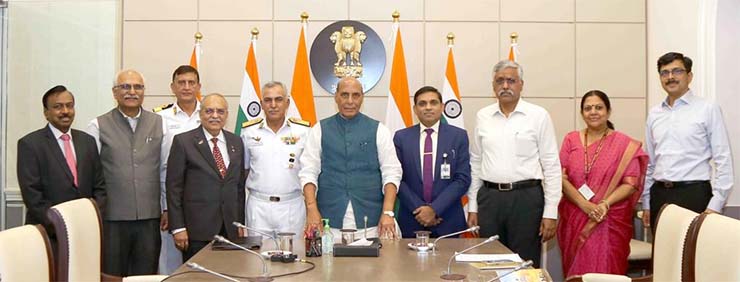
The indigenously designed, developed cadet training ships will be constructed at L&T’s Kattupalli facility in Tamil Nadu and the delivery is expected to begin in 2026. These ships will cater for training officer cadets, including women, at sea after their basic training ashore to meet the future manning and operational requirement of the Indian Navy. The ships can also extend training to cadets from friendly neighbouring countries.
With majority of the equipment and system sourced from indigenous manufacturers, these vessels will be a proud flag bearer of Aatmanirbhar Bharat, Make in India and Make for the World initiatives. Shipbuilding projects currently in progress at various shipyards are rightly poised to provide requisite economic stimulus to indigenous industry. Apart from creating a separate budget for purchasing locally made military hardware, the government has taken a raft of steps to promote self-reliance in the defence manufacturing sector, including increasing foreign direct investment from 49% to 74%, and notifying hundreds of weapons and systems that cannot be imported.