


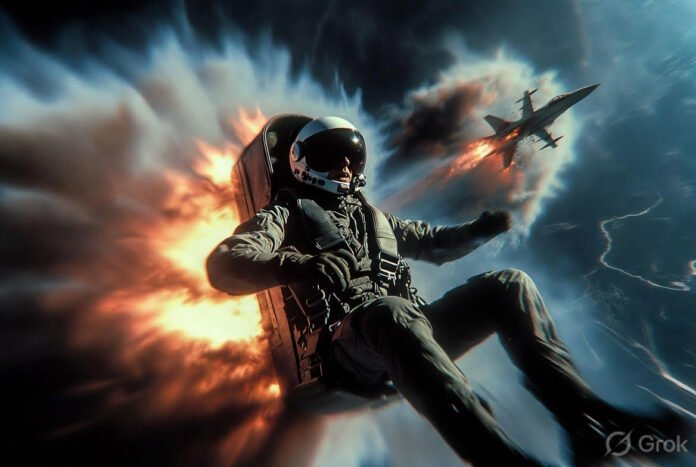
When a fighter pilot ejects at Mach 1, the human body faces the force it was never designed to handle. First, let us understand Mach 1. It simply means the speed of sound, which is around 1,235 km/hr at sea level. So, the jet is moving as fast as sound itself travels through air.
Now, the ejection seat fires the pilot upward with a force of up to 20 Gs in under a second. What does 20 Gs mean for a normal person? Think of it like this — your body suddenly feels twenty times heavier than usual. A man weighing 70 kg would, for that brief moment, feel like he weighs 1,400 kg. It is a crushing, violent push that the spine and organs must endure all at once.

But the real danger comes from the wind. At Mach 1, the wind blast alone hits the body at 760 miles per hour (around 1,223 km/hr). Imagine standing in a storm a hundred times stronger than any cyclone you have seen. This blast is powerful enough to tear a visor clean off the helmet, shatter exposed bones, and strip away unprotected skin in mere milliseconds. The face, hands, and any uncovered part suffer instantly.
After the seat fires, it separates from the pilot. Then a small parachute, called a drogue chute, opens first. Its job is to steady the tumbling body and slow it down in a controlled way before the main parachute can safely open. Without this step, the pilot would spin wildly and the main chute could tear apart.
At Mach 1, the wind blast alone hits the body at 760 miles per hour (around 1,223 km/hr). Imagine standing in a storm a hundred times stronger than any cyclone you have seen. This blast is powerful enough to tear a visor clean off the helmet, shatter exposed bones, and strip away unprotected skin in mere milliseconds
Here lies another hidden injury. The body goes from supersonic speed (faster than sound, above 1,235 km/hr) to a gentle parachute descent in a very short time. This sudden slowing, this harsh deceleration, can compress the spine so badly that several vertebrae — the small bones stacked in your backbone — get crushed together. Picture dropping from a very fast train onto solid hard ground — the jerk your back feels is similar, only many times worse. This is the injury pilots fear most, even more than the wind itself.
This is why pilots who survive a Mach 1 ejection almost always carry permanent spinal injuries for the rest of their lives. Many of them, sadly, never return to the cockpit again. Their flying days end in those few terrible seconds.

Ejection saves a pilot’s life, yes, but it extracts a heavy price from the body. It is a desperate last choice — survival bought through pain. Behind every successful ejection story lies a quiet truth: the man walked away alive, but he rarely walked away the same. That is the harsh reality of escaping a jet at the speed of sound.

-The writer is an award-winning science communicator and a Defence, Aerospace & Geopolitical Analyst. He is the Managing Director of ADD Engineering Components India Pvt. Ltd., a subsidiary of ADD Engineering GmbH, Germany. You can reach him at: girishlinganna@gmail.com. The views expressed are personal and do not necessarily carry the views of Raksha Anirveda






