


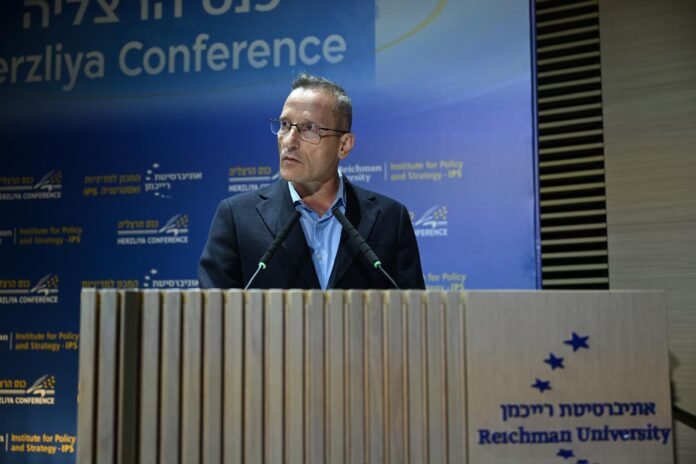
Tel Aviv: Addressing the Herzliya Conference, Baram called for tailored force buildup, a broader alliance stretching from India through the UAE to Greece and Cyprus, and a new US-Israel security MoU built on hard interests and shared values.
Speaking at the Herzliya Conference at Reichman University on Wednesday, July 01, Israel Ministry of Defence (IMOD) Director General Maj Gen (res.) Amir Baram, said, “The war has sharpened, for every actor in the region, the price of Iran’s military buildup. It has created a shared interest in forging a broader alliance, from India through the UAE to Greece and Cyprus.”

Baram warned that “the agreements now taking shape around the world, which could channel hundreds of billions of dollars into Iran, could dramatically accelerate its military buildup.” Facing this danger, he said, “the State of Israel must prepare through tailored force buildup and advance a new regional architecture, first and foremost with our strategic ally, the United States, and with others.”
On the US partnership and the security MOU now under negotiation, Baram addressed the domestic criticism of Washington’s approach. He stated, “We cannot afford to judge current American policy through a provincial lens. What some in Israel perceive as weakness or folly, an apparent disregard for every warning sign on the ground, is viewed in Washington as cold, calculated, and clear-eyed risk management in an era of shifting global attention. The difference between us is not in how we understand the threat, but in our priorities: for us, Iran is an existential threat; for the United States, it is a chronic regional challenge, while China and the Indo-Pacific theater remain the core concern. We think Tehran, they think Taiwan.”
“From the Pentagon’s perspective, with American munitions stretched between supporting current wars and preparing for a potential confrontation in the Taiwan Strait, a prolonged war in the Middle East runs counter to America’s global posture,” Baram added. “At the same time, based on my deep familiarity with the range of views within the American system, if there is one thing Americans hate more than this war that has dragged on for them, it is losing a campaign they have already won. Either way, as the United States operates under an America First approach, our partnership cannot rest on shared values alone. It must also rest on hard interests: a strong, independent, and proactive Israel that stabilises the Middle East is the very asset that allows the United States to redirect resources toward Asia. This is the foundation of the next Memorandum of Understanding on security cooperation now being formulated. The agreement will need to generate security, economic, and strategic benefits for both countries for years to come.”
Focusing on the Gulf and the new space of alliances, Baram said, “The war has sharpened, for every actor in the region, the price of Iran’s military buildup. It has created a shared interest in forging a broader alliance, from India through the UAE to Greece and Cyprus. Israel’s strengths in technology, proven operational experience, and defence innovation, combined with the Gulf’s financial power, could enable a new security-economic front. Expanding our strategic partnerships is not a substitute for our partnership with the United States, but it will allow Israel to broaden its room to manoeuvre and its standing on the international stage, and will allow us to diversify our strategic footing.”

On accelerating interceptor production, Baram stated, “Over the past year, as Director General, I was compelled to invoke the full range of emergency powers. We attacked bottlenecks head-on, conducted critical cross-continental procurement of raw materials, signed export deals to expand domestic production lines, and recruited a dedicated workforce for the industries involved. Thanks to these emergency measures, taken in real time, Israel today has a stockpile of Arrow, David’s Sling, and Iron Dome interceptors that continues to grow even amid fighting, but the work is not yet done.”






