


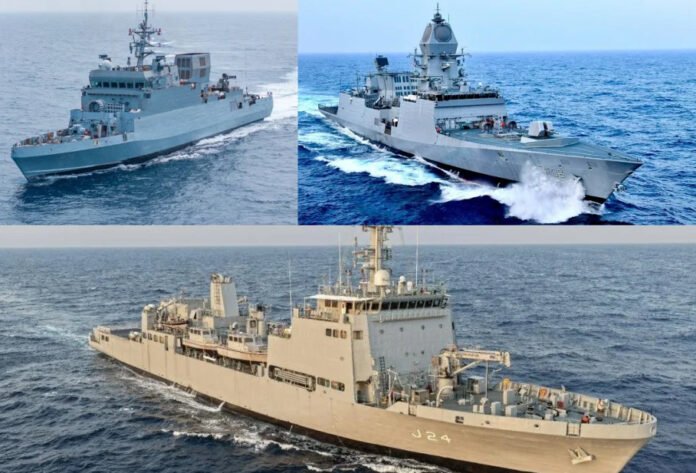
On June 21, the Indian Navy became stronger by adding three brand-new ships to its fleet. Each ship has a different and special job. One is built to fight enemies far out in the deep seas, the second can study and map the ocean floor, and the third is made to hunt down enemy submarines hiding near the coastline. Prime Minister Narendra Modi officially commissioned these three ships — INS Dunagiri, INS Sanshodhak, and INS Agray — in Kolkata. This is part of the Navy’s continuous effort to grow its fleet, and many new vessels have already joined since January 2025.
What makes this moment even more proud for the country is that all three ships were built right here in India, at Garden Reach Shipbuilders & Engineers (GRSE) in Kolkata. According to the Ministry of Defence, more than 75 percent of the parts and systems in these ships are Indian-made. Over 200 Micro, Small and Medium Enterprises (MSMEs) took part in building them. In simple words, this is not just a Navy success — it is a victory for “Made in India” and for thousands of small Indian businesses and workers.

INS Dunagiri is the biggest and most heavily armed. It is a frigate — a warship that is smaller than a destroyer but strong enough to travel far away from the coast and fight battles in the open sea. It belongs to the Navy’s Project 17A, under which India is building a new generation of advanced “stealth” frigates
INS Dunagiri – The Powerful Sea Warrior
Among the three, INS Dunagiri is the biggest and most heavily armed. It is a frigate — a warship that is smaller than a destroyer but strong enough to travel far away from the coast and fight battles in the open sea. It belongs to the Navy’s Project 17A, under which India is building a new generation of advanced “stealth” frigates. Here, the word “stealth” does not mean the ship becomes invisible. It simply means the ship is harder for enemy radars and detection systems to spot and follow.
INS Dunagiri carries powerful weapons, including BRAHMOS surface-to-surface missiles and a Medium-Range Surface-to-Air Missile (MRSAM) system to strike both ships and aircraft. It is also fitted with advanced sensors like the Multi-Function Surveillance, Track and Guidance Radar (MFSTAR), which helps it detect targets, track them, and guide weapons accurately. Along with this, it has sonar systems, electronic warfare equipment, and anti-submarine weapons to face threats both above and below the water.
A serving Navy officer, speaking to The Indian Express, explained that these multi-role frigates can work in a “blue water” environment — meaning they can carry out missions deep in the ocean, far from the shore. They can handle old-style threats like enemy warships and aircraft, and also modern challenges such as piracy, terrorism, smuggling, and even disaster relief work. Other ships in this same family include INS Nilgiri, Himgiri, Taragiri, Udaygiri, and Vindhyagiri.
INS Sanshodhak – The Ocean Mapmaker
The second ship, INS Sanshodhak, has a very different but equally important job. It is a Survey Vessel Large (SVL). Its main work is to survey and map the sea — measuring how deep the water is, studying the features on the seabed, mapping the routes leading to ports, finding safe paths for ships, and collecting valuable information about ocean conditions.

INS Sanshodhak, has a very different but equally important job. It is a Survey Vessel Large (SVL). Its main work is to survey and map the sea and is fitted with modern tools such as Autonomous Underwater Vehicles (AUVs), Remotely Operated Vehicles (ROVs), and Multi-Beam Echo Sounders. These devices help the ship gather information from both the surface and deep underwater, allowing very detailed mapping of the ocean
To do this work, the ship is fitted with modern tools such as Autonomous Underwater Vehicles (AUVs), Remotely Operated Vehicles (ROVs), and Multi-Beam Echo Sounders. These devices help the ship gather information from both the surface and deep underwater, allowing very detailed mapping of the ocean.
Why does this matter so much? Because warships and submarines do not travel through a flat, empty sea. The ocean is full of different depths, underwater hills and valleys, strong currents, reefs, busy shipping routes, and ports. Understanding all these conditions helps ships sail safely, helps submarines pick the best hidden routes, helps ports keep their maps updated, and helps the Navy plan its operations smartly. An officer who served on survey ships added that this work also supports commercial shipping, disaster relief, ocean research, and the development of coastal areas.

INS Sanshodhak is the fourth and final ship of the Sandhayak-class survey series. The contract for these four ships was signed back in October 2018. The earlier three — INS Sandhayak, INS Nirdeshak, and INS Ikshak — joined the Navy in February 2024, December 2024, and November 2025.
INS Agray is a submarine-hunter warship, built to detect, track, and destroy enemy submarines in shallow coastal waters. It is called an Anti-Submarine Warfare Shallow Water Craft (ASW SWC). It belongs to the Arnala-class of warships and is armed with lightweight torpedoes, Indian-made anti-submarine rocket launchers, and sonar systems to find and attack enemy submarines underwater; guard near ports, naval bases, and important sea routes close to the coast
INS Agray – The Silent Submarine Hunter
The third ship, INS Agray, is the smallest of the group, but it has a very special task. It is a submarine-hunter warship, built to detect, track, and destroy enemy submarines in shallow coastal waters. It is called an Anti-Submarine Warfare Shallow Water Craft (ASW SWC). Breaking it down: “Anti-Submarine Warfare” means finding and neutralising submarines, while “Shallow Water Craft” means a ship designed for coastal and shallow areas where bigger warships struggle to move.
INS Agray belongs to the Arnala-class of warships. It is armed with lightweight torpedoes, Indian-made anti-submarine rocket launchers, and sonar systems that help it find and attack enemy submarines underwater. These ships guard near ports, naval bases, and important sea routes close to the coast.
But why is this job so difficult? A Navy officer told The Indian Express that coastal waters, also called “littoral waters,” are very crowded and noisy. There are fishing boats, commercial ships, underwater features, and constant movement, all creating background noise. This makes it far harder to find a hidden submarine than in the open sea. Submarines are already among the hardest things to detect because they can stay hidden underwater for long periods. That is exactly why specially designed ships like INS Agray are needed.
The commissioning of three different ships strengthens the Navy in layers — big warships for long missions in distant seas, survey ships to understand the ocean, and small submarine-hunters to protect the coastline. It shows how carefully India is building strength at every level of the sea
Why Were All Three Commissioned Together?
The real beauty of the June 21 ceremony is that three different powers joined the Navy at the same moment. Together, they strengthen the Navy in layers — big warships for long missions in distant seas, survey ships to understand the ocean, and small submarine-hunters to protect the coastline.
This matters greatly today. As the Indian Ocean region becomes more competitive, with China and Pakistan increasing their naval activities, India’s responsibilities now stretch across the Arabian Sea, the Bay of Bengal, its island territories, and the wider Indo-Pacific. Adding these three ships shows how carefully India is building strength at every level of the sea.
Finally, it sends a strong message about India’s industrial growth. The fact that three completely different ships, using different technologies, were designed, built, and commissioned together in India proves how mature and capable our naval shipbuilding industry has become. It is a moment of pride — a sign that India is not just protecting its seas, but doing so with its own hands.

-The writer is an award-winning science communicator and a Defence, Aerospace & Geopolitical Analyst. He is the Managing Director of ADD Engineering Components India Pvt. Ltd., a subsidiary of ADD Engineering GmbH, Germany. You can reach him at: girishlinganna@gmail.com. The views expressed are personal and do not necessarily carry the views of Raksha Anirveda





