


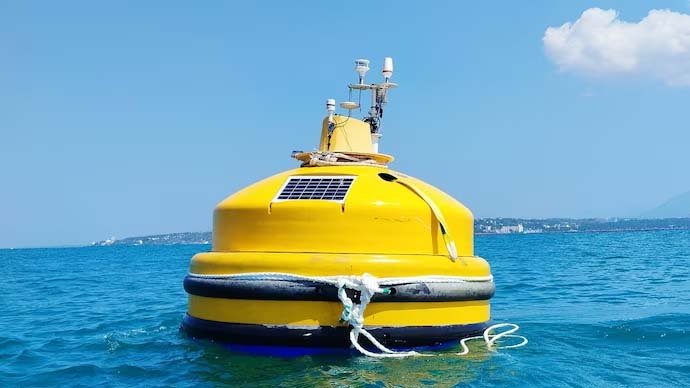
New Delhi: India has achieved a notable milestone in ocean observation technology with the successful testing of an indigenously developed Floating LiDAR Buoy System.
The National Institute of Ocean Technology (NIOT) conducted the trial off the coast of Muttom in Tamil Nadu. This innovation promises to revolutionise weather forecasting and offshore wind energy development.

A Floating LiDAR Buoy integrates a buoyant platform with Light Detection and Ranging (LiDAR) technology. This setup enables precise measurement of wind conditions over the sea. Unlike land-based systems, it operates in harsh marine environments, capturing data directly from offshore locations.
The system excels in measuring wind speed and direction profiles up to 300 metres above sea level. This high-resolution data surpasses traditional methods, providing vertical wind profiles essential for accurate modelling. Scientists emphasise its potential to refine atmospheric and oceanographic predictions.
Improved weather forecasting stands to benefit immensely from this technology. High-quality offshore wind data will enhance cyclone tracking, storm intensity forecasts, and marine safety advisories. Coastal communities and maritime operations will gain from more reliable predictions.
The Buoy System, developed, will significantly enhance the Indian Navy’s operational effectiveness in the Indian Ocean Region (IOR) by improving weather‑ocean situational awareness, mission‑planning quality, and maritime‑domain awareness.

This also supports coordination with the Coast Guard and other agencies under the National Disaster Management Authority (NDMA) framework, aligning with the Navy’s peacetime Humanitarian Assistance and Disaster Relief (HADR) role.
The buoy’s data also holds immense value for offshore wind resource assessment. As India ramps up its renewable energy ambitions, precise wind measurements are critical for site selection. They enable developers to optimise turbine placement and maximise energy output.

India’s offshore wind potential remains largely untapped, with vast opportunities along its extensive coastline. Technologies like this buoy address key gaps in data availability. Accurate assessments will accelerate project viability and investment inflows.
Developing the system presented significant engineering challenges. Constant buoy motion due to ocean waves distorted wind measurements. Researchers countered this with advanced motion compensation algorithms, ensuring data integrity amid dynamic sea conditions.
Power management posed another hurdle. The LiDAR system demands substantial energy, yet offshore deployment requires self-sufficiency. Innovations in energy-efficient design and battery systems enabled sustained operation.
Real-time data transmission from remote locations proved equally demanding. High volumes of continuous data necessitated robust communication protocols. Solutions incorporated satellite links and compression techniques for reliable offshore-to-shore transfer.
Despite these obstacles, the successful sea trial validates India’s prowess in marine technology. The project aligns seamlessly with the Make in India and Aatmanirbhar Bharat initiatives. These flagship programmes promote domestic innovation and curb reliance on imports.
Such advancements bolster India’s scientific infrastructure profoundly. They foster self-reliance in critical ocean technologies. NIOT’s role underscores the growing synergy between research institutions and national development goals.
Offshore wind energy features prominently in India’s clean energy transition. The government targets substantial capacity additions by 2030. Tools like the Floating LiDAR Buoy will underpin this expansion, identifying prime sites and mitigating risks.
Experts hail the buoy as a game-changer for renewable energy. It promises economic benefits through job creation and supply chain development. Indigenous manufacturing will further enhance cost-effectiveness and technological sovereignty.
Looking ahead, scaling deployment of these buoys could transform ocean data ecosystems. Integration with satellite and onshore networks will yield comprehensive marine insights. This positions India as a leader in blue economy innovations.
The trial’s success invites broader applications. Beyond wind and weather, the technology could support marine pollution monitoring and fisheries management. NIOT plans further refinements for multi-parameter sensing.
The Floating LiDAR Buoy exemplifies India’s technological ascent. It bridges critical gaps in offshore data, propelling advancements in forecasting, renewables, and marine science.






