


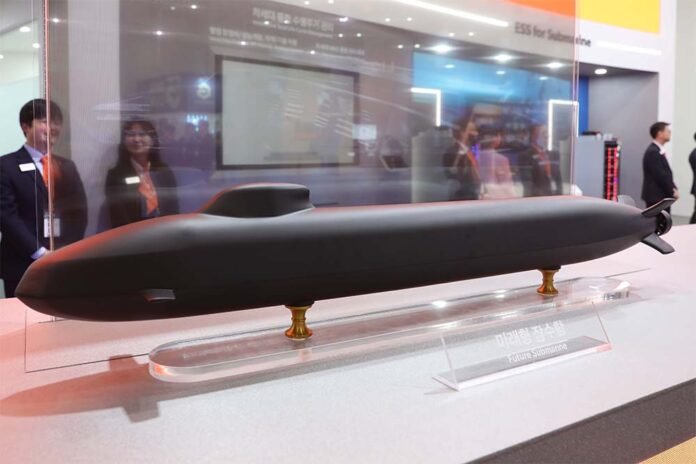
New Delhi: For the first time, South Korea has officially declared a national strategic roadmap to adopt nuclear-powered attack submarines, known as SSNs naval jargon.
Seoul plans to launch its first boat in the mid-2030s, and commission it in “the late 2030s,” the government proclaimed last week.

The Ministry of National Defence (MND) announced what it has dubbed the “Basic Plan for the Development of South Korean Nuclear-Propelled Submarines” on May 26.
This effort is being labelled as the Jang Bogo-N project, named after South Korea’s first ever submarine; built in Germany, it was commissioned in 1992. The “N” refers to “next generation,” “nuclear” and “neo technology.”
The Republic of Korea Navy previously declared a need for four SSNs. The submarines are likely to displace some 8,000 tons, which makes them similar in size to the American Virginia class.
Kim Jae Yeop, senior researcher at the Sungkyun Institute for Global Strategy in Seoul, listed four reasons why Seoul wants to adopt SSNs. The first has to do with fielding a counterweight military capability, as it must “counter Pyongyang’s submarine-launched ballistic missile threats, and possess a highly survivable deterrent against neighbouring powers like China.”

North Korea unveiled its new nuclear-powered, missile-armed submarine in December 2025. Pyongyang’s first move in this direction gave South Korea a political and moral green light to follow suit.
Secondly, Kim said, Seoul wishes to deepen and enhance cooperation with the United States, just as Australia is doing under the AUKUS programme.

A new national nuclear-submarine push “will enable Seoul to broaden the geographical range of combined military activities with the US beyond the Korean Peninsula,” he added.
A third factor is boosting the politico-military status of Korea in the international community. Finally, Kim pointed out, SSNs “present a valid alternative to nuclear armaments, which have been strongly demanded in Korea for the past several years in response to growing threats of nuclear weapons by the Pyongyang regime.”
According to the Defence Ministry announcement, “Nuclear-powered submarines possess dramatically enhanced operational capabilities compared to existing diesel submarines,” especially their submerged endurance and mobility.
The ministry said development of SSNs “is a national industrial development project spanning over 40 years (ten years of construction plus over 30 years of operation) that connects shipbuilding, nuclear power and defence industries.”
The emphasis is on domestic construction, with a prediction of 40,000+ jobs being created. This is in contrast to President Donald Trump’s declaration last October that Seoul should construct them at Philadelphia Shipyards in the United States. Hanwha Ocean acquired that shipyard in late 2024, but the site is not equipped to build nuclear-powered vessels.
Importantly, Korean submarines will use low-enriched uranium and long-cycle reactors, rather than the highly enriched fuel the US Navy utilises. This choice of fuel will minimise Korean submarine refuelling requirements.
“As one of the leading powerhouses in nuclear energy and shipbuilding industry in the world, Korea is widely believed to have sufficient capacity for developing and building its own nuclear-powered submarine,” said Kim.
This includes developing a small modular reactor. Nonetheless, the main challenge will be nuclear fuel supply and complying with international nonproliferation regulations, Kim indicated.
Seoul will work with the United States to secure and manage its uranium, and the two allies are expected to launch a working group in early June.
Kim pointed out that his country has produced more than 20 conventional submarines to date. The latest 4,000-ton vessel arrived in Canada on May 23 after completing a first-ever trans-Pacific voyage.






