


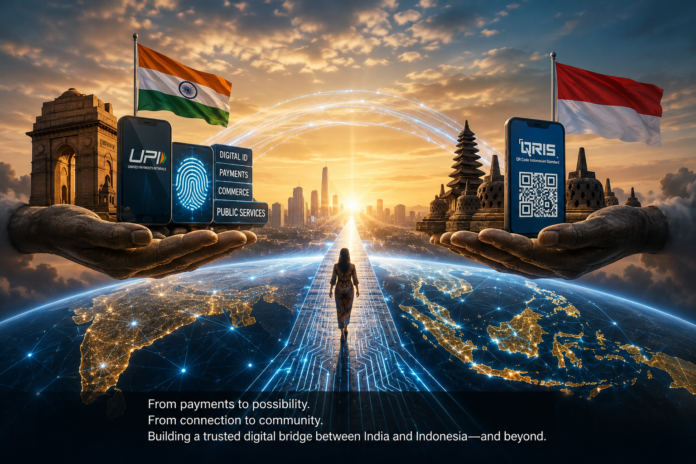
Indonesia’s Signal to the World: In international affairs, seemingly technical decisions often carry profound strategic significance. Indonesia’s decision to build its own sovereign digital ecosystem inspired by India’s Digital Public Infrastructure (DPI), while integrating its QRIS payment system with India’s Unified Payments Interface (UPI), is one such moment. It is not merely another fintech collaboration. It signals the emergence of a new form of international influence.
France, Singapore and the United Arab Emirates connected with UPI primarily to simplify payments for Indian travellers and businesses. Indonesia has chosen a different path. It seeks to adopt the architecture itself — developing interoperable platforms for digital payments, commerce, identity and public services that could eventually extend across ASEAN.

The distinction is crucial. Countries are no longer interested only in connecting to India’s payment network; they are beginning to study India’s digital governance model.
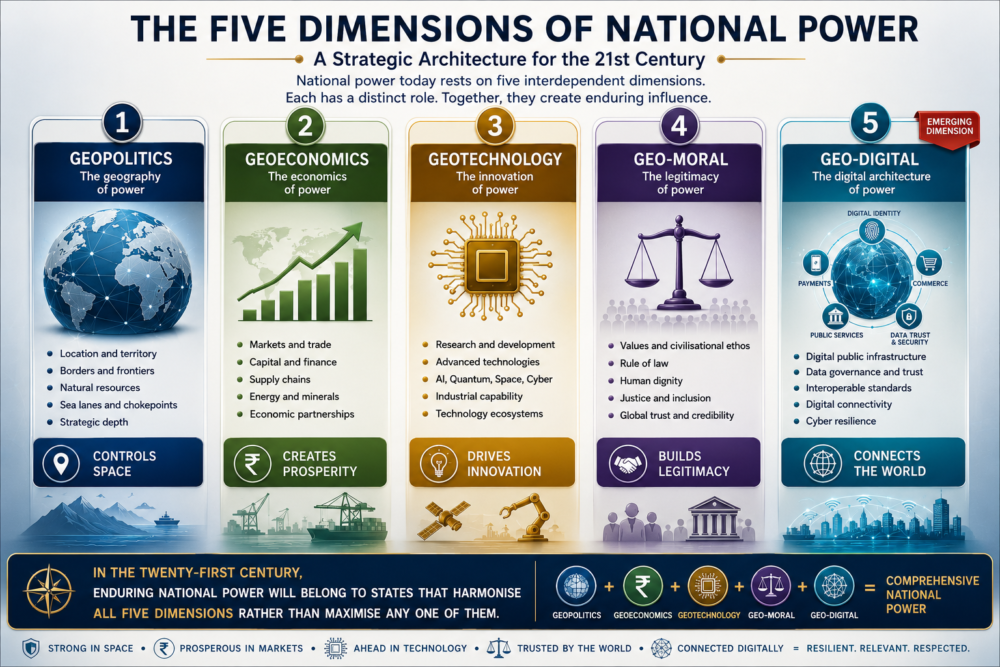
This marks the beginning of a larger strategic transition. The world has spent decades debating geopolitics, geoeconomics and technological competition. It must now recognise another emerging domain of power — Geo-Digital.
Introducing Geo-Digital
Every era creates its own vocabulary of power.
The twentieth century was defined by geopolitics, where geography determined strategic advantage, and by geoeconomics, where markets, trade routes and finance became instruments of statecraft.

The twenty-first century demands a new concept.
Geo-Digital is the projection of national power through trusted digital infrastructure, interoperable standards and public technology ecosystems that shape economic integration, governance and international influence.

Unlike conventional technological competition, Geo-Digital is not about producing the most sophisticated software or dominating consumer markets. It is about building the digital architecture through which societies transact, governments deliver services and economies connect across borders.
France, Singapore, and the UAE connected with UPI primarily to simplify payments for Indian travellers and businesses. Indonesia seeks to adopt the architecture itself, developing interoperable platforms for digital payments, commerce, identity, and public services that could eventually extend across ASEAN
Infrastructure has always been the hidden foundation of power. Roads enabled empires. Railways accelerated industrialisation. Shipping lanes expanded commerce. Financial networks shaped globalisation.
Today, digital infrastructure is becoming the next strategic layer beneath the global economy.
The nation whose digital standards become widely trusted will quietly shape international commerce for decades to come.
Five Ages of Global Integration
History can be understood as a succession of infrastructures.
- Geography: The first age belonged to geography. Rivers, deserts and oceans determined trade, conflict and civilisation. Whoever controlled the great maritime routes-controlled wealth.
- Industrialisation: The second age emerged with industrialisation. Railways, ports, highways and factories became the engines of national power. Physical infrastructure defined economic competitiveness.
- Financial Institutions: The third age was financial. Institutions created after the Second World War standardised global finance. Banking networks, reserve currencies and payment systems enabled unprecedented international integration.
- Technology: The fourth age was driven by digital platforms. Private technology companies transformed communication, commerce and information flows. While innovation flourished, digital power became concentrated within a handful of corporations, raising concerns over monopoly, data governance and digital dependence.
- Digital Public Infrastructure: The fifth age is now unfolding. Instead of proprietary platforms, countries are increasingly seeking trusted Digital Public Infrastructure — open, interoperable systems that combine innovation with sovereignty. The emphasis shifts from platform ownership to public digital rails on which countless innovators can build.
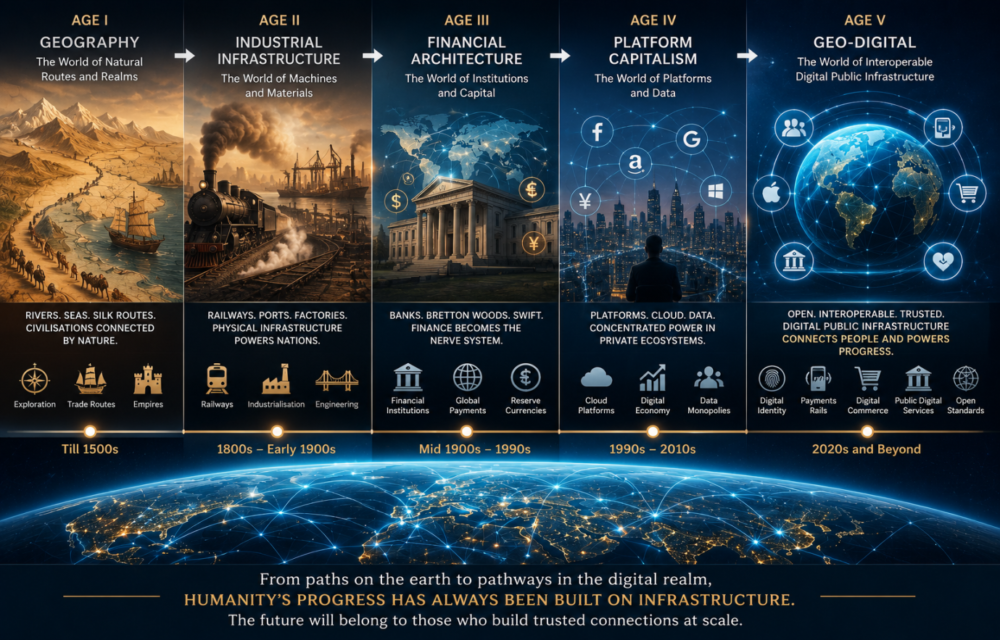
Every age has been defined by those who built the dominant infrastructure. The Geo-Digital age will be no different.
Why India’s Model is Different
India’s contribution lies not simply in creating a successful payment application. It has demonstrated an entirely different philosophy of digital development.
Rather than constructing closed commercial ecosystems, India has built interoperable public infrastructure.
Digital identity enables trusted authentication. Instant payment rails allow seamless transactions. Secure digital documents reduce administrative friction. Open commerce networks expand opportunities for businesses of every size. Public digital platforms improve access to essential services. These components reinforce one another. Together they form a digital ecosystem rather than a collection of disconnected applications.
The significance of this approach extends well beyond efficiency. It lowers barriers to participation, encourages competition, reduces costs and allows private innovation to flourish without surrendering public infrastructure to monopolistic control.
Digital infrastructure is becoming the next strategic layer beneath the global economy today. A nation whose digital standards become widely trusted will quietly shape international commerce for decades to come
For developing economies, this represents an attractive alternative. Countries seeking digital transformation need not replicate expensive proprietary models or become dependent upon external technological ecosystems.
They can instead adapt interoperable public infrastructure while preserving digital sovereignty. That may prove to be India’s most important technological export.
Indonesia and the Birth of a Geo-Digital Network
Indonesia’s interest, therefore, deserves attention far beyond Southeast Asia.
As ASEAN’s largest economy and one of the world’s most dynamic digital markets, Indonesia occupies a pivotal strategic position. Its ambition extends beyond integrating payment systems. It seeks to develop interoperable digital identity, commerce and public-service platforms inspired by India’s experience.
Should compatible systems gradually emerge across ASEAN, the implications would be substantial. Cross-border payments would become faster and cheaper. Small businesses could access regional markets with lower transaction costs. Digital credentials could simplify education, employment and travel. Governments could cooperate through compatible digital standards while retaining sovereign control over their own systems.
Such integration would create something unprecedented—not a political union, but a trusted Geo-Digital network.
History has witnessed economic communities built through customs unions, free trade agreements and financial institutions. The next generation of regional integration may increasingly be built through interoperable digital infrastructure.
Indonesia may become the first major node in that emerging architecture.
Geo-Digital as an Instrument of National Power
Power has always evolved with infrastructure. Military power secured territory. Economic power expanded markets. Diplomatic power-built alliances. Geo-Digital introduces another dimension.
Every age has been defined by those who built the dominant infrastructure. The Geo-Digital age will be no different. India’s contribution lies not simply in creating a successful payment application. It has demonstrated an entirely different philosophy of digital development. Rather than constructing closed commercial ecosystems, India has built interoperable public infrastructure
Countries that establish trusted digital standards acquire influence that extends well beyond technology.
- First, they shape commerce by reducing transaction costs across borders.
- Second, they influence governance by providing models for public digital infrastructure.
- Third, they strengthen diplomacy through long-term technological partnerships rather than transactional agreements.
- Fourth, they enhance strategic resilience by reducing dependence upon external digital ecosystems.
- Finally, they create powerful network effects. Every additional country adopting compatible standards increases the value of the entire ecosystem.
Unlike military alliances, these relationships are built upon mutual utility rather than coercion. Unlike proprietary platforms, they encourage participation rather than dependence. Unlike traditional aid, they build long-term institutional capacity.
Geo-Digital therefore represents an unusually durable form of influence because it becomes embedded in the daily functioning of economies. The most enduring power is often the least visible.
The Strategic Opportunity for India
India now stands at an important strategic inflection point.
It has demonstrated that Digital Public Infrastructure can operate at population scale while remaining inclusive, secure and affordable. The next challenge is not technological. It is diplomatic.
India should treat Digital Public Infrastructure as an instrument of foreign policy.
Partnerships in digital identity, payments, commerce, and public-service platforms should become integral to its engagement with ASEAN, Africa, Latin America, and the wider Global South. Capacity building, technical cooperation, standards development and institutional partnerships should accompany traditional economic diplomacy.
India stands at an important strategic inflection point. It has demonstrated that Digital Public Infrastructure can operate at population scale while remaining inclusive, secure and affordable. The next challenge is not technological. It is diplomatic. India should treat Digital Public Infrastructure as an instrument of foreign policy
Just as connectivity projects reshaped geopolitics during previous decades, Geo-Digital partnerships can shape the next phase of international integration.
India possesses a rare opportunity to lead not through dominance, but through collaboration.
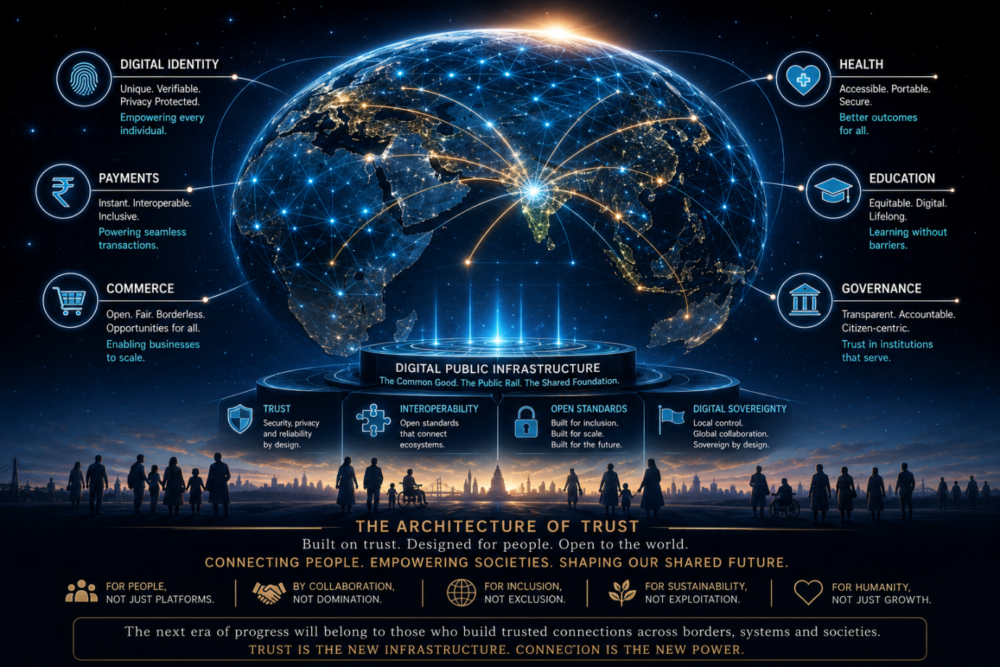
The Architecture of Trust
The great strategic transformations of history have rarely been recognised when they first began.
The Silk Roads were once ordinary trading routes. The Bretton Woods institutions initially appeared to be technical financial arrangements. The internet began as a specialised communications network. Each eventually reshaped the international order. Digital Public Infrastructure may represent the next such transformation.
If trusted, interoperable and sovereign digital ecosystems become the preferred foundation for international commerce and governance, Geo-digital will emerge as one of the defining dimensions of national power in the twenty-first century.
Indonesia’s decision should therefore not be viewed as an isolated technological initiative. It is an early indication that countries are beginning to value digital architecture as strategic infrastructure.
The coming decades will not belong solely to nations that command the largest militaries, the deepest financial markets, or the most advanced technologies. They will increasingly belong to those who build the trusted systems through which the world connects, transacts, and cooperates.
India has the opportunity to become the principal architect of that future. UPI is not the destination. It is the first visible milestone in a far larger journey — the emergence of the Geo-Digital age, where influence is earned not by controlling territory, but by building trust into the very architecture of the global economy.
# Geo-Digital is a strategic framework developed by the writer to describe the projection of national power through trusted Digital Public Infrastructure, interoperable standards and sovereign digital ecosystems. © 2026 Rajeev Chaudhry

Lt Gen Rajeev Chaudhry (Retd) writes on contemporary national and international issues, strategic implications of infrastructure development towards national power, geo-moral dimension of international relations, and leadership nuances in a changing social construct. The views expressed are of the author and do not necessarily reflect the views of Raksha Anirveda





