


On the bustling floors of Istanbul’s defence expo SAH 2026, where engineers, generals, and policymakers converge, a new narrative is unfolding. Türkiye is no longer merely showcasing weapons—it is unveiling a vision. A vision where the country is not just a participant in global security, but a central architect of it.
The most striking symbol of this transformation is the unveiling of the Yildirimhan intercontinental ballistic missile, a system that has instantly elevated Türkiye into an elite club of long-range strike powers. Capable of reaching speeds of up to Mach 25 and striking targets as far as 6,000 kilometres away, the missile represents a leap not just in range, but in ambition.

At such speeds and distances, the missile can potentially reach large parts of Europe, Asia, and Africa, fundamentally altering the strategic map surrounding Türkiye.
The Hypersonic Threshold
What makes this development particularly significant is its hypersonic capability. Hypersonic systems—typically defined as travelling at speeds above Mach 5—are among the most difficult weapons to intercept. Türkiye’s new missile, reportedly capable of manoeuvring at extreme speeds, is designed to evade traditional missile defence systems, making it a formidable deterrent.
This is not merely about speed. It is about survivability and unpredictability. A manoeuvrable hypersonic missile can alter its trajectory mid-flight, complicating detection and interception efforts. In strategic terms, this shifts the balance from defence to offence—forcing adversaries to rethink their security calculations.
From Ballistics to Cruise: A Layered Arsenal
Türkiye’s missile journey did not begin with Yildirimhan. Over the past decade, it has steadily expanded its arsenal, developing systems across the spectrum—from short-range tactical missiles to advanced air defence systems.

The Tayfun ballistic missile, for instance, marked an earlier milestone. With ranges extending beyond 800 kilometres and speeds reaching Mach 5–10, it demonstrated Türkiye’s growing capability in precision strike technology.
Parallel to offensive systems, Türkiye has also invested in defensive architecture. The SİPER air defence system, capable of engaging aircraft, cruise missiles, and UAVs at long ranges, forms a crucial part of its multi-layered defence shield.

The most striking symbol of this transformation is the unveiling of the Yildirimhan intercontinental ballistic missile, a system that has instantly elevated Türkiye into an elite club of long-range strike powers
This dual approach—developing both sword and shield—reflects a broader strategic doctrine: self-reliance combined with deterrence.
The Drone Revolution Continues
Long before hypersonic missiles captured headlines, Türkiye had already made its mark in another domain—unmanned systems.
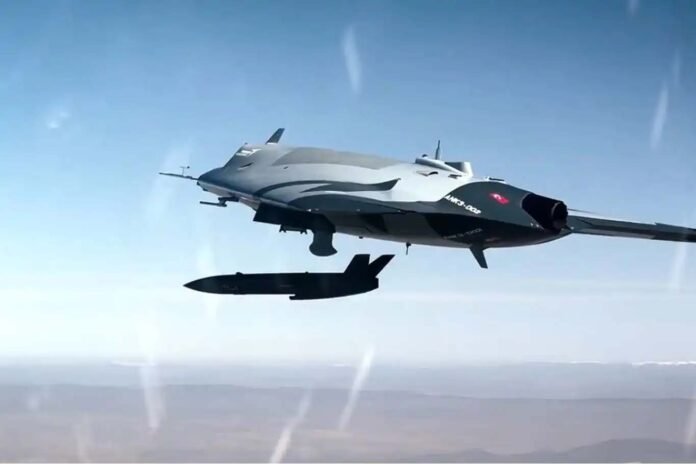
Platforms like the Bayraktar TB2 and next-generation systems such as the Bayraktar Kızılelma and TAI Anka-3 have redefined drone warfare. These systems are not just surveillance tools; they are autonomous combat platforms capable of launching air-to-air missiles, conducting electronic warfare, and operating with minimal human intervention.
At defence exhibitions like SAHA 2026, Turkish firms have gone even further, unveiling kamikaze drones and advanced missile systems designed for precision strikes and swarm warfare. These drones, often low-cost and highly effective, have become a cornerstone of Türkiye’s export success and battlefield reputation.
The integration of drones with missile systems is particularly noteworthy. It points toward a future where warfare is increasingly networked—where unmanned systems identify targets, relay data, and coordinate strikes in real time.
The SAHA 2026 Moment
The SAHA 2026 defence exhibition has emerged as a defining moment in Türkiye’s military-industrial narrative. It is here that the country showcased not just individual systems, but an ecosystem—one that spans missiles, drones, electronic warfare, and cyber capabilities.
The unveiling of Yildirimhan at this event was symbolic. It signalled that Türkiye is no longer content with incremental progress. It is aiming for breakthroughs—technologies that redefine its position on the global stage.
What makes this development particularly significant is its hypersonic capability. Hypersonic systems—typically defined as travelling at speeds above Mach 5—are among the most difficult weapons to intercept. Türkiye’s new missile, reportedly capable of manoeuvring at extreme speeds, is designed to evade traditional missile defence systems
The presence of multiple defence firms, each presenting cutting-edge innovations, underscored the depth of Türkiye’s industrial base. This is no longer a single-company success story; it is a national ecosystem driven by coordinated policy, investment, and ambition.
Strategic Implications: A New Power Equation
Türkiye’s rapid advancements are already reverberating across the region. For neighbouring countries and global powers alike, the implications are profound.
A 6,000-kilometre-range missile effectively extends Türkiye’s strategic reach far beyond its immediate borders. Combined with hypersonic capabilities, it introduces a level of deterrence that few countries possess.
Experts suggest that this could trigger a recalibration of military strategies in the Middle East, Eastern Europe, and beyond. As new capabilities emerge, so too does the risk of an arms race—particularly in hypersonic technologies, which are notoriously difficult to counter.
The SAHA 2026 defence exhibition has emerged as a defining moment in Türkiye’s military-industrial narrative. It is here that the country showcased not just individual systems, but an ecosystem—one that spans missiles, drones, electronic warfare, and cyber capabilities
At the same time, Türkiye’s emphasis on cost-effective systems has made it an attractive partner for countries seeking advanced capabilities without the high price tags associated with Western suppliers.
From Importer to Exporter
Perhaps the most remarkable aspect of Türkiye’s journey is its transformation from an arms importer to a leading exporter.
A decade ago, Türkiye relied heavily on foreign suppliers for critical defence systems. Today, it not only meets much of its own needs but also exports drones, missiles, and other equipment to countries across Europe, Asia, and Africa.
This shift has been driven by a deliberate policy of indigenisation—developing domestic capabilities, investing in research and development, and fostering collaboration between public institutions and private firms.
The result is a defence industry that is both resilient and competitive.
Türkiye–India Defence Relations: Cooperation, Competition, and Caution
India and Türkiye share a complex and evolving defence relationship. While there have been limited areas of cooperation—particularly in multilateral forums and defence dialogues—the relationship has often been overshadowed by geopolitical differences, especially Türkiye’s positions on issues concerning South Asia.
India and Türkiye share a complex and evolving defence relationship. While there have been limited areas of cooperation—particularly in multilateral forums and defence dialogues—the relationship has often been overshadowed by geopolitical differences, especially Türkiye’s positions on issues concerning South Asia
From a defence-industrial perspective, both countries are pursuing similar goals: self-reliance, indigenous development, and export competitiveness. However, Türkiye’s rapid advancements—particularly in drones and now long-range missiles—introduce a competitive dimension.
For India, the implications are twofold.
First, Türkiye’s emergence as a defence exporter—especially in drones—has already impacted global markets where India seeks to expand. Turkish systems, often cost-effective and battle-tested, have gained traction in Asia and Africa.
Second, the development of long-range and hypersonic-capable missiles underscores the accelerating pace of military technology. While Türkiye’s new missile does not directly target India, it contributes to a broader global trend that India must respond to—through its own missile programmes, air defence systems, and strategic partnerships.
At the same time, Türkiye’s growing ties with countries in India’s neighbourhood could influence regional security dynamics, making it essential for New Delhi to closely monitor Ankara’s defence trajectory.
Türkiye’s missile odyssey is about more than weapons. It is about identity. As the world watches this transformation unfold, one thing is clear: the era of Türkiye as a passive player in defence is over. A new chapter has begun—one written in speed, precision, and the unmistakable signature of ambition
The Road Ahead
Despite its achievements, Türkiye’s path forward is not without challenges. Developing and maintaining advanced systems such as hypersonic missiles requires sustained investment, technological innovation, and rigorous testing.
There are also geopolitical considerations. As Türkiye’s capabilities grow, so too does scrutiny from global powers concerned about the proliferation of advanced weapons.
Yet, if recent developments are any indication, Türkiye is unlikely to slow down.
A New Strategic Identity
In the end, Türkiye’s missile odyssey is about more than weapons. It is about identity.
It is about a nation redefining its role—from a regional actor to a strategic power with global reach. From drones that dominate battlefields to missiles that reshape deterrence, Türkiye is crafting a new narrative—one where technology, ambition, and geopolitics converge.
And as the world watches this transformation unfold, one thing is clear: the era of Türkiye as a passive player in defence is over. A new chapter has begun—one written in speed, precision, and the unmistakable signature of ambition.

-The writer is a New Delhi-based senior commentator on international and strategic affairs, environmental issues, an interfaith practitioner, and a media consultant. The views expressed are personal and do not necessarily carry the views of Raksha Anirveda





