


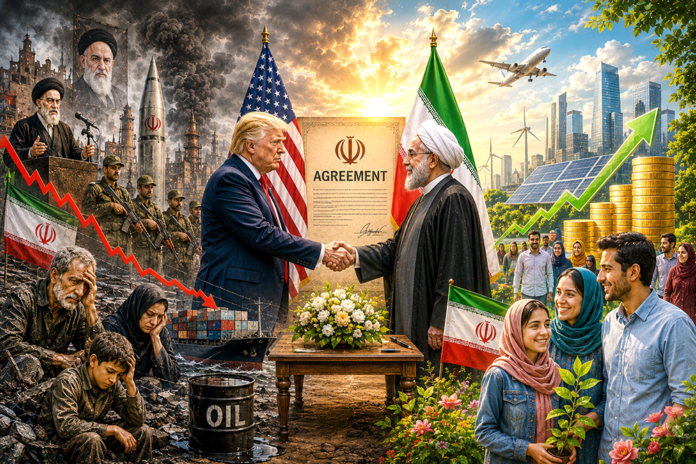
For a very long time, ordinary people in Iran had been waiting for some good news. They wanted peace and relief, but the wait stretched on much longer than anyone had expected. During the recent conflict, American and Israeli airstrikes badly damaged Iran’s factories, industries and basic infrastructure. On top of this, American naval forces blocked Iran’s ports, which means ships carrying goods could not enter or leave freely. This blockade choked the country’s trade and made daily life harder for everyone.
Finally, on June 17, a small ray of hope appeared. Donald Trump and Iran signed a memorandum of understanding (MoU) in Versailles. A memorandum of understanding is simply a written promise between two sides to talk seriously and work towards a final agreement. This MoU gives both sides 60 days to negotiate a proper deal. It also dangles a big carrot in front of Iran: possibly up to $300 billion in investment, but only if Iran cooperates. However, how much money Iran will actually get is still uncertain, and this could become a big point of fighting later.

Meanwhile, life inside Iran has become painfully difficult. Last month, inflation touched 84 percent compared to a year ago, which is more than double the level seen in January. Inflation simply means prices going up, and here food prices shot up even faster, by 131 percent. Because of the blockade, imports were badly disrupted. Since mid-April, about 3,000 containers meant for Iran got stuck at Pakistani ports, and grain shipments to Iran’s main agricultural import hub fell by 40 percent.
A small ray of hope has appeared. Donald Trump and Iran signed a memorandum of understanding (MoU) in Versailles. This MoU gives both sides 60 days to negotiate a proper deal. It also dangles a big carrot in front of Iran: possibly up to $300 billion in investment, but only if Iran cooperates
The poor are suffering the most. Many families are now so short of money that they are buying even basic items like meat and bread on instalment payments, meaning they pay slowly in small parts. According to Iran’s Deputy Labour Minister, as many as 2 million people may have lost their jobs, which is about 7 percent of all working people in the country. An Iranian newspaper reported that on one job website, around 360 people applied for a single opening, double the usual number. That shows how desperate the search for work has become. President Masoud Pezeshkian himself admitted that protecting people’s livelihoods is now Iran’s biggest challenge.
Interestingly, some of the damage was self-inflicted. During the January protests, the Iranian government itself blocked a large part of the global internet, only restoring it in May. This hurt online businesses badly. Iran’s largest online shopping company, Digikala, had to cut its workforce by 3 percent. But the bigger blows came from American and Israeli attacks on factories, oil refineries, steel plants and Iran’s biggest petrochemical complex. Since that complex was hit in April, Iran stopped exporting petrochemical products, which normally make up nearly one-third of its non-oil exports.
The repair bill is enormous. One energy firm estimates that fixing Iran’s damaged energy facilities alone could cost up to $19 billion, while a US think tank puts the total damage at around $144 billion, roughly half of Iran’s entire economy. With the MoU signed, the United States is now expected to ease the blockade and reduce sanctions. Sanctions are punishments, like trade and money restrictions, used to pressure a country. Lifting them matters a lot because the blockade had crushed Iran’s oil exports, which fell by 84 percent in May.

The repair bill is enormous. One energy firm estimates that fixing Iran’s damaged energy facilities alone could cost up to $19 billion, while a US think tank puts the total damage at around $144 billion, roughly half of Iran’s entire economy. With the MoU signed, the United States is now expected to ease the blockade and reduce sanctions
The biggest possible reward is that $300 billion investment package, almost equal to Iran’s full yearly income. US Vice President J D Vance hinted Iran could receive it if talks go well. After the announcement, Iran’s currency, the rial, actually grew stronger. But there is a catch. On June 17, Trump clearly said the United States would not put its own money into the project, nor had he asked Gulf countries to fund it.
So where will the money come from? Foreign companies are unlikely to invest unless sanctions are fully removed. Even then, hardline politicians in America will strongly resist. Senator Lindsey Graham compared it to helping rebuild a country while the same criticised leaders stay in power. There is another tricky problem: a large part of Iran’s industries is controlled by the Islamic Revolutionary Guard Corps, a powerful and hardline military group. Allowing big foreign investment would mean removing sanctions on them too, which is highly controversial.

History shows the difficulty. Even small sanction reductions during Barack Obama’s nuclear deal about ten years ago triggered loud criticism. So while Iran’s ruling leadership may gain from this new deal, the sad truth is that the people who are already struggling may see very little real improvement in their everyday lives.

-The writer is an award-winning science communicator and a Defence, Aerospace & Geopolitical Analyst. He is the Managing Director of ADD Engineering Components India Pvt. Ltd., a subsidiary of ADD Engineering GmbH, Germany. You can reach him at: girishlinganna@gmail.com. The views expressed are personal and do not necessarily carry the views of Raksha Anirveda





