


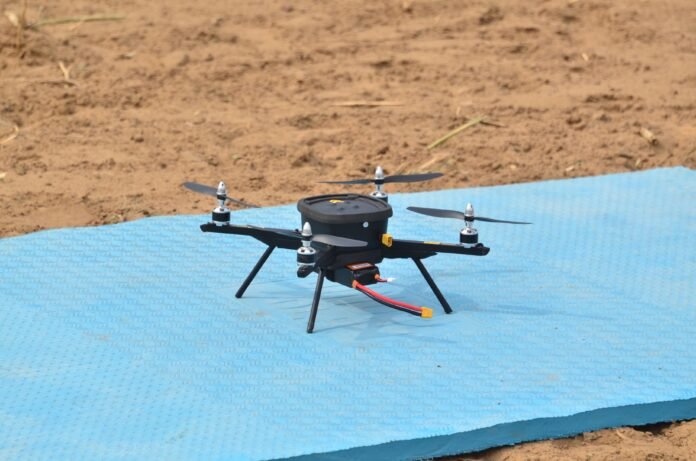
As dawn breaks over India’s strategic landscape, a silent transformation is taking shape—one that does not roar like fighter jets or thunder like artillery, but watches, waits, and endures. The country’s ambitious ₹25,000 crore tri-service Medium Altitude Long Endurance (MALE) drone programme is now edging toward a crucial turning point, signalling a shift in how India prepares for the wars of tomorrow.
At the heart of this story lies a massive plan to acquire 87 advanced MALE unmanned aerial vehicles for the Indian Army, Navy, and Air Force. These drones are not mere machines; they are designed to be persistent sentinels—capable of flying for over 30 hours at altitudes above 35,000 feet, gathering intelligence, tracking threats, and even striking targets when required.

The Quiet March to RFQ
The programme, launched under the “Make in India” initiative in late 2025, is now approaching the Request for Quote (RFQ) stage, and expected to be executed by mid-2026. This shift marks more than bureaucratic progress—it represents the transition from broad proposals to hard negotiations on price, capability, and delivery timelines.
For months, India’s leading defence firms have been locked in intense preparations. Giants like Adani Defence, Tata Advanced Systems, Larsen & Toubro, and Hindustan Aeronautics Limited have been racing to finalise bids, often partnering with global aerospace leaders such as Israel Aerospace Industries, Elbit Systems, and General Atomics.
But this is not a straightforward race. The complexity of the project has already forced deadline extensions, pushing submissions toward mid-2026. Global geopolitical tensions—especially in West Asia—have added unexpected hurdles, slowing negotiations and logistics between Indian firms and their foreign collaborators.
A Contest of Technology and Sovereignty
Unlike earlier defence procurements, this project is as much about ‘technology ownership’ as it is about ‘acquisition’. The Ministry of Defence has set a strict requirement: at least 60% indigenous content.

This means the winning companies must not only assemble drones in India but also ensure deep technology transfer—covering software source codes, engines, sensors, and communication systems. The goal is clear: India does not want to merely operate drones; it wants to build, maintain, and upgrade them independently.
The evaluation process in the RFQ phase will therefore go beyond pricing. Authorities will scrutinise the depth of technology transfer, the feasibility of local manufacturing, and the long-term sustainability of maintenance ecosystems.

Testing the Future
Once the bids are finalised, the project will move swiftly into field trials. Within six months, prototype drones will be tested across diverse terrains—from the icy heights of Ladakh to the vast maritime stretches of the Indian Ocean.
These trials will push the drones to their limits—examining endurance, sensor accuracy, communication reliability, and their ability to operate seamlessly within India’s existing military networks.
In essence, these machines must prove they can function as the backbone of a modern, network-centric battlefield.
A Dual-Vendor Strategy
One of the most intriguing aspects of the programme is its dual-vendor model. Instead of awarding the contract to a single company, the government plans to split it—64% to the lowest bidder and 36% to the second-lowest.
This approach serves multiple purposes. It avoids monopolies, ensures competition, and creates two independent production lines. In times of crisis, such redundancy could prove invaluable, guaranteeing uninterrupted supply and operational readiness.
Beyond Procurement: Building an Ecosystem
This project is not just about acquiring drones; it is about reshaping India’s defence-industrial base. By compelling domestic firms to collaborate with global leaders while retaining control over core technologies, the programme is nurturing a new generation of aerospace capabilities.
The long-term vision extends beyond national security. With global demand for unmanned systems rising rapidly, India aims to position itself as a potential exporter of MALE-class drones in the coming decade.
The Strategic Imperative
The urgency behind this initiative is rooted in evolving security challenges. From high-altitude standoffs along the Line of Actual Control to maritime competition in the Indian Ocean, India faces a dynamic threat environment.
In such scenarios, MALE drones offer a decisive advantage. They provide continuous surveillance, reduce risks to human pilots, and enable faster, data-driven decision-making. In modern warfare, information is power—and these drones are designed to deliver it in real time.
A Defining Moment
As the programme inches toward the RFQ stage, it stands at a crossroads. Success could herald a new era where India not only meets its defence needs but also becomes a global hub for advanced unmanned systems. Failure, however, would risk prolonging dependence on foreign technologies.
For now, the skies remain quiet. But soon, if this project unfolds as planned, they will be filled with silent watchers—India’s own—guarding borders, seas, and strategic interests with unblinking precision.






