


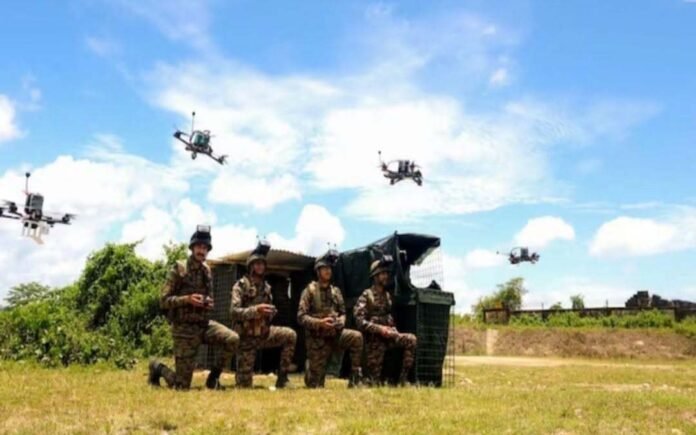
Jalandhar. Demonstrating a massive leap toward modernised aerial warfare, the Indian Army has raised its dedicated drone-operating force, titled Baaz Battalions, along the sensitive western border facing Pakistan. Operating under the command of the Army’s 11 Corps – headquartered in Jalandhar, Punjab – the newly formed unit serves as a core pillar of the military’s post-Operation Sindoor organisational transformation.
Strategic Airborne Evolution
Named after the hawk (Baaz), a bird renowned for its keen eyesight and predatory precision, these specialised battalions mark a transition from fragmented unmanned aerial vehicle (UAV) usage to a centralised operational doctrine. The initiative addresses tactical imperatives highlighted during border standoffs along the Line of Actual Control (LAC) and lessons drawn from modern multi-domain engagements.

Rather than treating drone platforms as isolated tactical add-ons, the Baaz units will act as a centralised “brain”. They are tasked with orchestrating the entire lifecycle of unmanned systems – ranging from deployment and rapid software integration to managing high-density real-time intelligence feeds.
At the top of the command structure sit the Baaz Battalions, which function as the central hub responsible for command, fleet management and operational data exploitation.
From this centralised command, operations flow directly down into two specialised operational arms:
- Tactical Units (Ashini Drone Platoons): Tasked with close-range surveillance and squad-level situational awareness.
- Fire & Strike Units (Divyastra / Artillery): Specialised in target destruction and kinetic operations using loitering munitions.
A Heterogeneous Fleet Ecosystem
The Baaz Battalions bring together a diverse, multi-tiered fleet of unmanned platforms capable of persistent border surveillance, target acquisition and electronic mapping:

- Strategic Long-Endurance UAVs: High-altitude platforms including the American-built MQ-9B Predator drones from General Atomics alongside Israeli-built Heron and Hermes systems.
- Indigenous Combat & Reconnaissance: Domestically developed platforms, including the Defence Research and Development Organisation’s (DRDO) Ghatak stealth UAV.
- Tactical & Swarm Capabilities: Custom cutting-edge platforms sourced from Indian defence tech startups like ideaForge, SMPP and NewSpace Research.
Multi-Layered Battlefield Integration
This strategic integration fits seamlessly into the Army’s multi-tiered drone architecture. While frontline infantry divisions rely on Ashini platoons for immediate squad-level situational awareness, and artillery regiments employ Divyastra units to direct loitering munitions, the Baaz Battalions operate at a higher echelon. They execute deep-penetration surveillance, process high-bandwidth data streams and feed real-time coordinates back to strike forces.
By housing a dedicated pool of technical specialists, operators and mission planners, under a unified command structure, the Indian Army significantly compresses its sensor-to-shooter loop. The raising of the Jalandhar unit heralds a decisive shift toward sustained, network-centric aerial dominance across the western theatre.







