


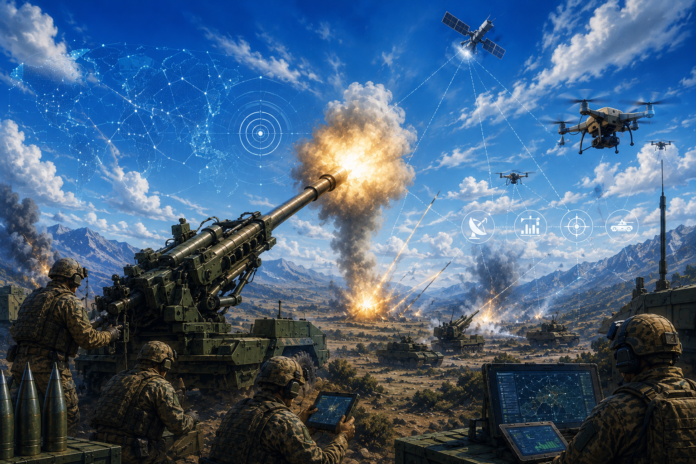
Rockets, missiles and UAVs are playing an increasing role in ongoing conflicts. The US and Israel exploited their airpower in Iran, as it lacked air defences. Iran responded with drones and missiles. The Ukraine conflict has been a learning curve, where the nature of warfare has shifted from contact (with which it commenced) to non-contact, with both sides concentrating on utilising rockets, missiles and UAVs to target not only depth areas, but also movement of troops in the immediate battlefield. Territorial gains are slow, as the assembly of troops can no longer be hidden. Mechanised forces have limited utility in a battlefield saturated with satellites and UAVs. Over 80% of Russian casualties are from Ukrainian UAV strikes.
Addressing the press before Army Day in January this year, the army chief, General Upendra Dwivedi, mentioned that India, based on lessons from ongoing conflicts and Operation Sindoor, is creating a rocket cum missile force. “Pakistan has established a rocket force, and China has also created one,” he added. A pending decision is about its command and control, implying whether it would be under the army or centralised under the CDS. In any case, large components of those in raising and manning this force would flow from the artillery.

On restructuring within the army, post Operation Sindoor, the army chief highlighted the raising of Shaktibaan regiments and Divyastra batteries of the artillery, among others. Shaktibaan regiments would be equipped with surveillance and loiter drones to engage targets up to 500 km. Divyastra batteries will be part of select artillery regiments and will possess UAVs with both surveillance and strike capabilities, in addition to artillery guns. Their structure would be dependent on the formation they support.
Guns, rockets and missiles, currently under induction into the artillery, have increased ranges, accuracy and lethality. Artillery can acquire and engage targets up to and beyond 300 km in extremely short timeframes, employing a combination of guns and rockets. With missiles, the ranges could be far greater. The artillery is also the ears and eyes of formations, conducting surveillance 24X7. This is in tune with the changing nature of warfare.
Army Chief General Upendra Dwivedi has said India is creating a rocket cum missile force. Its command and control, implying whether it would be under the army or the CDS, is under consideration. In any case, large components of those in raising and manning this force would flow from the artillery
It is a fact that Pakistan will not stop supporting terrorism, nor would talks bring about peace. This implies that terrorist strikes, testing Indian patience, will happen, as will our counter to them. In all probability, our response would commence with employment of long-range vectors engaging select strategic targets. Considering the density of air defence, the ideal option would be exploiting the accuracy of missiles and rockets, as well as the long ranges of air-delivered weapons. Pakistan’s reaction will determine the future course of action, including a full-scale war under a nuclear overhang.
With China, the LAC will always be unstable, despite ongoing talks. China has displayed that it cannot be trusted, and troops must remain alert. The neighbourhood remains under stress. A powerful missile and rocket force alongside surveillance is an ideal counter to rising threats. This implies that the army must, on priority, raise the number of artillery divisions equipped with rocket, missile and UAV regiments to enhance its firepower.

Technology will also impact the future form of warfare. Proliferation of UAVs and satellites will deny employment of large mechanised columns. Any assembly of force could be a target for swarms of UAVs alongside missiles and rockets. Conflicts will no longer commence with contact battles, involving infantry and armour, as was the norm, but with long-range vectors and UAVs, targeting the adversary’s critical installations, including command, control and communications. Hybrid warfare would be ongoing.
Contact battle would come at a later phase, if it does, post destruction of the enemy’s surveillance devices, and would be limited in depth and range, especially under a nuclear overhang.

Thus, the artillery, aptly termed as the ‘God of War,’ would play a major role in future conflicts from its commencement to its termination. It currently manages the army’s long-range weapon systems and UAVs designed to target deep within enemy territory. It will also be responsible for close support and early warning to troops deployed along the forward line by use of UAVs and precision ammunition, since it may not be possible for air power to fly freely in a heavily contested airspace over the combat area.
Unless the army changes, it will continue to fight tomorrow’s war with yesterday’s concepts, by pushing those essential for coordinating operations away from the mainstream. It may work in small skirmishes, as in Sindoor, where limited resources were employed, but not when hostilities move beyond these levels
During Sindoor, artillery fire demolished terrorist camps located within 30 km of the border and also Pakistan’s posts, which had supported infiltration. The firing was accurate with no collateral damage.
The artillery’s role has changed from one which supported contact operations to one which initiates conflicts and aims to deter the enemy from expanding it further. Success in future conflicts would depend on the manner in which artillery firepower is applied. Artillery officers are trained in the nuances of massed fire, integrating different weapon systems onto a common plan to ensure optimum utilisation of firepower while simultaneously ensuring the survivability of platforms. Their involvement at every level is essential for ensuring success in future operations. However, despite its critical role in future conflicts, artillery is not being given its due.
The current concept of combat and support weapons, resulting in promotions and selection to higher ranks, came into existence when war was expected to commence with large-scale manoeuvre of mechanised forces and also infantry assaulting objectives across different terrains. Those were days when the artillery participated in a supporting role.
Currently, the scenario has reversed. Surprise by employing large mechanised forces is no longer feasible, and any assembly of troops would be detected and engaged. Operations will involve small teams operating with limited objectives covered by intense artillery fire. Hence, artillery would be a victory-determining force.
However, in the Indian army, artillery officers appear to be increasingly sidelined at apex levels. Currently, most senior artillery officers are kept away from the mainstream, posted largely to non-combat establishments, reducing the numbers needed to manage complex operations.
The current selection system has created a vicious cycle in which few artillery officers opt to join streams for higher command. The result is a loss for the forces, especially as this arm will play a crucial role in future wars. Corrective measures must be taken now. The longer we take, the more we will fumble
Is this because there is an unwillingness to accept the emerging nature of war (while referring to it) and change existing concepts of promotions and command, thereby defending age-old turf? Unless the army changes, it will continue to fight tomorrow’s war with yesterday’s concepts, by pushing those essential for coordinating operations away from the mainstream. It may work in small skirmishes, as in Sindoor, where limited resources were employed, but their absence will be evident once hostilities move beyond these levels.
The current selection system has been so mitigated that it has created a vicious cycle, resulting in few artillery officers opting to join streams for higher command. The result is a loss for the forces, especially as this arm will play a crucial role in future wars. Corrective measures must be taken now. The top brass of the army needs to look with an open mind at the way conflicts would emerge and re-evaluate their archival selection systems to include those whose experience and knowledge would ensure success to rise. The longer we take, the more we will fumble.

The writer is a strategic analyst and a motivator. He can be reached at @kakar_harsha. The views expressed are of the writer and do not necessarily reflect the views of Raksha Anirveda





