


Nearly 200 nations gathered in Antalya, Türkiye, with a shared objective: to confront a climate crisis that recognises neither political boundaries nor national interests. Two weeks of negotiations, more than 50 hours of overtime and an unprecedented diplomatic effort eventually produced an outcome that exposed the fragility of international cooperation. COP31 concluded on November 22 without agreement on its overarching political declaration, the proposed Antalya Pact. The last comparable failure was Copenhagen in 2009. The symbolism was difficult to ignore. Sixteen years after the world struggled to establish a common climate framework, it has again failed to agree on the direction of its collective future.
The immediate disagreement centred on fossil fuels. The European Union, the United Kingdom and several climate-vulnerable nations wanted an explicit commitment to transition away from coal, oil and natural gas. Saudi Arabia, Russia and other fossil-fuel-dependent interests resisted such language. The final draft omitted the commitment, prompting its rejection by countries that considered the proposed agreement inadequate. Climate finance and the role of carbon capture technology further widened the divisions.

Yet, the real significance of the Antalya summit lies beyond the negotiating text. It exposed a fundamental contradiction in contemporary international relations. Nations acknowledge that the climate crisis demands collective action, but they remain unwilling to subordinate their economic interests, energy security and strategic autonomy to a common timetable. Climate change has become a global security challenge, but the instruments required to address it remain firmly embedded in national politics.
The collapse should therefore be understood not simply as a diplomatic failure, but as a collision between environmental necessity and geopolitical reality.
Fossil Fuels: The Economics of Power
At the heart of the confrontation lies a question that international diplomacy has repeatedly attempted to soften: can the world genuinely transition away from fossil fuels without fundamentally altering the existing architecture of economic and geopolitical power?
Oil, coal and natural gas are not merely commodities; they sustain industries, transport systems, electricity networks, government revenues and international trade.
Oil, coal and natural gas are not merely commodities; they sustain industries, transport systems, electricity networks, government revenues and international trade. For exporting countries, hydrocarbons represent economic prosperity, fiscal stability and strategic influence. For importing nations, they remain essential to industrial production and energy security. The interests may differ, but dependence is widespread.

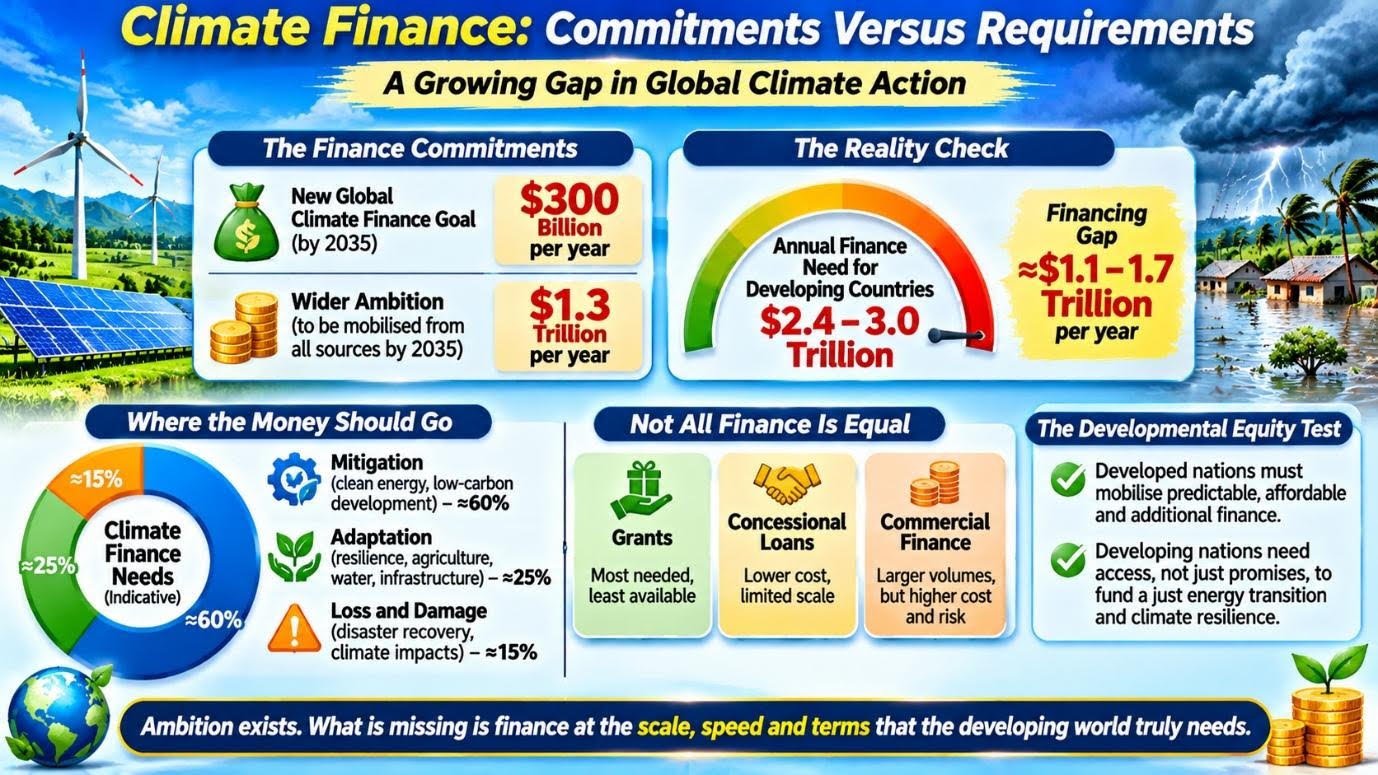
The scale of the challenge is evident in the numbers. Fossil fuels still account for approximately 80% of global primary energy consumption, despite a decade of rapid renewable expansion. Coal and gas continue to dominate electricity generation, while oil remains indispensable to transportation and petrochemicals.
This dependence explains why negotiations become difficult when general commitments are translated into specific obligations. A declaration to accelerate clean energy attracts broad support; a binding commitment to reduce fossil-fuel production and consumption creates identifiable economic winners and losers.

There is also a question of sequencing. Renewable capacity can be installed rapidly, but replacing dependable generation, industrial heat, aviation fuel, shipping energy and petrochemical feedstocks requires technological, financial and infrastructural transformation. Energy storage, transmission networks and reliable alternative fuels must expand alongside renewable generation.
The oil-producing countries are not the only ones defending their interests. Major industrial economies also seek affordable energy and competitive manufacturing. The difference is that some possess greater financial and technological capacity to absorb transition costs.
Antalya exposed this uncomfortable reality: the world is prepared to endorse an energy transition in principle, but its members remain divided over the redistribution of power and prosperity that transition would entail.
Climate Justice: The Unresolved Historical Bargain
The second fault line is climate justice. It is impossible to examine the disagreement over fossil fuels without investigating who created the accumulated emissions, who benefited from carbon-intensive industrialisation, and who is being asked to bear the cost of changing course.
Developed economies built much of their industrial wealth through coal, oil and gas. Their accumulated infrastructure, technological advantages and financial institutions were shaped during an era when environmental costs were either ignored or inadequately understood. Developing nations, meanwhile, are being asked to pursue cleaner pathways while addressing poverty, inadequate infrastructure, employment, urbanisation and rising energy requirements.
This is not an argument for unlimited emissions. It is an argument for differentiated responsibility and equitable opportunity.
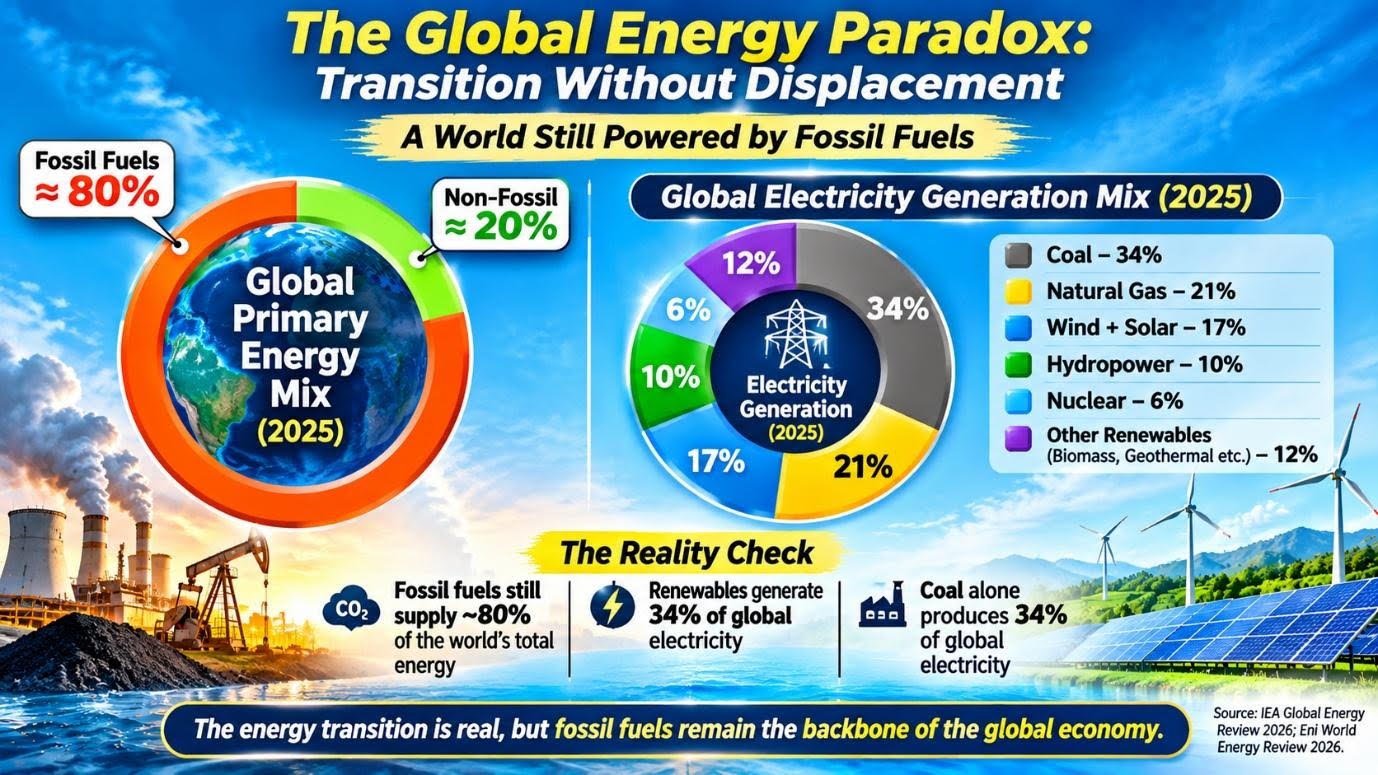
The climate-finance debate illustrates the problem. At COP29, countries agreed on a new goal of at least $300 billion annually by 2035 for developing nations, with a wider ambition to scale finance from public and private sources to $1.3 trillion annually. Yet the distinction between announced targets, accessible finance, actual disbursement and affordable funding remains crucial.
For vulnerable countries, adaptation is not a distant policy objective. It concerns coastal protection, agricultural resilience, drinking water, disaster preparedness and the survival of communities already exposed to climate extremes. Finance for adaptation and loss and damage cannot be treated as secondary to investments in emissions reduction.
Fossil fuels account for 80% of global primary energy consumption. Coal and gas dominate electricity generation, while oil remains indispensable to transportation and petrochemicals
Equally, historical responsibility cannot become a permanent exemption from present-day action. Major emerging economies must also contribute according to their capabilities and changing economic circumstances.
The climate bargain must therefore move beyond competing claims of historical guilt. It must establish a practical compact in which responsibility, financial capacity, technological access and developmental needs are recognised together.
Without that compact, climate negotiations will continue to reproduce the divisions they are intended to resolve.
Energy Security: The Geopolitical Contradiction
The contemporary energy transition is unfolding in an increasingly unstable geopolitical environment. The Russia-Ukraine conflict, tensions in West Asia, disruptions to maritime routes and the strategic importance of the Strait of Hormuz have reinforced the vulnerability of global energy supply chains.
For governments, energy security is not negotiable. An electricity shortage can disrupt industry, undermine economic growth and generate political instability. An interruption in oil or gas supplies can rapidly become a national security concern.
This explains the paradox of climate diplomacy. Countries may commit to reducing fossil-fuel dependence while simultaneously securing long-term hydrocarbon supplies to protect their economies against geopolitical uncertainty.
The transition also creates new strategic dependencies. Solar panels, batteries, wind turbines, electric vehicles and grid technologies require critical minerals, rare earth elements, processing capacity and sophisticated manufacturing ecosystems. Control over these supply chains is becoming an important instrument of economic leverage.
The world could gradually reduce its dependence on oil-producing regions while becoming more dependent on countries controlling critical mineral processing, battery technologies and clean-energy manufacturing.
Consequently, the transition from fossil fuels is not necessarily a transition away from energy geopolitics. It may simply change its geography and principal instruments.
A credible climate strategy must therefore integrate environmental objectives with diversification of supply chains, domestic manufacturing, strategic reserves, technology partnerships and resilient electricity infrastructure.
Developed countries built much of their industrial wealth through coal, oil and gas. But developing nations are being asked to pursue cleaner pathways while addressing poverty, inadequate infrastructure, and rising energy requirements
The lesson is clear: climate security cannot be pursued at the expense of energy security. The two must increasingly become complementary elements of national security.
Carbon Capture: Technology vs Political Courage
Carbon capture and storage emerged as another contentious issue at Antalya. Its supporters regard it as an essential instrument for reducing emissions from industries where complete electrification is difficult, including cement, steel and certain chemical processes. Critics fear that its growing prominence could provide political cover for continued fossil-fuel expansion.
Both arguments deserve consideration.
Carbon capture can have a legitimate role in reducing emissions from hard-to-abate industrial processes. It can also help address emissions that cannot be eliminated economically through existing technologies. However, its effectiveness depends on capture rates, lifecycle emissions, transportation infrastructure, permanent storage, monitoring and costs.
The danger arises when future technological possibilities are used to justify present-day inaction. Capturing carbon after combustion cannot automatically be treated as equivalent to avoiding its release in the first place. Nor can speculative large-scale removal compensate indefinitely for continued expansion of emissions-intensive production.
The strategic answer is not to reject technology but to establish clear standards for its application. Carbon capture should complement deep emissions reductions, not become a substitute for them.
The same principle must guide investment in hydrogen, nuclear power, battery storage and other emerging technologies. No single technology will deliver the transition. A diversified portfolio, adapted to national circumstances, is more credible than ideological dependence on one solution.
For governments, energy security is not negotiable. An interruption in oil or gas supplies can rapidly become a national security concern. This explains the paradox of climate diplomacy
Antalya demonstrated that technological innovation cannot resolve a political disagreement over who should change, how quickly and at whose expense.
Multilateralism: When Consensus Becomes a Liability
The failure of COP31 also raises uncomfortable questions about the effectiveness of multilateral institutions. The United Nations climate framework operates through consensus among nearly 200 parties, each with different economic structures, political priorities and development trajectories. This gives every country a voice, but it also gives determined opponents considerable leverage over the collective outcome.
Consensus is valuable when it produces legitimacy and shared responsibility. It becomes counterproductive when the search for unanimity reduces ambition to the lowest acceptable common denominator.
The absence of a final political agreement at Antalya should not, however, be confused with the collapse of the entire climate process. Individual negotiating tracks produced decisions, while voluntary initiatives continued. Nearly 100 countries supported a separate ambition to increase electricity’s share in final energy consumption to 35% by 2035, although the proposed global pledge did not secure agreement.
This distinction matters. Multilateralism must be judged not merely by the declarations it produces, but by the implementation it enables. The Paris Agreement remains in force; national commitments continue to operate and investments in clean energy are not dependent on the success of an annual summit.
Nevertheless, repeated diplomatic deadlocks undermine confidence, particularly among vulnerable nations that depend on international cooperation for their survival. The absence of direct US federal participation at Antalya further illustrated the difficulty of securing sustained leadership from major powers.
The international climate architecture needs reform. It must preserve universal participation while creating stronger mechanisms for implementation, accountability, technology sharing and finance.
The world cannot afford a system in which procedural consensus becomes more important than measurable environmental progress.
India’s Position: Development without Developmental Surrender
For India, the outcome of COP31 carries particular significance. It must be viewed through the intersection of developmental aspirations, energy security and climate responsibility. India is neither a passive participant in global climate diplomacy nor a country willing to accept externally determined limits on its economic growth.
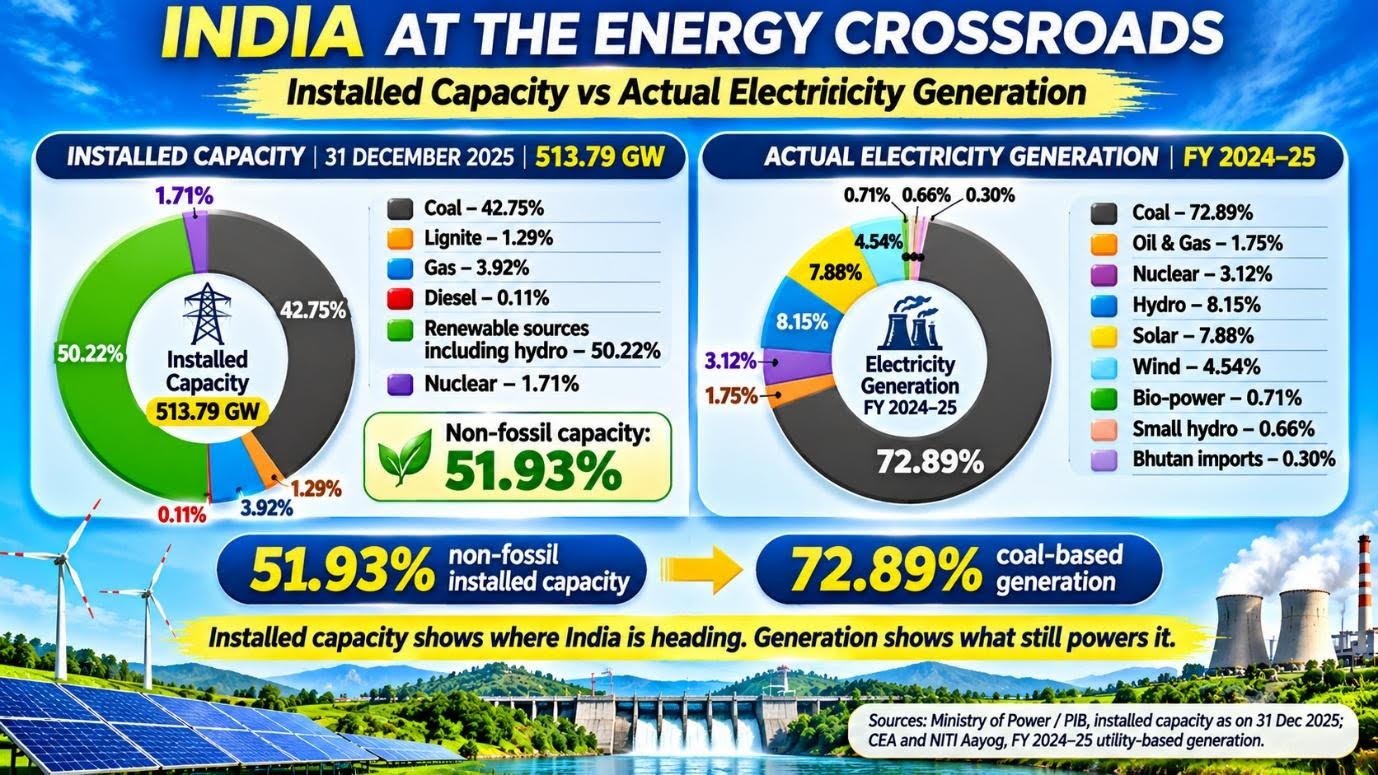
In 2024-25, coal generated approximately 73% of India’s electricity, even as solar, wind and hydro capacity expanded rapidly. By December 2025, non-fossil sources had crossed 51% of installed electricity capacity
Its circumstances are distinct. A large population, expanding industrial base, rapid urbanisation and substantial infrastructure requirements will continue to drive energy demand. Affordable electricity is fundamental to manufacturing, transportation, agriculture, digital infrastructure and the aspirations of millions seeking a better quality of life.
The numbers explain the complexity. In 2024-25, coal generated approximately 73% of India’s electricity, even as solar, wind and hydro capacity expanded rapidly. By December 2025, non-fossil sources had crossed 51% of installed electricity capacity. The distinction between installed capacity and actual electricity generation is important: renewable capacity is growing faster than its contribution to dependable generation.
India’s transition must therefore be judged through the realities of affordability, reliability, accessibility and sustainability. It cannot simply replicate the pathway followed by industrialised economies with different historical circumstances and financial resources.
India has already demonstrated considerable ambition through renewable energy expansion, its 2070 net-zero commitment and its international leadership on solar cooperation. Its challenge is to accelerate this transformation while maintaining the capacity to power economic growth.
There are three strategic priorities:
- India must diversify its energy portfolio through solar, wind, hydroelectricity, nuclear power, green hydrogen and emerging storage technologies, while managing the gradual reduction of coal dependence responsibly.
- It must secure technology and supply chains for critical minerals, batteries, semiconductors and clean-energy equipment. Strategic autonomy in the emerging energy economy will be as important as energy independence in the conventional one.
India’s climate leadership will ultimately be measured not by the commitments it makes at international conferences, but by how successfully it reconciles environmental responsibility with the aspirations of its people
- India must insist that climate finance and technology transfer become accessible instruments of development rather than diplomatic promises. Climate justice must translate into affordable capital, research partnerships and practical assistance.
India should neither obstruct the global transition nor surrender its developmental choices. Its position must remain one of constructive engagement, differentiated responsibility and strategic autonomy.
India’s climate leadership will ultimately be measured not by the commitments it makes at international conferences, but by how successfully it reconciles environmental responsibility with the aspirations of its people.
Beyond Antalya: Need for a new Climate Compact
The collapse of COP31 should serve as a warning, not an excuse for abandoning climate cooperation. The physical consequences of global warming will not wait for diplomatic consensus. Extreme heat, floods, droughts, coastal erosion and disruptions to food and water security are already imposing enormous economic and human costs. The scientific urgency remains unchanged by the failure of a negotiating conference.
The next climate summit in Addis Ababa will inherit the unresolved questions of Antalya. But repeating the familiar language of ambition, responsibility and partnership will achieve little unless countries address the structural disagreements beneath them.
The world needs a more pragmatic climate compact built around four principles:
- Measurable emissions reductions.
- Equitable and accessible climate finance.
- Accelerated technology cooperation.
- Recognition of legitimate developmental and energy-security requirements.
There must also be greater honesty about the transition itself. Renewable energy is expanding, but fossil fuels still dominate global primary energy consumption. Electrification is essential, but it requires reliable grids, storage and generation. Carbon capture has a role but cannot become a licence for indefinite fossil-fuel dependence. Climate finance is indispensable, but commitments must translate into actual resources.
The collapse of COP31 should serve as a warning, not an excuse for abandoning climate cooperation. The physical consequences of global warming will not wait for diplomatic consensus
Above all, climate diplomacy must move away from the false choice between development and environmental protection. The objective should be to make economic development progressively less carbon-intensive, technologically more efficient and environmentally sustainable.
Antalya exposed the distance between the world’s climate aspirations and its political willingness to implement them. It also demonstrated that the energy transition is no longer simply an environmental agenda. It is a contest over industrial competitiveness, financial resources, technological dominance and the future distribution of global power.
The planet cannot afford another generation of conferences that mistake declarations for action. Nor can developing countries be expected to finance a transition whose costs they did little to create, and whose benefits may remain unequally distributed.
The ultimate test of global climate leadership is not how convincingly nations promise to save the planet, but how fairly and effectively they share the responsibility of doing so.
The world may be divided over who should give up fossil fuels, but it cannot afford to remain divided over the future it is trying to protect.

Lt Gen Rajeev Chaudhry (Retd) writes on contemporary national and international issues, strategic implications of infrastructure development towards national power, geo-moral dimension of international relations, and leadership nuances in a changing social construct. The views expressed are of the author and do not necessarily reflect the views of Raksha Anirveda