


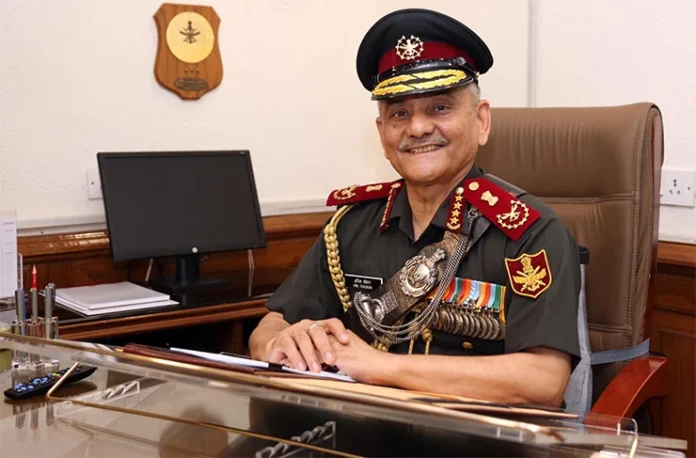
Two forthcoming actions, the appointment of a new CDS as General Anil Chauhan finishes his tenure by the end of May, and the likely formation of Integrated Theatre Commands (ITCs), have reignited the battle between services for dominance. There have been discussions and articles highlighting individual service viewpoints.
A serving air force officer published an article in an online journal commenting that the first two CDSs were army officers. In his opinion, this was due to the army’s large strength. Similar views were subsequently reiterated by a senior air force veteran in a tweet, comparing India’s individual service strengths with those of the US and China.

The article went on to mention that appointing another army officer as CDS would not bode well in an era where “air, sea, and space are gaining prominence.” It appears he is questioning the capabilities of senior appointments in understanding the employment of other services. His additional recommendation was that integration between services should follow the bottom-up model rather than a combination of top-down and bottom-up, as is currently projected, a view the Air Force has been recommending for some time, alongside hesitation in sharing limited air power resources.
The author also questioned reforms within the armed forces, including the creation of Rudra Brigades and Integrated Battle Groups in the army alongside the creation of ITCs. In his view, multiple reforms almost simultaneously are a possible ‘recipe for disaster’. There is no doubt that the air force has been against the concept of ITCs from the beginning, and as it nears fruition, it has been demanding an equal share of appointments within, despite being a smaller force.
The second was an article by a senior Naval veteran, based on his study of aerial warfare in recent conflicts, Op Sindoor, Ukraine and Iran. In his opinion, “airpower is no longer decided by platform prestige or the romance of dogfights. Sensors, standoff reach, missile mass, and unmanned systems now shape outcomes.” He also mentions that for nations, which equate air superiority with fleets of high-end fighters, “the message is urgent and unambiguous: adapt or be outflanked.” The US and Israel rely on manned fighters, while Iran relies on drones and missiles. Both sides inflicted damage in their own way. The article was adversely commented upon by Air Force veterans as they felt it tampered with their turf.
The article by an IAF officer has questioned reforms within the armed forces, including the creation of Rudra Brigades and Integrated Battle Groups in the army alongside the creation of Integrated Theatre Commands. In his view, multiple reforms almost simultaneously are a possible ‘recipe for disaster’. The Air Force has been against the concept of ITCs from the beginning
The third was a discussion involving a former vice chief of air staff at a book launch in Delhi. The officer, highlighting the role of air power in Sindoor, mentioned that rocket forces and drones will not make as major an impact as modern fighter aircraft. He further claimed that only China and Russia emphasised missiles and drones, while the West concentrates on air power.

The spate and timing of these articles and discussions on public platforms indicate that services are projecting viewpoints hoping to either stall reforms or, if they are carried out, protect their turf. Simultaneously, there are media reports that ITCs are finally close to being formed and which service would head which ITC. How it ultimately pans out is to be seen.
It is illogical to compare inter-service ratios in the Indian scenario with the West, where there are no territorial disputes and their armed forces are expeditionary, involved in conflicts away from their homeland. In a region where borders have yet to be defined, holding the front being essential, the army will always be the dominant force. Even the loss of a km of territory is unacceptable to the national public. Victory, especially in our subcontinent, would be determined by territory gained or lost, and boots on the ground remain a predominant factor.

No nation have theatre commands been formed with acceptance of the services. They have been thrust down by the government. The current approach, employing a combination of bottom-up and top-down, while displaying the patience of the government, will result in faster integration.
In modern warfare, no single service has single-handedly forced the capitulation of the adversary, despite being far superior. Success has flowed only when the three services, alongside other supporting forces, operate in unison. ITCs would ensure joint planning and execution, exploiting maximum combat potential.
Another article by a senior Naval veteran is based on his study of aerial warfare in recent conflicts, Op Sindoor, Ukraine and Iran. In his opinion, “airpower is no longer decided by platform prestige or the romance of dogfights. Sensors, standoff reach, missile mass, and unmanned systems now shape outcomes”
The CDS is appointed by the government and is an individual whom the government trusts to deliver desired results. It is not the prerogative of any single service. Commenting on the same should preferably be avoided. Once appointed, he has no link with his parent service. Further, assuming that anyone appointed as the CDS lacks knowledge of others indicates a narrow mindset.
In modern warfare, success flows to those who learn lessons and restructure rather than continue with structures suitable for wars of yesterday. Never is re-structuring conducted without multiple rounds of discussions and exercises, both table-top and physical. The army realigning its existing formations into task-oriented integrated forces is designed to cater for future warfare. This internal restructuring has no link with the creation of ITCs, which has anyway been inordinately delayed.
Recent conflicts have displayed a changing character of war. The US and European forces are unlikely to engage adversaries on their borders. Thus, there is greater reliance on air power, rather than missiles and drones. China, Russia, and India are nations which would engage in conflicts in the vicinity of their land borders and hence need a combination of all aerial forces, drones, missiles and air power. These have proved very effective in recent conflicts in Ukraine and Iran. Israel also possesses a combination of all three aerial forces.
The spate and timing of these articles and discussions on public platforms indicate that services are projecting viewpoints hoping to either stall reforms or, if they are carried out, protect their turf. Simultaneously, there are media reports that ITCs are finally close to being formed and which service would head which ITC. How it ultimately pans out is to be seen
The future will involve drones, missiles and air power working in tandem rather than in silos. The faster they are integrated, the better. Based on the recently released ‘Defence Forces Vision 2047’, the government proposes to raise a ‘Drone Force’ while the army is contemplating raising a ‘Rocket cum Missile’ force. While these may result in a congested airspace, there are always solutions.
In none of the ongoing conflicts has air power alone determined success. Russia’s powerful air force failed to penetrate Ukraine’s air defences, and the battle shifted towards the employment of missiles and drones. Sindoor displayed that in the Indian subcontinent, air power would exploit standoff capabilities from its own side of the border, rather than traditional dogfights of the past. It did bring about a ceasefire, but it has not deterred Pakistan from continuing to support terrorism. In addition, there has been a profound change in the pattern of aerial conflicts of 2019 (Balakot) and Sindoor. The next could be even more different.
In Iran, the US and Israeli air power had a largely free run due to the lack of anti-aircraft capabilities of Iran, yet failed to compel Iran to surrender. Ultimately, the US realised that the only alternative was boots on the ground, which would have been costly in casualties, opening the door to a diplomatic solution
In Iran, the US and Israeli air power had a largely free run due to the lack of anti-aircraft capabilities of Iran, yet failed to compel Iran to surrender. Ultimately, the US realised that the only alternative was boots on the ground, which would have been costly in casualties, opening the door to a diplomatic solution.
It is time we grow out of the syndrome of individual service and look towards greater integration and cohesion, combining the capabilities of each service and organisations raised for multi-domain operations to ensure success. Further, we need to stop questioning the knowledge and capabilities of those in senior appointments. The government will choose an individual it believes will deliver, not one based on service. Finally, the Indian security scenario and that of Western nations are vastly different; comparing them is akin to comparing apples and oranges.

The writer is a strategic analyst and a motivator. He can be reached at @kakar_harsha. The views expressed are of the writer and do not necessarily reflect the views of Raksha Anirveda





