


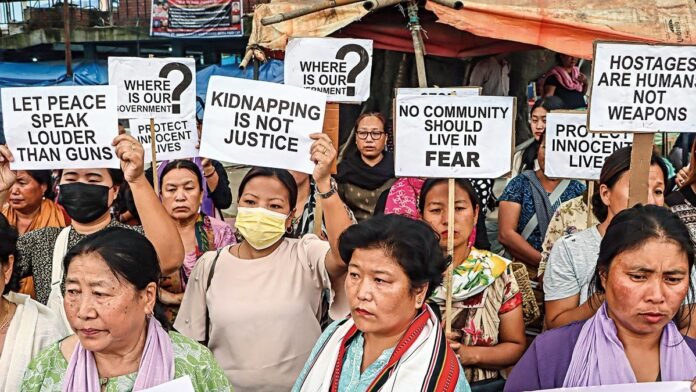
“Peace is not merely the absence of violence, but the presence of justice.” — Martin Luther King Jr.
More than three years after ethnic violence engulfed Manipur in May 2023, the state remains politically fragile, socially fragmented and strategically vulnerable. Despite changes in the political leadership and intermittent periods of relative calm, recurring violence demonstrates that the underlying causes of the conflict remain unresolved.

Recent incidents involving Naga communities, renewed arson attacks, economic blockades and fresh protests indicate that the crisis is evolving beyond the original Meitei-Kuki confrontation into a more complex multi-ethnic conflict.
The greatest danger today is not merely the continuation of violence but the gradual institutionalisation of ethnic separation. Manipur increasingly resembles a geographically divided state, where political authority, administrative control and public confidence are organised along ethnic lines rather than around constitutional governance.
If this trajectory continues, restoring the state’s territorial cohesion may ultimately prove far more difficult than ending sporadic violence.
Understanding Manipur’s Ethnic Geography
Understanding Manipur requires appreciating its unique demographic and geographical realities.

The Imphal Valley, which constitutes barely one-tenth of Manipur’s land area, accommodates more than half of the state’s population. It is overwhelmingly inhabited by the Meitei community, which dominates political representation, administration and economic activity.
The surrounding hill districts account for nearly 90 per cent of the state’s territory and are inhabited primarily by tribal communities, principally the Kuki-Zo and various Naga tribes. This geographical separation has historically produced distinct political aspirations.

The Meiteis have traditionally favoured preserving Manipur’s territorial integrity. The Kuki-Zo community has increasingly demanded separate administration or Union Territory status, arguing that coexistence under the existing constitutional arrangement has become untenable.
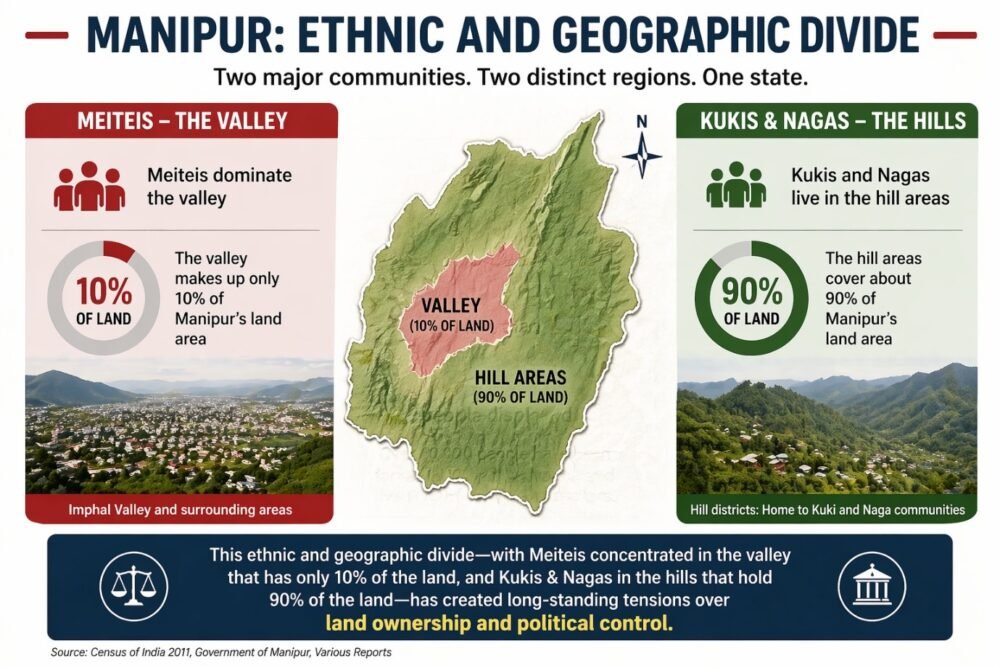
The Nagas, while maintaining a degree of distance from both sides, continue to pursue their long-standing aspiration of integrating Naga-inhabited areas into a unified political framework extending beyond Manipur.
Consequently, Manipur is no longer witnessing merely communal unrest. It has evolved into a contest among three competing political visions of statehood.
The Evolving Security Situation
Recent developments suggest that the security situation has entered another dangerous phase.
Fresh attacks in Kamjong district have resulted in villages being burnt, while tensions have intensified along the Kangpokpi-Imphal axis following protests and counter-blockades involving Kuki and Naga groups. Security forces have repeatedly intervened to prevent direct confrontations.
Another disturbing development has been the killing of six Liangmai Naga civilians, which has triggered widespread protests by Naga organisations demanding accountability.
The incident has introduced a significant Naga dimension into an already volatile situation.
Hostage-taking by armed groups and continuing reports of civilian insecurity further illustrate that state authority remains incomplete across several sensitive areas.
The Emerging Naga Dimension
The original conflict largely centred on the Meitei and Kuki communities. Recent developments, however, point to increasing Naga involvement.
Historically, the Nagas have maintained a cautious neutrality. While sharing long-standing grievances with the Meiteis over political representation, they also have enduring territorial disputes with Kuki organisations regarding the ownership of several hill districts.
The recent killings of Naga civilians have generated unprecedented anger across Naga civil society.
Simultaneously, reports of Naga-led economic blockades and Kuki mobilisation in response suggest that dormant territorial disputes are resurfacing.
Should the conflict evolve into simultaneous Meitei-Kuki, Naga-Kuki and Meitei-Naga confrontations, Manipur could witness a far more dangerous three-cornered ethnic conflict.
Such a development would significantly complicate political reconciliation as well as military stabilisation efforts.
Why the Conflict Persists
The violence has endured because its causes extend far beyond the immediate controversy surrounding Scheduled Tribe status.
The underlying drivers include competing claims over land ownership, demographic anxieties, concerns regarding illegal migration, the continuing influence of insurgent organisations, historical grievances, identity politics, narcotics trafficking, weak policing and the progressive erosion of trust in state institutions.
Thousands of sophisticated weapons looted from police armouries during the initial phase of the conflict remain outside government control.
Parallel ethnic volunteer groups continue to exercise considerable local influence, while many communities increasingly depend upon ethnic militias rather than constitutional institutions for security.
This represents perhaps the gravest long-term challenge confronting governance in Manipur.
The Militant Landscape: The Armed Actors Behind Manipur’s Protracted Conflict
The security crisis in Manipur cannot be understood solely through the lens of ethnic antagonism. Beneath the communal violence lies one of India’s most complex insurgent ecosystems, comprising Meitei valley-based insurgent groups, Kuki-Zo armed organisations, Naga insurgent factions and numerous armed village volunteer groups.
While many organisations operate under ceasefire or Suspension of Operations (SoO) agreements with the Government of India, others remain active underground. The widespread looting of more than 6,000 weapons from state armouries since the outbreak of violence has further increased the lethality of the conflict.
The greatest danger today is not merely continuing violence, but the gradual institutionalisation of ethnic separation
The coexistence of insurgency, communal mobilisation, organised crime and cross-border militant networks has transformed Manipur from a law-and-order challenge into a multidimensional internal security crisis.
Meitei Valley-Based Insurgent Groups
Among the Meitei Valley-Based Insurgent Groups (VBIGs), the most prominent organisations include the United National Liberation Front (UNLF), the People’s Liberation Army (PLA) and its political wing, the Revolutionary People’s Front (RPF), the People’s Revolutionary Party of Kangleipak (PREPAK), the Kangleipak Communist Party (KCP) and the Kanglei Yawol Kanna Lup (KYKL).
Historically, these organisations sought an independent Manipur and maintained bases across the India-Myanmar border.
Although one faction of the UNLF has signed a peace agreement with the Government of India, several other valley-based organisations continue to retain armed capabilities, organisational networks and local influence.
The present conflict has also witnessed the emergence of influential Meitei volunteer organisations, notably Arambai Tenggol and Meitei Leepun.
Although these groups describe themselves as socio-cultural organisations, they have played a visible role in mobilising volunteers during the ethnic violence and have attracted considerable attention from security agencies and human rights organisations.
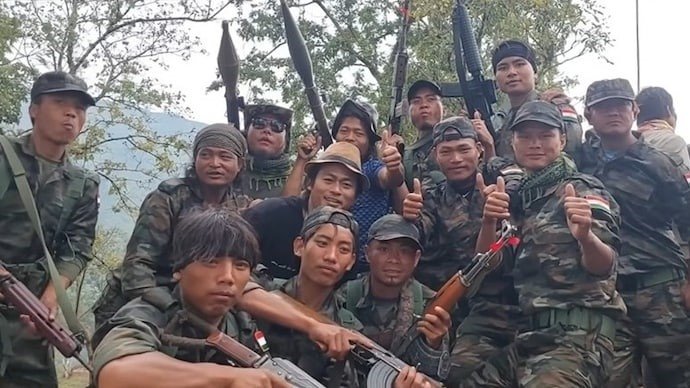
Their growing influence reflects the gradual militarisation of civil society, with community-based defence groups increasingly performing functions that are traditionally the responsibility of the state.
Kuki-Zo Armed Organisations
On the tribal side, the Kuki-Zo armed organisations constitute another significant pillar of Manipur’s security landscape.
Most operate under the umbrella of the SoO agreement signed with the Union Government and the Government of Manipur.
These include the Kuki National Army (KNA), Kuki National Organisation (KNO), United People’s Front (UPF), Kuki Revolutionary Army (KRA), United Kuki Liberation Front (UKLF), Kuki National Front (KNF) and the Zomi Revolutionary Army (ZRA).
Although these organisations are officially covered by ceasefire arrangements, allegations of violations, armed mobilisation and localised confrontations have periodically surfaced during the ongoing crisis, complicating efforts to maintain neutrality and enforce peace.
The Naga Insurgent Factor
The Naga insurgent movement, the oldest insurgency in India’s Northeast, remains another critical component of the security landscape.
The National Socialist Council of Nagalim (Isak-Muivah) [NSCN-IM] continues to be the most influential Naga insurgent organisation in Manipur, particularly across the Tangkhul-dominated districts of Ukhrul, Kamjong and adjoining hill areas.
Other factions, including elements of the NSCN-Khaplang (NSCN-K) and its splinter groups such as NSCN (Reformation) and NSCN (Khole-Kitovi), continue to maintain varying degrees of presence across the wider region.
While the Naga insurgency has historically focused on the creation of a Greater Nagalim, recent tensions with Kuki organisations over territorial claims and the killing of Naga civilians have introduced an additional layer of complexity to the present conflict.
If these tensions continue to intensify, Manipur risks evolving from a two-sided ethnic confrontation into a far more dangerous three-cornered conflict involving the Meitei, Kuki-Zo and Naga communities.
The Myanmar Dimension
The insurgent ecosystem is further reinforced by the porous India-Myanmar border, which has historically provided sanctuary, training areas, arms-trafficking routes and logistical support to multiple insurgent organisations.
The continuing instability in Myanmar’s Chin State and Sagaing Region, following the 2021 military coup, has weakened border governance and facilitated the movement of armed cadres, sophisticated weapons, narcotics and illicit financial networks.
This external dimension significantly complicates India’s counter-insurgency strategy and elevates the Manipur crisis from a state-level law-and-order challenge to an issue of national strategic importance.
A Conflict Beyond Conventional Policing
Taken together, the presence of multiple insurgent organisations with divergent political objectives, competing ethnic aspirations and varying levels of military capability explains why the Manipur conflict has proved so resistant to conventional law-enforcement measures.
Lasting peace will require not only reconciliation among communities but also a comprehensive security strategy addressing insurgency, cross-border militancy, illegal arms, narcotics trafficking and the gradual erosion of the state’s monopoly over the legitimate use of force.
Why the Centre Has Proceeded Cautiously
One of the most widely debated aspects of the Manipur crisis has been the Union Government’s cautious approach. This perceived restraint appears to stem from several strategic considerations rather than simple administrative inaction.
First, New Delhi has sought to avoid being perceived as favouring either the Meitei majority or the tribal communities. Any overt intervention risks alienating one side while reinforcing extremist narratives on the other.
Second, excessive coercive operations could revive insurgencies that had largely subsided after years of painstaking counter-insurgency efforts.
Third, the Centre recognises that military force can suppress violence, but it cannot reconcile competing political aspirations or rebuild fractured social trust.
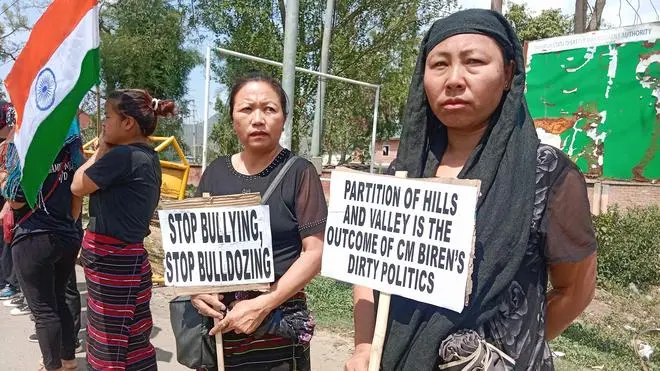
Fourth, Manipur’s proximity to Myanmar significantly complicates security planning. Continuing instability across the India-Myanmar border facilitates the movement of armed groups, illegal weapons and narcotics, while simultaneously limiting the effectiveness of purely internal security measures.
Finally, the Centre appears to have preferred incremental confidence-building, intelligence-led operations and political engagement over large-scale coercive action.
The Costs of Strategic Restraint
Critics, however, argue that excessive caution has contributed to a governance vacuum.
Delayed political engagement, the absence of sustained inter-community dialogue and inadequate accountability have enabled ethnic polarisation to deepen further.
Several conflict analysts have similarly argued that the state’s de facto ethnic partition has become increasingly entrenched, making eventual reconciliation progressively more difficult.
Has Manipur Already Been Informally Partitioned?
Perhaps the most striking feature of present-day Manipur is the emergence of de facto ethnic separation.
Large sections of the Meitei and Kuki-Zo populations no longer travel through one another’s areas. Security-force-monitored buffer zones increasingly separate communities.
Schools, markets, transport routes and even access to public administration now function largely within ethnic boundaries.
Civil servants frequently find themselves unable to discharge their responsibilities across districts, while political representatives often struggle to campaign beyond their own ethnic constituencies.
The emerging Naga dimension could transform Manipur’s two-sided conflict into a far more complex three-cornered confrontation
Although the Constitution continues to recognise one unified state, the social reality increasingly resembles territorial partition.
Such informal separation, once institutionalised, is invariably far more difficult to reverse than episodic violence.
The Security Challenge
For the security forces, Manipur presents one of the most demanding operational environments in contemporary India.
Unlike a conventional insurgency, the present conflict combines communal violence, armed militias, organised crime, cross-border movement, narcotics trafficking and information warfare into a single, interconnected security challenge.
The Army, Assam Rifles, CRPF and Manipur Police must simultaneously:
- prevent inter-community violence;
- secure national highways;
- recover thousands of looted weapons;
- protect vulnerable villages;
- maintain essential supplies; and
- remain visibly neutral in an intensely polarised environment.
Every operational decision is scrutinised through ethnic and political lenses, significantly constraining the freedom of action available to security agencies.
The prolonged deployment of security forces also imposes substantial operational, administrative and psychological pressures.
A Crisis of Political Trust
Ultimately, durable peace requires political legitimacy.
Unfortunately, trust among Manipur’s principal communities has eroded to unprecedented levels.
Many Meiteis increasingly perceive themselves as politically isolated and strategically encircled.
The Kuki-Zo community believes that coexistence under the present constitutional arrangement has become untenable.
Many Nagas, meanwhile, remain sceptical of both narratives while continuing to pursue their own long-standing political aspirations.
Consequently, no single political initiative currently commands broad cross-community legitimacy.
Without rebuilding confidence among all three communities, administrative and security measures alone are unlikely to restore lasting peace.
The External Dimension
Manipur’s internal security challenges cannot be viewed in isolation from the wider regional environment.
Myanmar’s continuing instability remains one of the most significant external variables influencing the conflict. The porous international border facilitates the movement of armed groups, illegal weapons, narcotics and other illicit networks. The Golden Triangle continues to fuel organised criminal activity, while the prolonged political instability in Myanmar has weakened border governance and enforcement.
China’s expanding strategic interests in Myanmar further enhance the geopolitical significance of stability in Manipur. Consequently, what appears to be an internal ethnic conflict also carries important national security and regional strategic implications.
Can the Nagas Become the Decisive Factor?
The evolving political position of the Naga community may well determine the future trajectory of the Manipur crisis.
If the Nagas continue to maintain relative neutrality while supporting a constitutional and negotiated settlement, they could emerge as an important stabilising force capable of facilitating wider reconciliation.
Recovering looted weapons and rebuilding trust are indispensable to any durable political settlement
However, should territorial disputes intensify and Naga-Kuki confrontations expand, the conflict risks entering an entirely new and far more dangerous phase.
The Union Government, therefore, cannot afford to dismiss recent Naga mobilisation as a series of isolated incidents.
Rather, these developments should be viewed as an early warning that the conflict is widening beyond its original contours.
Preventive political engagement with Naga civil society, community leaders and representative organisations should therefore become an immediate national priority.
The Way Forward
Lasting peace in Manipur will require simultaneous progress on the political, security and developmental fronts.
The immediate priority must be the comprehensive recovery of looted weapons and the dismantling of illegal armed formations, irrespective of their ethnic affiliation. Restoring the state’s monopoly over the legitimate use of force remains indispensable to rebuilding public confidence.
Equally important is the appointment of an empowered political interlocutor, acceptable to the Meitei, Kuki-Zo and Naga communities, who can facilitate sustained dialogue and confidence-building.
Political engagement must move beyond ceasefire arrangements towards structured discussions on autonomy, land rights, policing, administrative reforms and constitutional safeguards. Without addressing these underlying issues, security operations alone are unlikely to produce durable peace.
Justice mechanisms must investigate all major incidents fairly, transparently and impartially. Any perception of selective accountability will only deepen mistrust and reinforce competing victimhood narratives.
Economic reconstruction deserves equal priority. Thousands of displaced families require rehabilitation, while destroyed villages must be rebuilt. Educational institutions, healthcare infrastructure, transport connectivity and local livelihoods need urgent restoration. Generating meaningful employment opportunities for young people will also help reduce the attraction of militant organisations and armed groups.
Military deployment can prevent escalation, but only political reconciliation can restore lasting peace
Simultaneously, border management along the India-Myanmar frontier should be strengthened through enhanced surveillance technologies, improved intelligence coordination and fencing wherever operationally feasible.
Manipur today faces far more than a conventional law-and-order problem. It confronts an existential crisis involving political identity, territorial integrity and constitutional governance. The state’s geographical division increasingly mirrors its psychological fragmentation. Communities have lost trust not only in one another but also in the institutions responsible for protecting them. The longer this situation persists, the more difficult meaningful reintegration will become.
Military deployment can prevent escalation. Administrative control can restore a measure of order. Neither, however, can by itself create reconciliation or restore political legitimacy.
Only a comprehensive political settlement that simultaneously addresses the aspirations, insecurities and legitimate concerns of the Meitei, Kuki-Zo and Naga communities can prevent Manipur from evolving into a permanently fractured state.
As former UN Secretary-General Kofi Annan aptly observed:
“Without development there is no peace; without peace there is no development.”
For Manipur, one may add an equally compelling proposition: without justice, neither peace nor development can endure.
-The author retired as Major General, Army Ordnance Corps, Central Command, after 37 years of service. A management doctorate and expert on defence modernisation, he is the author of four books, including the Amazon bestseller “Breaking the Chinese Myth,” and a frequent media commentator. He is affiliated with several leading defence and strategic studies institutions in New Delhi. The views expressed are of the writer and do not necessarily reflect the views of Raksha Anirveda





