


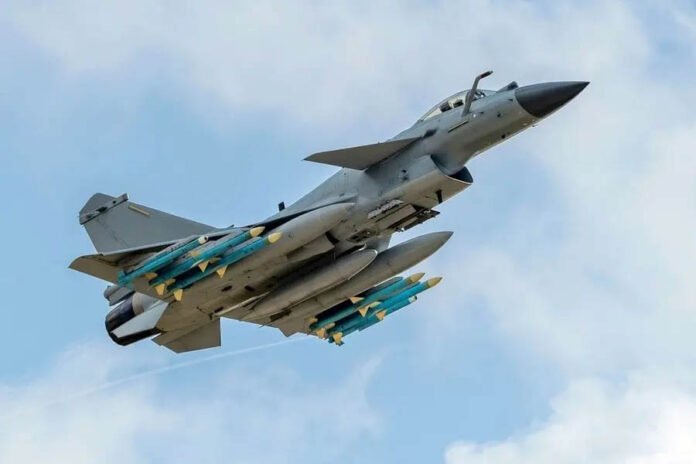
For much of this year, the J-10CE story out of Dhaka carried a familiar hedge word attached to it, i.e. reportedly. Reportedly considering. Reportedly in talks. Reportedly up to 24 aircraft. That hedge disappeared on August 26, when Zahed-Ur Rahman, the Bangladeshi Prime Minister’s Information and Broadcasting Adviser, told reporters that a draft proposal for the fighters had already gone to the Finance Ministry and the Armed Forces Division for approval.
Twenty Chengdu J-10CE multirole fighters. A package that reportedly includes attack helicopters, VIP transport helicopters and unmanned systems. With a price in the region of USD 2.2 to 2.3 billion. A payment plan spread across ten annual budget cycles, running through to the 2035-36 financial year. This is no longer a rumour to be filed away. It is a procurement in motion.

There is a reflex in South Asian security writing to treat every neighbouring acquisition as an alarm bell. That reflex is neither useful nor accurate. But there is an equally lazy reflex on the other side namely to wave off a confirmed billion-dollar defence commitment as routine modernisation. Neither instinct serves India well here. The honest position sits somewhere in between, and it demands a harder look than either.
The Actual Change Since the Last Round of Reporting
Three things separate this from the earlier speculative coverage. First, the number has come down and firmed-up only 20 aircrafts, not the earlier ceiling of 24, which suggests budget discipline rather than open-ended appetite.
The J-10CE purchase has transitioned from exploratory talks into formal ministry pipelines, cementing a 10-year, $2.3 billion commitment through FY 2035-36
Second, the process has moved from exploratory to bureaucratic stage: a draft has entered India’s neighbour’s own Finance Ministry approval chain, which is a different address from a defence attaché’s informal signal.
Third, Dhaka has attached a public justification to the deal that it did not offer earlier, Rahman told reporters the decision was influenced by the J-10’s reported performance against Rafale jets during the India-Pakistan clash of May 2025.

That last point needs a caveat, and Raksha Anirveda’s readers will expect one. Pakistan’s claims about Rafale losses in that conflict remain contested and have not been independently corroborated in a manner that settles the question.
What is verifiable is that Bangladesh’s own government has used that narrative, whatever its evidentiary weight, as part of its public rationale for the purchase. The strategic fact worth noting is not who actually won an air engagement 15 months ago. It is that the story of that engagement is now doing diplomatic work for Beijing’s export pitch across the region.

A fighter jet isn’t a standalone buy; it binds Bangladesh to Chinese technical advisers, data architectures, simulators and software updates for a generation
The Airframe is the Least Interesting Part
A fighter aircraft is not a stand-alone object. It arrives with a training pipeline, a maintenance regime, a weapons ecosystem, a data architecture and over a ten-year payment horizon, a long institutional relationship with the supplier.
China is not simply selling Bangladesh 20 aircraft. It is selling a decade-long dependency structure – spares, simulators, software updates, pilot conversion courses, technical advisers on the ground.
India has watched this pattern build elsewhere before, and it rarely announces itself as strategic capture on day one. It arrives as a support contract renewal. It arrives as a training slot filled by a Chinese instructor rather than a Western or an Indian one. By the time the pattern is visible in outline, the relationship is already several years deep.
None of this means Bangladesh is drifting into becoming a Chinese military outpost, that conclusion would be premature and, frankly, insulting to Dhaka’s own record of hedging between powers. Bangladesh explored the Eurofighter Typhoon route as recently as December last year before this deal firmed-up.
Dhaka’s reliance on Beijing’s contested air-combat claims highlights how geopolitical narratives – regardless of evidentiary proof – are doing real diplomatic work for Chinese arms exports
A country genuinely locked into single-source alignment does not keep a Western option open in parallel. Bangladesh is doing what most mid-sized states in this region do; diversifying suppliers while extracting the best terms from each.
Why the Eastern Theatre Reads Differently from the Western One
India’s western threat picture – the Line of Control, cross-border terrorism, Pakistan’s nuclear posture, China’s shadow behind Islamabad have been analysed and re-analysed for decades.
The eastern flank has never demanded the same intensity of attention, largely because Bangladesh has not, until now, been a platform for advanced Chinese-origin combat aircraft.
That changes the arithmetic in the Bay of Bengal and along the Siliguri Corridor, the narrow stretch of Indian territory connecting the mainland to the Northeast. It does not, by itself, change intent.
Dhaka’s motives here are about air force modernisation and diversification, not confrontation with New Delhi. But capability outlives intent, and India’s planners have to account for the aircraft regardless of why it was bought.
While Dhaka’s intent remains focused on routine modernisation rather than hostility, introducing advanced Chinese combat platforms along the Bay of Bengal shifts the regional military arithmetic that Indian strategists must manage
There is also an opportunity hiding inside this proposed acquisition. China cannot replicate what India has with Bangladesh – a shared land border, shared rivers, deep trade integration and millions of people-to-people connections that no arms deal can substitute for. That is India’s actual advantage in this contest, and it is one Beijing cannot buy its way into.
The Response India Should Not Make
There is an old military teaching worth borrowing here, one that gets repeated in staff colleges more than it gets practiced in policy: never let the adversary choose the ground on which you fight.
If New Delhi responds to this deal with public alarm or thinly veiled pressure on Dhaka, it hands Beijing exactly the narrative it wants – India as the anxious neighbour, China as the reliable modernisation partner without political strings attached. That would be a self-inflicted wound.
The better ground for India to fight on is the one where it already holds the advantage: proximity, economic interdependence and a defence-industrial base that can now offer maintenance, spares, coastal surveillance platforms, patrol vessels, helicopters and training packages of its own.
New Delhi must avoid anxious, high-handed reactions. Instead, India should leverage its unmatchable structural edges – geography, deep trade, shared borders and localised defence support – to remain Bangladesh’s most trusted anchor
The goal should not be persuading Bangladesh to cancel a signed deal and buy Indian hardware, as that ship, largely, has sailed.
Instead, the goal should be making sure India remains the indispensable partner for everything the J-10CE cannot provide: trust, geography and a relationship that does not carry a decade-long repayment clause attached to it.
What to Actually Watch
Golf offers an unlikely but useful analogy here. A good round is rarely decided by the tee shot everyone is watching. It is decided by what happens after – the recovery from the rough, the read of the green, the decisions nobody in the gallery is paying attention to.
The J-10CE purchase is the tee shot. The real game is in what follows: the training pipelines Beijing sets up in Bangladesh, the maintenance contracts that get renewed year on year, the data links and command architecture that quietly bind two air forces together.
New Delhi should not lose sleep over 20 aircraft. It should watch, with far more patience than anxiety, everything that arrives in their wake.

The writer is an Independent Director, Strategic Governance commentator, and leadership practitioner. He writes on geopolitics, corporate governance, sustainability, and the intersection of national strategy, boardroom leadership, and sports, bridging the battlefield, the boardroom, and the sports fields. He can be contacted on: 5cg9220rg@gmail.com. The views expressed are personal and do not necessarily carry the views of Raksha Anirveda





