


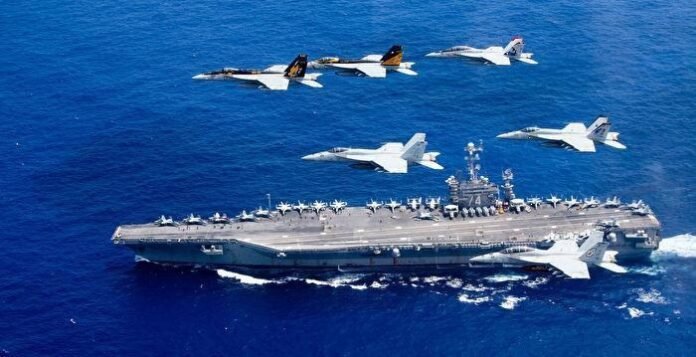
The signing of an agreement between Washington and Tehran may ultimately be remembered not for ending a crisis but for enabling a strategic pivot. For over two decades, American foreign policy has been repeatedly pulled back into the gravitational field of the Middle East. Afghanistan, Iraq, Syria, ISIS, Gaza and Iran consumed immense military resources, diplomatic bandwidth and political attention.
Yet none of these theatres represents the central strategic challenge of the 21st century.

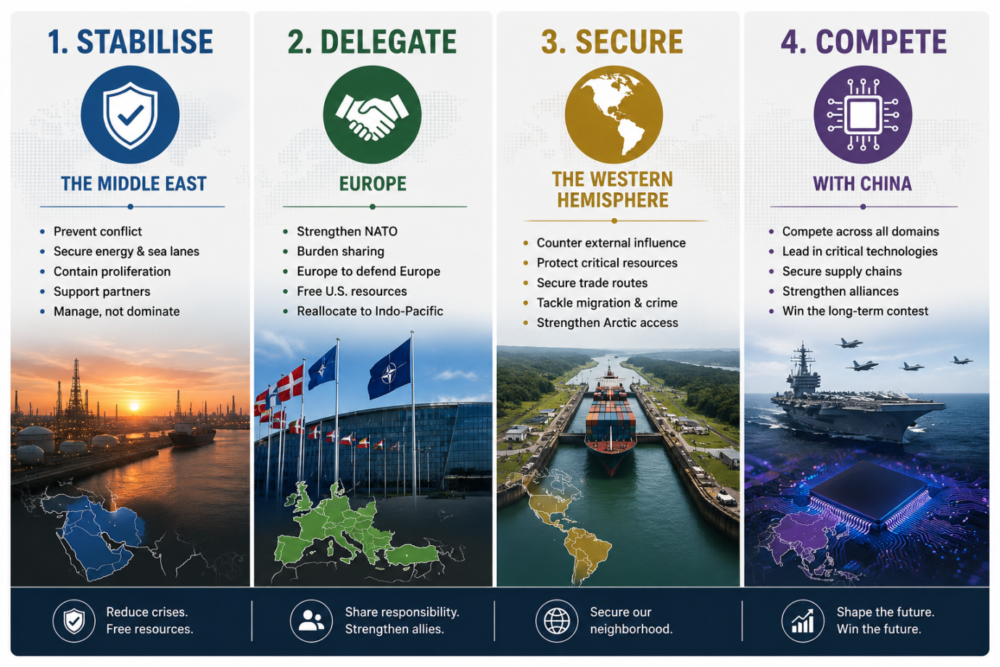
For the United States, the imperative is no longer to fight yesterday’s wars. It is to prepare for tomorrow’s competition. If the Iran question has been sufficiently stabilised, Washington’s attention is likely to shift towards a broader and more consequential agenda. The emerging contours of American grand strategy can be captured in four simple verbs: Stabilise, Delegate, Secure and Compete.
Together, they describe not merely a change in priorities but a reordering of the global chessboard.
Stabilise the Middle East
The first objective is neither withdrawal nor disengagement. It is stabilisation.
The United States no longer seeks to transform the Middle East through ambitious nation-building projects. The experiences of Iraq and Afghanistan have imposed strategic humility. What Washington seeks today is a region that remains sufficiently stable to prevent disruption of global energy markets, unchecked nuclear proliferation and major interstate conflict.

The objective is management rather than transformation.
The United States no longer seeks to transform the Middle East through ambitious nation-building projects. The experiences of Iraq and Afghanistan have imposed strategic humility. What Washington seeks today is a region that remains sufficiently stable to prevent disruption of global energy markets, unchecked nuclear proliferation and major interstate conflict
A stable Gulf protects global commerce. Secure sea lanes ensure uninterrupted trade. Containing regional rivalries prevents crises that demand large-scale American military intervention. From Washington’s perspective, every crisis avoided in the Middle East frees resources for more pressing strategic priorities elsewhere.

The region remains important, but it is no longer the centrepiece of American strategy. It has become a theatre that must be managed efficiently rather than dominated continuously. This distinction is critical.
The United States is not abandoning the Middle East. It is seeking to reduce the strategic opportunity cost of remaining there.
Delegate Europe
The second verb is Delegate.
The war in Ukraine has fundamentally altered Europe’s understanding of security. For decades, many European nations operated under the assumption that American military power would remain the ultimate guarantor of continental stability. That assumption is being reassessed.
Washington increasingly expects Europe to shoulder a larger share of its own defence burden. This does not imply a weakening of NATO. On the contrary, the alliance remains central to Western security architecture. What is changing is the distribution of responsibility within it.
American policymakers understand a basic strategic reality: resources are finite. Military assets are finite. Political attention is finite. If Europe can provide a larger portion of its own security requirements, the United States can allocate greater resources towards the Indo-Pacific, where the long-term balance of power is being determined.
The future of the transatlantic alliance is therefore likely to rest on burden sharing rather than dependence. Europe is being encouraged to evolve from a security consumer into a stronger security provider.
The war in Ukraine has fundamentally altered Europe’s understanding of security. Washington increasingly expects Europe to shoulder a larger share of its own defence burden. This does not imply a weakening of NATO. On the contrary, the alliance remains central to Western security architecture. What is changing is the distribution of responsibility within it
For Washington, this is not retrenchment. It is a strategic reallocation.
Secure the Western Hemisphere
The third verb is Secure.
Great powers often become preoccupied with distant theatres while overlooking developments closer to home. Recent American strategic thinking suggests a renewed appreciation of the Western Hemisphere as a vital foundation of national power. This includes North America, the Caribbean, Central America and much of Latin America. Several concerns drive this renewed focus.
- The first is economic security. Critical minerals, manufacturing networks and supply chains increasingly possess strategic significance.
- The second is geopolitical competition. Expanding external influence in Latin America, particularly through infrastructure investments and commercial partnerships, has attracted growing attention in Washington.
- The third involves migration, organised crime and border management, issues that carry both domestic and strategic implications.
The Arctic also forms part of this emerging picture. As polar ice recedes, new shipping routes and resource opportunities are emerging. Greenland, northern sea lanes and Arctic access are assuming growing strategic importance. Geography, long considered fixed, is being reshaped by climate change.
A secure hemisphere provides strategic depth. It strengthens economic resilience and creates a stable platform from which global competition can be conducted.
Recent American strategic thinking suggests a renewed appreciation of the Western Hemisphere as a vital foundation of national power. This includes North America, the Caribbean, Central America and much of Latin America. The Arctic also forms part of this emerging picture. As polar ice recedes, new shipping routes and resource opportunities are emerging
Before projecting power abroad, America appears increasingly determined to consolidate security closer to home.
Compete with China
The fourth and most important verb is Compete.
At the centre of contemporary American strategy lies a simple reality: China is the only nation capable of challenging the United States across multiple dimensions simultaneously.
- Economic power.
- Technological capability.
- Industrial capacity.
- Military strength.
- Maritime reach.
- Diplomatic influence.
Unlike previous competitors, China combines scale with sophistication. It is deeply integrated into the global economy while simultaneously seeking to reshape aspects of the international order. For Washington, the challenge extends far beyond Taiwan.
The competition encompasses semiconductor manufacturing, artificial intelligence, quantum computing, rare earth minerals, advanced telecommunications, space systems and global supply chains. It is not merely a contest between two militaries; it is a contest between two ecosystems of power. This explains why aircraft carriers and microchips increasingly appear in the same strategic conversation.
The defining question of the coming decades may not be who controls more territory. It may be who controls the technologies that shape economic productivity, military effectiveness and societal resilience. The United States recognises that future power will be generated not only by naval fleets and air forces but also by innovation hubs, research laboratories and semiconductor fabrication plants.
Competition with China is therefore not a regional issue. It is the organising principle around which much of American strategy is being structured.
The Rise of Geo-Technology
Underlying all four verbs is a deeper transformation.
The 20th century was defined largely by industrial capacity and access to oil. The 21st century is increasingly being shaped by data, algorithms, computing power and technological innovation. Economic security and national security are converging.
Artificial intelligence influences military decision-making. Semiconductor supply chains determine industrial resilience. Quantum technologies promise transformative advantages in communication and computation. Cyber capabilities affect everything from financial systems to critical infrastructure.
Technology is no longer a supporting element of geopolitics. Technology has become geopolitics. The emerging global order will be shaped not only by armies and alliances but also by those who dominate the architecture of innovation.
The nations that lead in these domains will define the strategic landscape of the decades ahead.
Conclusion
The significance of a US–Iran agreement, therefore, lies beyond diplomacy itself. It may signal the closing of one strategic chapter and the opening of another.
For much of the post-Cold War era, the Middle East occupied a disproportionate share of American attention. Today, Washington appears increasingly focused on preparing for a more complex and competitive world.
The competition with China encompasses semiconductor manufacturing, AI, quantum computing, rare minerals, advanced telecom, space systems and supply chains. It is a contest not merely between two militaries, but between two ecosystems of power. This explains why aircraft carriers and microchips increasingly appear in the same strategic conversation
The emerging framework is remarkably clear. Stabilise the Middle East. Delegate Europe. Secure the Western Hemisphere. Compete with China. These four verbs provide a concise description of the direction in which American grand strategy appears to be moving.
The ultimate objective is not merely to preserve military superiority. It is to maintain strategic relevance in an era defined by shifting balances of power, technological disruption and geopolitical competition. The next decisive contest is unlikely to be fought solely in deserts or mountain valleys. It will unfold across Arctic sea lanes, Pacific waters, semiconductor foundries, quantum laboratories and the invisible networks that power the digital age.
That is where the future battlefield of power is emerging. And that is where America is positioning itself for the next great strategic campaign.

Lt Gen Rajeev Chaudhry (Retd) writes on contemporary national and international issues, strategic implications of infrastructure development towards national power, geo-moral dimension of international relations, and leadership nuances in a changing social construct. The views expressed are of the author and do not necessarily reflect the views of Raksha Anirveda





