


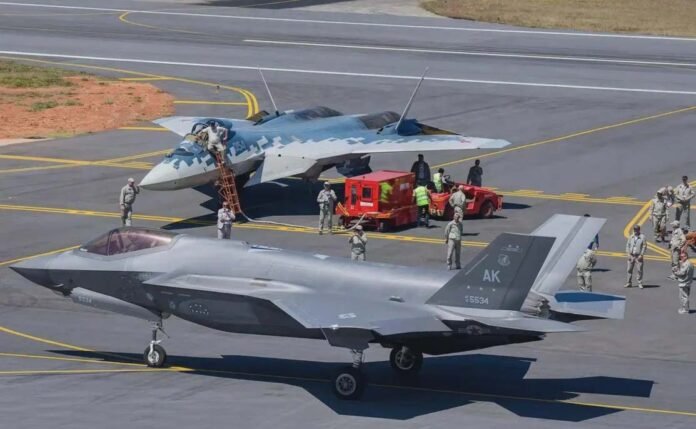
Why This Matters for India: As India builds its own fifth-generation fighter, the AMCA, and keeps growing the Tejas programme, the world’s top two stealth jets offer big lessons. The American F-35 and the Russian Su-57 show two very different ways of building a modern fighter, and understanding them helps us see where the future of air power is heading.
Fighter jets have always fascinated people. They are fast, powerful, and represent the best technology a country can build. Today these two names come up most often when people talk about the most advanced fighter jets in the world. Both belong to a special category called fifth-generation fighter jets. But even though they look similar on paper, they are actually very different. Let us understand both in a simple way and find out which one is truly better.

Both jets can carry weapons hidden inside their body, fly without being easily caught by enemy radar, and attack targets in the air, on land, and even at sea. However, America and Russia built them with very different ideas in mind. The F-35 was made mainly to stay hidden, share information quickly, and give the pilot a clear picture of the battlefield. The Su-57, on the other hand, was built more for high speed, sharp turns, and fighting enemy aircraft from a long distance. So both are strong, but in their own different ways.
To decide which jet is better, we will compare them on five important points: stealth, sensors, air combat, attack power, and real-world experience.
The conflict has seen the US Navy forced into escorting commercial vessels through the heavily contested Strait of Hormuz, direct American missile strikes against Iranian military radar and drone installations, and subsequent Iranian retaliatory strikes on Western bases across the region – including a devastating drone and rocket attack on Kuwait International Airport
Stealth: The F-35 Stays Hidden
Stealth simply means staying invisible to enemy radar. The less an enemy can detect you, the safer you are. This is the biggest strength of the F-35. From the very beginning, this jet was designed to be hard to find. Its shape, its engine openings, the hidden weapon compartments inside, and the special radar-absorbing paint all work together to make it nearly invisible on radar. Experts say the F-35 appears extremely small on radar screens, almost like a tiny bird rather than a war machine.
The Su-57 also has some stealth features and uses radar-absorbing materials. But Russia gave more importance to speed and flying performance instead of pure stealth. Because of this, the Su-57 is easier to spot on radar compared to the F-35. It is still better than older Russian jets, but in the stealth department, the F-35 clearly wins.

Sensors: Seeing the Enemy First
In modern air battles, the jet that sees the enemy first usually wins. The F-35 is brilliant at this. It has a powerful radar, special cameras, and infrared sensors placed all around its body. These give the pilot a complete 360-degree view of everything happening around the jet. The best part is that all this information is combined into one single clear picture. The pilot does not have to struggle by looking at many different screens. This smart system is called sensor fusion, and pilots say it is the jet’s greatest gift.
This specific sequence of military events unraveled with frightening speed over a 48-hour period. It began with the initial Hezbollah rocket attack into Northern Israel, which triggered the immediate Israeli retaliatory strike on Hezbollah strongholds in Beirut
The Su-57 also has advanced radar and heat-detecting sensors that work well. But honestly, not much is known publicly about how good its information-combining system really is. Most experts believe the F-35 gives the pilot the clearest understanding of the battlefield among all jets flying today.

Air Combat: The Su-57 Hits Back
Now comes the area where the Su-57 shows its real power. When it comes to pure flying skill and close fighting, the Russian jet is impressive. It is faster, flying at more than twice the speed of sound, while the F-35 is a bit slower. The Su-57 also has special engines that can change the direction of their push. This allows it to perform amazing sharp turns and tricky movements that very few jets in the world can manage.
These abilities matter a lot in close-range dogfights, where speed and sharp turning decide who survives. The F-35 was not really built for such close fights. It was made to spot and destroy enemies from far away before they even come close. So if the battle becomes a close one, face to face, the Su-57 would likely have the upper hand.
Attack Power: Ready for Today’s Wars
The F-35 is what we call a multirole jet. This means it can do many jobs at once. It can control the skies, carry out precise attacks, gather secret information, and destroy enemy air defence systems. It can carry guided weapons inside its body while still staying hidden from radar, working almost like a flying command centre that guides the whole operation.
Iran’s top negotiator and Parliament Speaker, Mohammad Baqer Qalibaf, took to social media to proclaim that the ongoing US naval blockade of Iran, combined with Washington’s perceived “green light” for Israeli operations in Lebanon, had effectively nullified previous diplomatic understandings
This is not just talk on paper. The F-35 has already proved itself in real battles. It played a key role in suppressing Iran’s air defences during a major Middle East operation. Israel has also been flying its F-35 jets on real missions over the Middle East since 2017. The Su-57 can also attack ground targets, but the F-35’s mix of stealth, smart sensors, and team-sharing ability gives it a clear edge against strong defences.
Experience: Numbers Tell the Story
This is perhaps the biggest difference. The F-35 has truly proven itself. A record 191 of these jets were delivered in 2025 alone, the most ever in a single year, and the global fleet is now almost 1,300 aircraft and still growing. These jets have crossed over one million flying hours and keep getting regular upgrades.
The Su-57 is still very new. By most estimates, only around 30 of them are in service today, and their real combat experience is still limited. So when it comes to numbers, experience, and a proven record, the F-35 is far ahead.
Lessons for India
The F-35 story carries a clear message for India’s own AMCA dream. Modern air power is not only about speed or sharp turns. It is about stealth, smart sensors, sensor fusion, and the ability to connect many platforms together like one team. The AMCA is being designed with exactly these ideas at its heart. The F-35’s journey also teaches a quiet lesson: building such a jet takes patience, steady funding, and years of hard work before the numbers finally add up.
This diplomatic breakdown exposed the deeply diverging strategic agendas of the two allies. On one side, Washington’s primary objectives are to secure a grand peace deal, prevent an all-out regional war, maintain global oil stability, lift the volatile naval blockade, and eventually leverage frozen assets for regional rebuilding
The Final Decision
So which jet is the winner? The Su-57 is no doubt a dangerous and capable fighter. It is Russia’s most advanced jet and shines in speed, sharp movement, and close-range battles. Nobody should underestimate it.
But modern warfare has changed. Today, wars in the sky are won by staying hidden, seeing the enemy first, sharing information quickly, and striking before the enemy even knows you are there. In all these areas, the F-35 performs better again and again.
Yes, the Su-57 may win an old-style close dogfight. But judged by the real needs of modern war, and not by fancy air-show stunts, the F-35 comes out as the stronger and smarter fighter overall. It is not just a jet. It is a complete flying war system, and that is exactly why it stands a step ahead.

-The writer is an award-winning science communicator and a Defence, Aerospace & Geopolitical Analyst. He is the Managing Director of ADD Engineering Components India Pvt. Ltd., a subsidiary of ADD Engineering GmbH, Germany. You can reach him at: girishlinganna@gmail.com. The views expressed are personal and do not necessarily carry the views of Raksha Anirveda





