


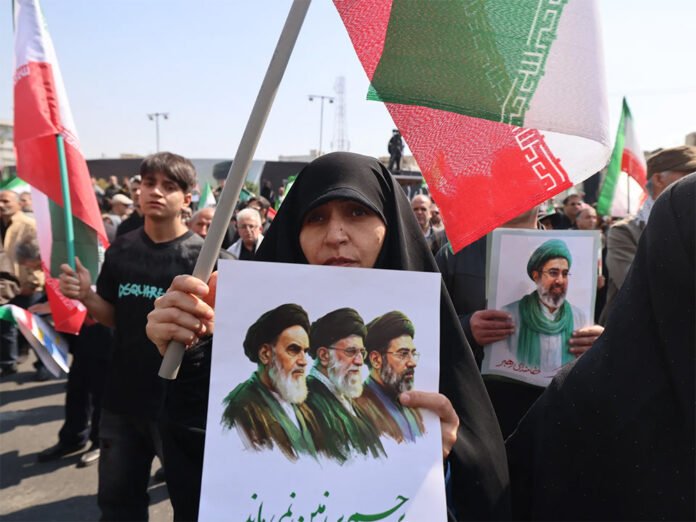
The Iranian economy is rattled. The naval blockade will restrict its shadow fleet from moving oil, its main source of income. Its Kharg Island oil storage tanks are filled with an export block. It may have to shut down production. Its military capabilities have been dented. Participation of its proxies has reduced. Iran’s only benefit is that its population has not risen in anger.
The economy of the rest of the world is hit by rising oil and fertiliser prices. Middle Eastern nations have damaged oil infrastructure, which will take time to make operational. Added is the closure of Hormuz, limiting exports. Israel, which instigated the conflict, is out of the picture, with the US firmly in control, while Tel Aviv handles Lebanon. Israel cannot launch strikes without US approval. Claims and counter-claims on the opening of the double-blockaded Straits of Hormuz continue to flow.

Pakistan has so far failed in convincing Iran to resume dialogue. Iran does not trust Pakistan as it parrots the US line rather than neutrality. Simultaneously, within the United States, Pakistan and specifically Asim Munir are dubbed as unreliable mediators
Despite reduced capabilities, Iran remains defiant and has placed conditions ahead of talks. Pakistan, which Washington nominated as the mediator, has thus far failed in convincing Iran to resume dialogue. While Pak media claims that its efforts are appreciated by both sides, inputs mention that Iran does not trust Pakistan as it parrots the US line rather than neutrality. Simultaneously, within the US, Pakistan and specifically Asim Munir, are dubbed as unreliable mediators.
Pakistan has its own interest in ending the conflict. Its economy is in tatters, its lifeline is oil imports from the Gulf, which have been affected by the closure of the straits. Added is its defence agreement with the Saudis, which could compel it to enter the conflict. There are reports that Iran recently eliminated a group of terrorists attempting to infiltrate from Pakistan. Islamabad cannot risk a third active border.
The question remains that if Iran’s military capabilities are degraded, then why is it refusing to commence dialogue? Simultaneously, why is the US resorting to a ceasefire if it is aware that Iran has limited ability to respond?
Iran may be weak, but it can still inflict damage on the region. It is aware that the US will not risk boots on the ground nor move its naval fleet within range of their missiles. Its insistence on opening the Straits based on the US lifting the blockade, followed by talks, is playing the game of who blinks first. If Trump does so, then TACO (Trump Always Chicken’s Out) will gain traction, damaging his internal ratings. If Iran blinks, then the IRGC leadership may face internal backlash as it would imply a surrender. The ongoing stalemate is part of the waiting game. The question is, how long will the world have to wait before one side blinks?

Trump’s major demand has been on Iran’s existing nuclear stockpiles. Trump wants them within the US, which Iran refuses. In case it is moved to Russia, neutral in the conflict, but a supporter of Iran, it would be a defeat for Trump, as additional stockpiles in 2015 (as part of JCPOA) were shipped there
Trump defends his decision on a ceasefire, mentioning the Iranian leadership is fragmented and he is giving it time to accept US demands. He also claims it is on the request of the Pakistani leadership, which is attempting to mediate. On the contrary, Iran announced that there is no fragmentation and all are on the same page. Interestingly, disagreements appear more within the US military hierarchy as sackings of senior military and civil defence officials continue during an ongoing conflict.
Trump’s threats to Iran are changing by the day. It began with regime change, moved to eliminating a complete civilisation, reduced to targeting power plants and other infrastructure, followed by attacking the current leadership. He insists that Iran reopen the straits, which were never closed till he decided to invade. The straits are currently double-blocked. Iran prevents global shipping from moving through it, while the US prevents Iran from utilising it.

Trump also has his own internal battle to manage. He cannot accept any agreement with Iran below or similar in conditions to the JCPOA (Joint Comprehensive Plan of Action), from which he walked out in 2018, as it was negotiated by Obama. Iran, on the contrary, seeks a deal which ensures that the regime is not accused of having surrendered to the US, implying it should not be worse than the JCPOA. A difficult scenario for both sides.
President Trump is aware that Iran humiliated and ended the political career of President Jimmy Carter in 1979 with the hostage crisis, and that if he does not act carefully, he could be next. Iran does not have much to lose
Trump’s major demand has been on Iran’s existing nuclear stockpiles. Trump wants them within the US, which Iran refuses. In case it is moved to Russia, neutral in the conflict, but a supporter of Iran, it would be a defeat for Trump, as additional stockpiles in 2015 (as part of JCPOA) were shipped there.
Added is the confusion created by Trump’s social media posts. Trump has been listing his demands on social media. He even makes false claims like Iran not executing eight women based on US demands. Fact check confirms it was false. His abusive and threatening posts may have an intent to enhance pressure on Iran, but realistically display the US President in a poor light. They also convey that Trump is more desperate for talks as the US seeks a way out.
The forthcoming mid-term elections in the US and the sinking popularity of Trump are added pressures, ensuring he terminates the conflict early. Iran has no such scenario. It can delay talks while the US cannot.
A new emerging scenario is the 60-day deadline for employing US forces in an operation without Congressional approval. This ends around May 1. Some members of his own party opposed the conflict, which could damage approval by Congress. An additional 30-day grace period is available, but only to withdraw troops. Iran may be exploiting this and delaying talks.
A new emerging scenario is the 60-day deadline for employing US forces in an operation without Congressional approval. This ends around May 1. Some members of his own party opposed the conflict, which could damage approval by Congress. An additional 30-day grace period is available, but only to withdraw troops. Iran may be exploiting this and delaying talks
Talks will take place at the end of the day, but the question is who will blink first and accept the rival’s terms. An ideal mediator would be working to narrow down differences rather than act as a post office, as Pakistan is doing. Trump is aware that Iran humiliated and ended the political career of Jimmy Carter in 1979 with the hostage crisis, and if he does not act carefully, he could be next. Iran does not have much to lose.
Iran has to reconstruct damages caused by the war, running into billions, which could severely dent its economy. Inflation is rising and could cross unmanageable levels, adding to public anger. Hence, it seeks release of its locked funds before talks, calling for the use of Hormuz as well as payment from the US for damages. The US has no such concern, though repairing its bases and assets in the Middle East would also cost billions.
Any conflict ending in a ceasefire implies a stalemate with both sides claiming victory, which is already being done. While Trump would gloat over it, the current hardline Iranian leadership would emerge stronger and more demanding. Peace in the region is only an illusion, especially as long as Trump and Netanyahu remain in office. Iran is aware and hence could consider creating a more offensive military power with longer-range missiles and drones for future conflicts. Its experience in this will be its mainstay in preparing for the future. Its desperation to develop nuclear weapons will only increase.
The writer is a strategic analyst and a motivator. He can be reached at @kakar_harsha. The views expressed are of the writer and do not necessarily reflect the views of Raksha Anirveda





