

Chief of Defence Staff General NS Raja Subramani’s remarks are more consequential than a routine call for India to invest in military satellites. The concern he described is not simply that Pakistan is developing space technology. It is that Pakistan might gain access to capabilities developed elsewhere, especially in China, while building its own institutions and systems. That prospect, he said, must be factored into India’s security calculations.
The distinction matters. A country does not need to independently design, manufacture and operate every satellite or sensor to benefit from space-based intelligence. If a partner can provide data, services, training or technical assistance, the recipient may gain some operational advantages without reproducing the partner’s entire space infrastructure.

Gen Subramani specifically pointed to intelligence, surveillance and reconnaissance (ISR), and positioning, navigation and timing (PNT) capabilities as areas where Pakistan could benefit from China’s advances. His warning is therefore about access and integration, not just the number of Pakistani satellites in orbit.
CDS Gen NS Raja Subramani’s warning isn’t about Pakistan’s independent satellite count, but its potential to plug into China’s advanced surveillance and navigation networks to gain immediate operational leverage
That is the strongest analytical point in the CDS’s statement, and also the point that requires careful qualification. The statement does not demonstrate that Pakistan already has unrestricted access to China’s full military-space capabilities. Nor does it specify which systems, services or data-sharing arrangements might be available, under what conditions, or at what level of reliability. “Could benefit” is a strategic possibility, not proof of a particular transfer or operational arrangement, yet.
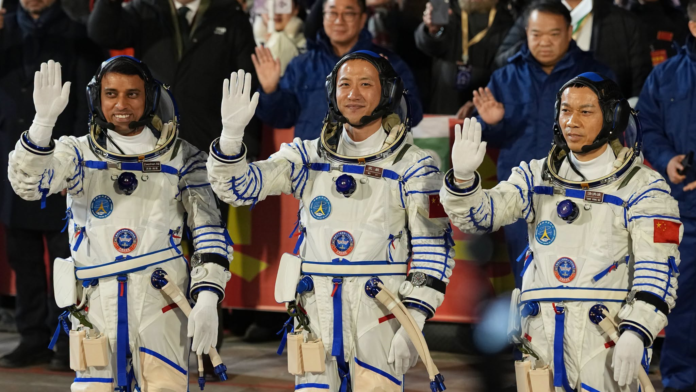
The China-Pakistan relationship, nevertheless, has a substantial space dimension. The two countries have cooperated on satellite launches and space projects, and their agencies signed an agreement in February 2025 covering astronaut selection, training and participation in a mission to China’s Tiangong space station. Pakistan’s human-spaceflight partnership is a visible example of access to Chinese infrastructure and expertise. It demonstrates close collaboration, though it should not be mistaken for evidence that China has provided Pakistan with military targeting or surveillance data.
Pakistan is also pursuing domestic capabilities through its Space and Upper Atmosphere Research Commission, or SUPARCO. Its programmes include satellite development and applications such as communications and Earth observation. The agency describes international cooperation as part of its capacity-building approach. That combination, home-grown institutions alongside foreign partnerships, is precisely why Gen Subramani’s comments focus on the cumulative effect. A country can improve its technical base over time while drawing on external expertise, launch services or equipment in the near term.

While deep Sino-Pak space cooperation is well-documented and Turkish assistance remains a precautionary planning assumption, Indian strategists must account for borrowed capabilities without mistaking plausible scenarios for confirmed military transfers
The Turkey element is less firmly established in the evidence presented publicly. Gen Subramani said India should assume Ankara could assist Pakistan, but the coverage of his remarks does not identify a new agreement, a specific technology transfer or a confirmed Turkish contribution to Pakistan’s space programme.
SUPARCO’s account of international cooperation includes Turkey among the members of the Asia-Pacific Space Cooperation Organisation, alongside Pakistan and China. That establishes a channel for multilateral interaction, not proof of a current bilateral military-space arrangement. The CDS’s phrasing is best read as precautionary planning rather than confirmation.

This distinction is important for responsible analysis. Treating a possibility as an established fact can inflate perceptions of an emerging threat and obscure what is actually known. Yet, planners cannot wait for every transfer to be publicly confirmed before considering its implications.
If Pakistani forces were able to draw on improved imagery, navigation support or communications from partners, the practical effect could be better situational awareness and coordination. The degree of that effect would depend on access, data quality, institutional integration and the ability to use information quickly, not simply on diplomatic closeness.
Gen Subramani’s proposed response was not to match China satellite for satellite. He said India should identify the capabilities it needs, including better observation of its borders and shorter revisit times, the interval between opportunities for a satellite to observe the same area. That is a more focused standard than a prestige-driven race: build enough capacity to meet operational requirements, rather than treating China’s scale as a target in itself.
Rather than chasing China satellite-for-satellite, India’s ₹26,968-crore Space-Based Surveillance Phase III programme targets practical operational needs, specifically tighter border monitoring and shorter revisit times across a 52-satellite constellation
India’s Space-Based Surveillance Phase III programme gives that ambition a concrete form. Approved in October 2024, it is budgeted at ₹26,968 crore and plans a constellation of 52 dedicated military satellites. Reports say ISRO is to build 21, with private companies responsible for 31.
The CDS said the programme would substantially improve India’s capabilities and that efforts were under way to build and launch more satellites. The architecture is intended to strengthen surveillance, but its ultimate value will turn on delivery, data processing, resilience and how effectively information reaches decision-makers.
There is also a broader vulnerability behind the warning: modern militaries rely on space-enabled communications, navigation and surveillance, while satellites and their supporting links can be disrupted. Gen Subramani flagged China’s ability to interfere with or target satellites. That makes resilience as important as expansion. More satellites may improve coverage, but diversified systems, secure links and alternatives to space-based services also matter when a conflict puts those assets under pressure.
With space assets increasingly vulnerable to interference, India’s ultimate edge will depend not just on launching more satellites, but on securing communication links and turning raw data into rapid, resilient battlefield decisions
The real cause for concern, then, is not a proven Pakistani leap to parity with India or China. It is the possibility that partnership could let Pakistan improve selected military functions faster than its independent space industry might otherwise permit.
The CDS has framed that possibility as a planning assumption, especially regarding China, while presenting Turkish help as something India should anticipate. The evidence supports the existence of close cooperation with China and Pakistan’s own development effort; it does not yet establish the specific extent of military assistance from either partner.
That makes Gen Subramani’s message both a warning and a test of judgement. India must account for the capabilities Pakistan might access, without confusing plausible scenarios with verified transfers. Its response, by the CDS’s own logic, should be measured against practical needs: reliable surveillance, shorter observation gaps, secure communications and resilience. The strategic challenge is not merely who owns more satellites, but who can turn information into sound decisions, and keep doing so when space systems are contested.